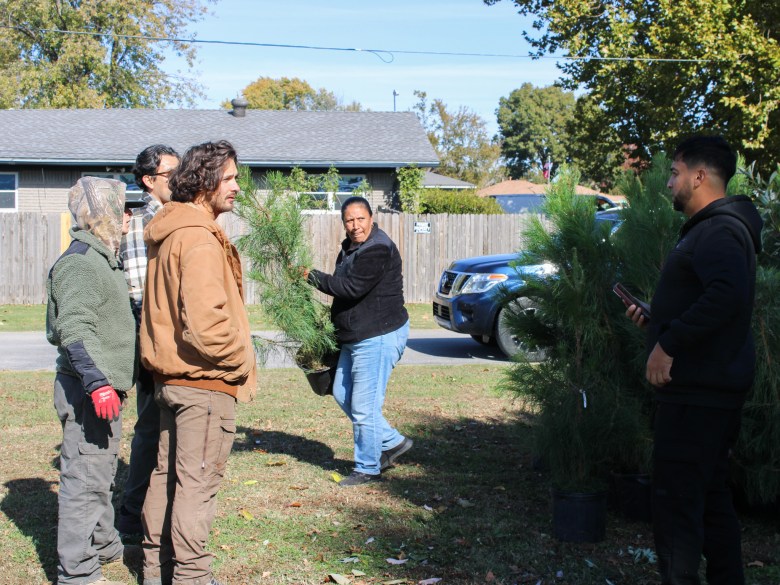
Yogi Cuenca grew up in east Tulsa, and for him, planting trees is personal. Now, as the operations director for Up With Trees, he brings his job to the place he frequented as a kid.
Up With Trees is a local nonprofit advancing Tulsa’s tree canopy since 1976. The organization has planted more than 40,000 trees over the years. Its goals are to have a 30% tree canopy coverage in neighborhoods and to have every Tulsan live within 300 meters of a “quality green space.”
East Tulsa, specifically the intersection of 21st Street and Garnett Road, is nowhere near 30%, Cuenca said. It sits at about 21%.
The nonprofit is partnering with east Tulsa organizations Tulsa Global District and Eastside Rise to increase the urban forest and canopy of the area to ultimately make the neighborhood greener.
“As corny as it sounds, this is kind of my home,” he said. “I grew up at Admiral and Memorial. This is my stomping ground. It makes me really happy that I can come out here and plant trees in the area that I grew up in. I would love to see more people out and just getting their hands dirty, making a difference.”
Tulsa Global District plants trees off 21st and Garnett
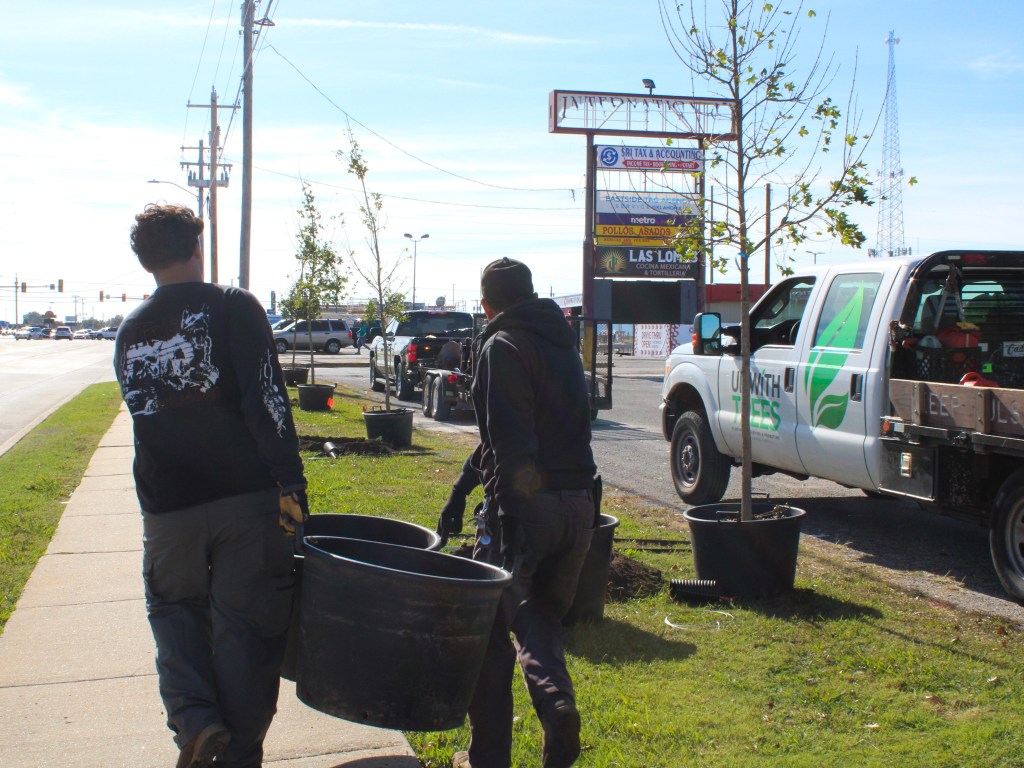
On Nov. 14, Cuenca and his team were on the east side planting trees at the intersection of 21st Street and Garnett Road. They planted 25 trees and gave about 200 more to community members.
Up With Trees handed out a variety of trees that Saturday, including pollinator-friendly trees, oak trees and swamp whites. Cuenca likes to place swamp whites near highways to help with carbon sequestration, he said.
“Over time they get a very large canopy,” he said. “The top of the leaf is very waxy; the bottom is very fluffy, kind of like a rabid deer. And whenever these cars go by and they have a lot of CO2 and smog, it’ll actually catch up in those leaves.”
Rain will help wash the leaves and bring the carbon to the ground, he said.
Alejandro Garcia, executive director of the Tulsa Global District, said east Tulsa is one of the zones where more trees are needed to help with shading and heat. The 21st and Garnett area has a lot of concrete.
“I learned from (Up With Trees) that these zones without trees normally are 10 degrees hotter in the summer than the rest of the city because there are not enough trees,” Garcia said.
During the time Up With Trees was thinking of expanding to the east side, Garcia was already thinking about adding trees in his district. The organization is also working with the City of Tulsa to be sure it plants trees in appropriate places.
Aside from the data about the heat, Garcia said trees make an area prettier. It lowers crime and can change the perception of an area, he said.
“So these are parts of the beautification efforts, like the art we’re putting up, like the Beat Boxes, like the Dragon Trail, like the gateways. It’s art, but it’s art and nature; they go hand in hand,” he said. “And nature is the most logical and simple way to make the zone prettier.”
Eastside Rise’s The Neighborhood Network launches tree project
Xareny Quijada, who has lived in east Tulsa for 28 years, said the opportunity to see trees around her improves her well-being.
“Since I was little I loved being in nature,” she said. “I lived in a place with a lot of fruit trees, and for me having trees is a great blessing.”
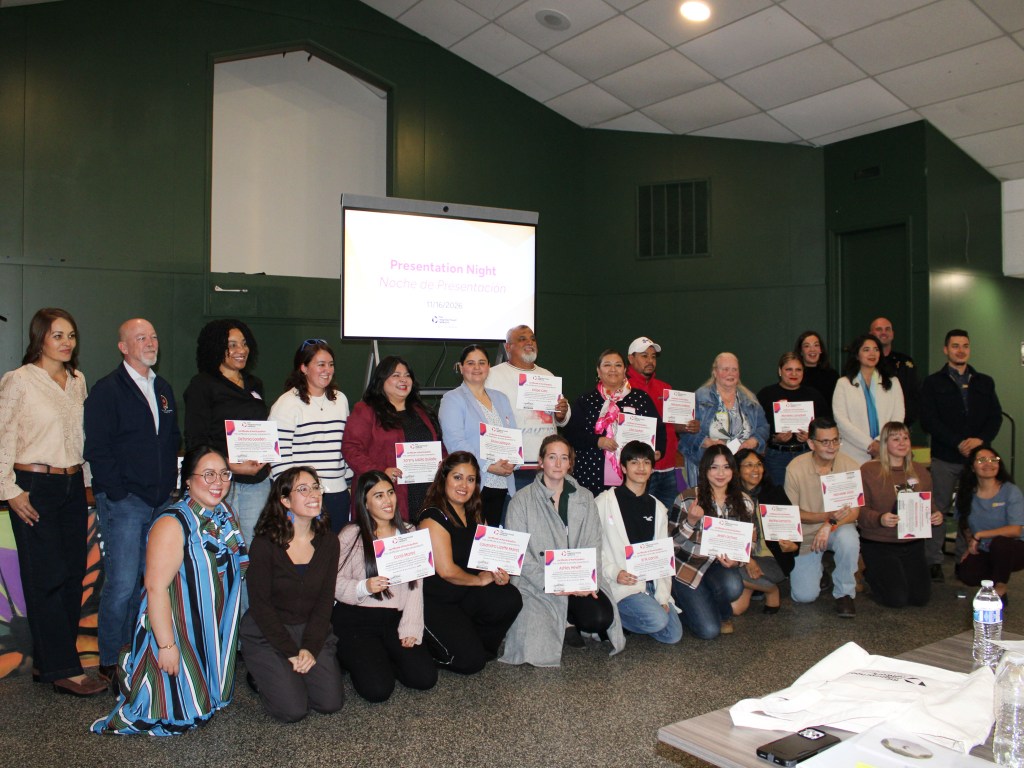
Quijada is part of the second cohort of The Neighborhood Network, an eight-week program focused on helping community members understand how to be civically engaged. The project is an initiative of Eastside Rise and the Tulsa Global District.
This year’s cohort presented its community project focused on increasing east Tulsa’s tree canopy starting next year. The class of 15 voted to plant 100 to 200 additional trees next year in Eastside Rise’s four surrounding neighborhoods.
“The challenge that most closely aligned with our criteria was improving tree canopy coverage in east Tulsa,” said participant DeTonia Gooden. “What’s more important here is that it wasn’t one person’s idea or one person’s decision. It was a community-informed decision shaped by listening, examining our resources, setting priorities and working together.”
Once the class ends, interested participants will join the organization’s community council, where they will work with Eastside Rise, Up With Trees and the City of Tulsa starting in February to begin determining specific locations to plant trees.
The group also plans to help educate their neighbors about trees, including where east Tulsa’s tree canopy percentage as compared to that in other parts of the city. Participants also mentioned how natural disasters, including the Father’s Day storm of 2023, impacted their part of town.
Participant Silvia Gallegos has been in Tulsa about 26 years. She called for attendees to take a deep breath and remember that the air they breathe impacts the health of their children, parents and every person around them, and she encourages residents to get involved in the project.
“You are welcome to volunteer and come help us out and choose the trees that you like to have in your neighborhood,” Gallegos said.
This article was produced as part of a partnership between the Tulsa Flyer and La Semana, a Tulsa-based bilingual Spanish-English newspaper serving Latino communities in Oklahoma.
News decisions at the Tulsa Flyer are made independently of our board members and financial supporters. Read more about our editorial independence policy here.