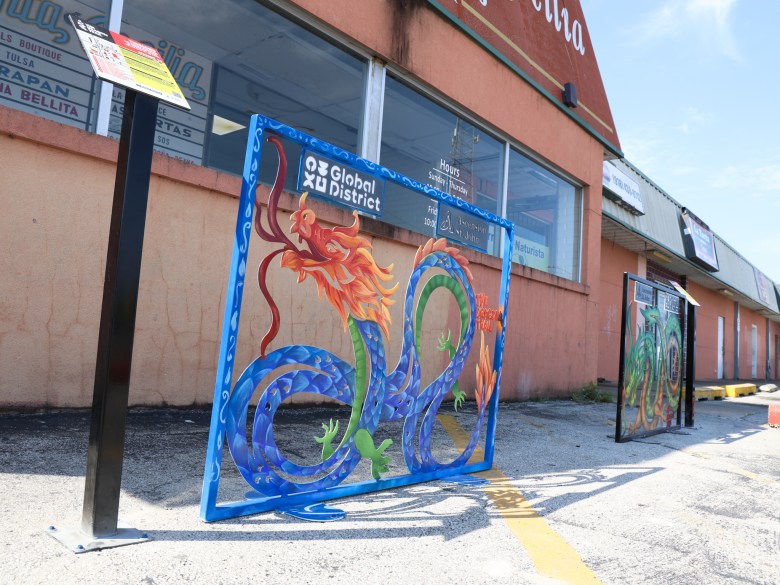
East Tulsa has blended the cultures of its residents as local art celebrating the Asian American and Pacific Islander community was added across town at mostly Latino-owned businesses.
The Tulsa Global District launched The Dragon Trail, a project that combines exercise and urban art, in August as part of its efforts to revitalize the area around 21st and Garnett streets.
The bike trail and dragon-shaped racks arrive as a growing number of Asian American residents and business owners have moved to the eastside in recent years.
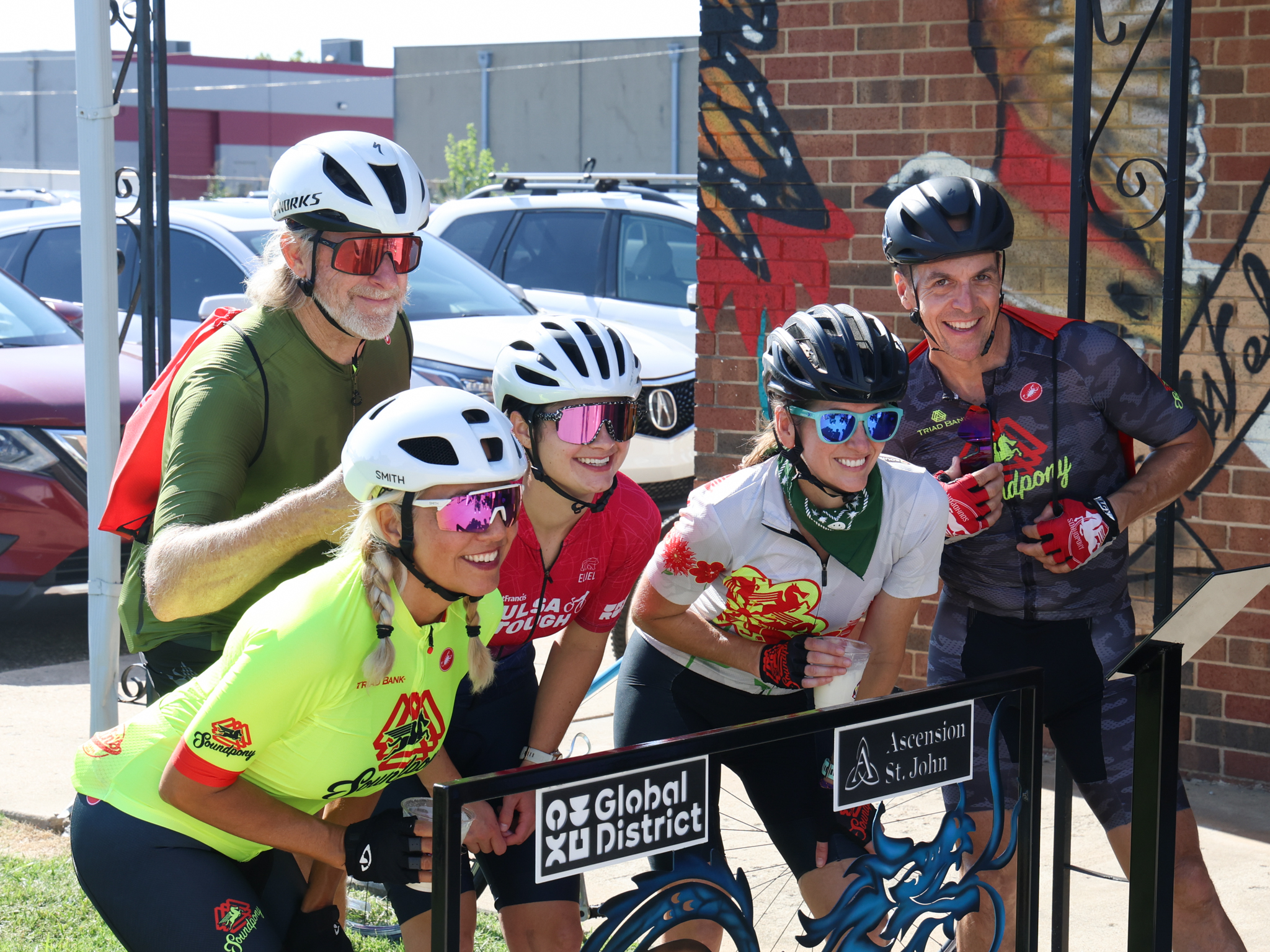
The dragon was the perfect animal to represent the Asian American and Pacific Islander community, said An-Nam “Anna” Tran, an east Tulsa resident and Global District board member.
“The dragon itself is such a center in the AAPI community,” she said. “The dragon is the most ominous creature and it just represents power, strength, fortune, wisdom.”
Mayor Monroe Nichols spoke at the unveiling of The Dragon Trail and a new mural underneath Highway 169 in August.
“All across this city, not only are we inspiring art and cool things to look at, we’re really showing the character of this community, and this is a great example of that,” Nichols said.
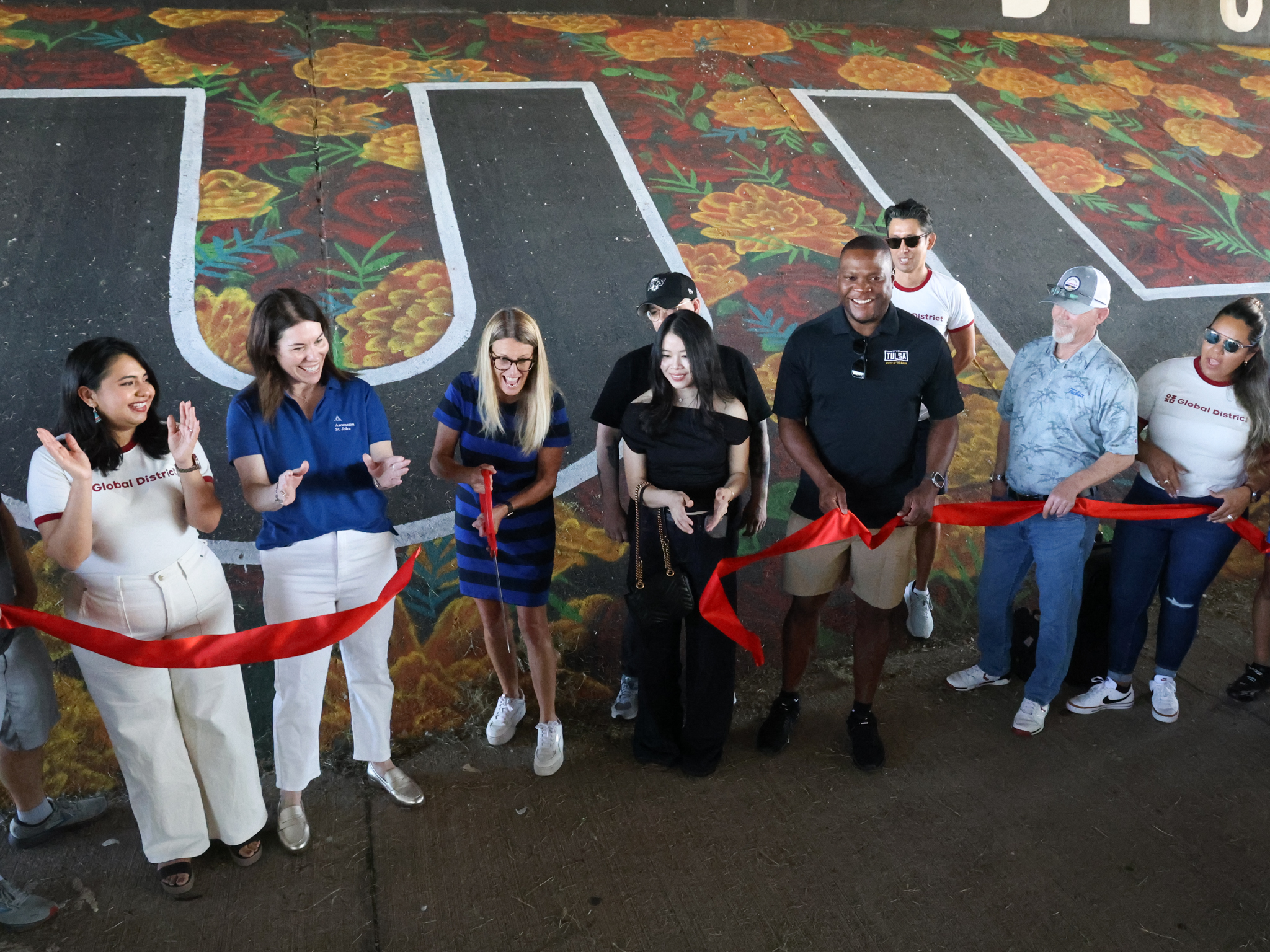
District 6 Councilor Christian Bengel, who represents the eastside, said The Dragon Trail is an expansion of the revitalization that has already started on 21st and Garnett streets. The global district needed a trail and it finally has one showcasing the uniqueness of the area, he said.
“I love that we’re not only focused on one specific culture since there are a significant amount of cultures here,” Bengel said. “We are literally the most diverse district. I’m actually a minority of my own district, if you can believe it, so that’s what I love about this.”
Jesse Backstrom has been to a few events at Hannah Hall since his family moved to southeast Tulsa from Austin last year. He worried at the time that his mixed race daughter would have less exposure to her culture.
“It was good to get here and find out that there’s places we can go where she gets that exposure to the Latino community,” he said, as his daughter rode a tricycle nearby.
Here’s everything you need to know about The Dragon Trail.
What is the project?
The Dragon Trail features 14 dragon-shaped bike racks and 12 stops. The project uplifts 11 local artists applying their own artistic vision to their individual dragon’s story.
While it’s not a traditional trail, people can walk and bike to each location, said Alejandro Garcia, executive director of the Tulsa Global District.
He chose dragons as the theme because he knew the animal was honored in various Asian cultures.
“It’s going to be like urban art in east Tulsa,” Garcia said. “There’s not another project like this in Tulsa.”
Where can you find the dragons?
Tulsans can find the dragon-shaped bike racks around 21st and Garnett streets at a dozen local businesses. The majority of the bike racks are located at Latino-owned small businesses, as well as Nam Hai Oriental Food Market at 11528 E. 21st St.
Each bike rack includes a sign that explains the stories in Spanish, English and Vietnamese. Supported by Ascension St. John, the trail also aims to help local businesses increase their visibility to new clients.
Why in east Tulsa?
The eastside has become the unofficial hub of the AAPI community in Tulsa, Tran said. Places of worship, along with businesses and residences, are congregated in the area.
About 4.5% of east Tulsa’s population identifies as Asian American and Pacific Islander, according to the Tulsa Global District’s 2025 annual report. The city of Tulsa is home to 14,352 Asians and 905 Native Hawaiian or Pacific Islanders, based on 2020 U.S. Census data.
Residents have found reminders of home through restaurants, grocery stores such as Nam Hai Oriental Food Market and the annual Asian American Night Market each May. Ultimately, Tran hopes the trail brings more visitors to the Tulsa Global District.
“It’s just so joyous to see other people appreciate and celebrate your culture when we don’t get to see that every day,” Tran said. “At a time like now, seeing people embrace our differences has been a little bit more healing.”
Lea este artículo en español aquí.
This article was produced as part of a partnership between the Tulsa Flyer and La Semana, a Tulsa-based bilingual Spanish-English newspaper serving Latino communities in Oklahoma.
Alejandro Garcia is a member of the community advisory committee for the Tulsa Flyer. News decisions are made independently of our board members and financial supporters. Read more about our editorial independence policy here.