


In the year of the pandemic, a Tulsa nonprofit offering parent education experienced a 116% increase. Requests used to come from about eight surrounding communities, but the number has shot up to 48 Oklahoma counties since then.
Demand hasn’t let up. That’s when The Parent Child Center of Tulsa decided it was time to change its name and look to better explain what it does.
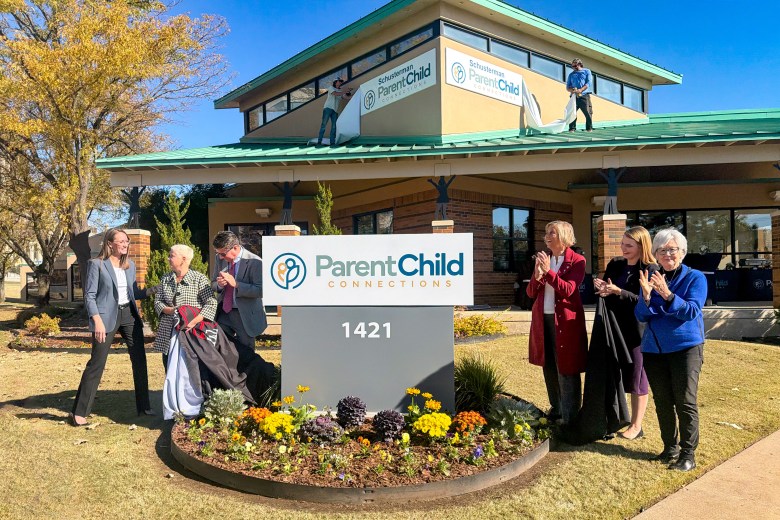
The Parent Child Connections moniker and logo design were unveiled on Thursday at its location at 1421 S. Boston Ave.
“As we continue to see growth and this expansion of reach, we recognized that having Tulsa in our name has created a misnomer for a lot of individuals,” said Melanie Anderegg, president and CEO of Parent Child Connections. “We recognized our name does create a lot of confusion.”
A year was spent asking the public what they thought the nonprofit did. Some said they thought it was a child-care center. Others had no idea.
“It became really clear that our name doesn’t quite message what we do and who we are in a way that’s representative of who we are today and the future direction,” Anderegg said.
The Parent Child Connections logo shows an image of a parent and child embracing within a circle to symbolize the community surrounding them.
The nonprofit’s genesis came in 1970, when two separate hospital initiatives launched to prevent child abuse and neglect. In 1990, they merged to form the Parent Child Center of Tulsa.
Among the original funders were the late Charles Schusterman and his wife, Lynn Schusterman, who spoke at Thursday’s event. She recalled moving to Tulsa at age 23 and volunteering with the Tulsa Police Department, where she witnessed the removal from their homes of children who were abused and neglected.
“I saw children with broken bones. I saw children whose bodies were covered with cigarette burns,” Schusterman said. “So when the Parent Child Center came to me and my late husband, Charlie, years later with an idea to build a new home for its critical work supporting children and families, of course we were in.
“It was our first major gift in Tulsa.”
Schusterman read what her husband said at the original groundbreaking.
“Charlie said, ‘Each of us must recognize our responsibility to protect the right of every child to a safe and secure and, hopefully, loving upbringing,” Schusterman said.
“I still feel this responsibility to my core today, building a world that is safe for children – where they can feel secure and protected – is really one of our most important responsibilities.”
Oklahoma consistently ranks among the top five states for child abuse and neglect, with a rate of 14.2 cases per 1,000 children – compared to a national rate of 7.7.
Each of Parent Child Connections’ 11 programs works to prevent and intervene in child abuse and neglect cases. These include various parent education classes, trauma therapy and fatherhood groups. More than 93,000 people a year participate in the nonprofit’s services.
Two popular programs – Positive Parenting and Safe Care – include home visits. Some programs have a waiting list that would take an additional $2 million to eliminate.
Its Kids on the Block program will be in every Tulsa Public Schools elementary school starting next year. It’s an interactive puppet program that can help children recognize unsafe situations and know what to do in those instances.
Part of the jump in demand is due to parents’ willingness to admit that they need help with their children, Anderegg said. They want to learn how to manage behavior challenges and stress in their families.
“A silver lining of the pandemic was that it reduced the stigma,” Anderegg said. “People no longer felt that they were alone in their need for help. They just continued to reach out.”
News decisions at the Tulsa Flyer are made independently of our board members and financial supporters. Read more about our editorial independence policy here.