


This article is a part of “Mental Health Snapshot,” a reporting collaboration between Tulsa Flyer, The Oklahoma Eagle, The Frontier, KOSU, La Semana and Focus Black Oklahoma on mental health and resources in Northeast Oklahoma.
All editorial decisions for this series are made by the participating newsrooms.
Major series support provided by: Healthy Minds Policy Initiative
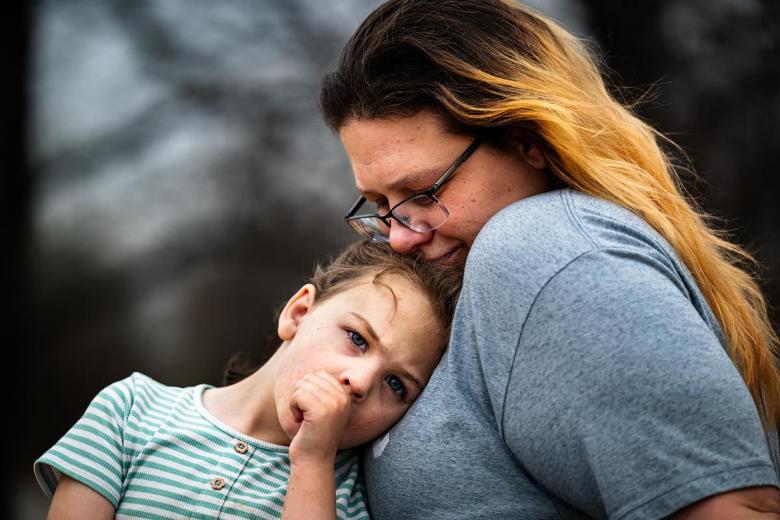
A few years ago, Amanda Billings stopped to consider her life. She knew she talked too much, shared too much. She knew her choices led to substance abuse addiction and the loss of her oldest children to foster care. She never felt like she fit into the world.
“I’ve always done counseling in my life, but I never addressed the mental health underneath it all,” Billings said.
Therapy helped Billings make sense of a chaotic childhood that landed her in the home of an aunt and uncle before age 10. By 18, she was diagnosed at various times with bipolar disorder, major depressive disorder and attention-deficit/hyperactivity disorder. Now, at age 37, she continues wrestling with the right treatment.
“I’m not consistent enough with medication,” she said. “It’s been a fight over the years, and I don’t think it works. It makes me feel numb. I’d rather feel sad than numb.”
After finding sobriety and stable relationships, Billings has become a student leader at Tulsa Community College and a community advocate for families. She wants to start a program to help parents navigate the child welfare system.
“It’s just been in the past couple of years I’ve tried to figure out why I am the way I am,” Billings said. “I carry a lot of regret about not raising my older two children. It reminds me how hard I’ve worked and how far I’ve come, and that I can’t go backwards now. God didn’t bring me to leave me. The only way I’ll ever forgive myself is by using my experiences to help other families not end up where I’ve been.”

Billings was born in Texas but brought to Tulsa as a child by her mother, who remarried when she was 8. She recalls multiple incidents of sexual assault that were not believed.
“I’ve blocked a lot of my childhood. What I do remember is not pleasant,” she said. “Looking back, I can see that a lot of my behavior as a teenager was connected to the trauma I experienced.”
She attended Street School but left to enroll in the Job Corps, where she met the father of her two oldest children. She was increasingly exposed to drug culture through his family, who made meth. One of his friends convinced her to try it, leading her down a substance abuse path.
“When I tried it the first time, my heart fluttered, and suddenly everything didn’t seem so bad. I was addicted almost immediately,” Billings said. “At first, I was hanging out with the dealers, and meth was always available, but I didn’t realize how chaotic life was becoming.”
She was 22, and the couple had two children younger than 4. She spent nearly two years living in a series of motel rooms where her boyfriend cooked the illegal drug. During this time, she held a job while he stayed home with the children.
“It was chaotic, and I was chasing their dad because I wanted to feel love. I wanted my kids to have both of us,” Billings said.
Interactions with child welfare workers began during this period — visits that persist today.
The couple broke up, and the children were removed from her care. Her oldest child spent most of his youth moving between mental health facilities and group homes, struggling in traditional foster care placements. After several years working within the child welfare system, she relinquished parental rights to her second child in 2015 for adoption — a decision she struggles to reconcile.
“I was confused and didn’t fully understand the impact my situation was having on my kids,” Billings said. “I remember thinking at the time that I wasn’t that bad of a mom and that I was doing the best I could with what I knew.”
Billings entered several rehabilitation programs before reaching a sustained sobriety. She reconnected with a man she knew during her teen years. They married and now have two children, ages 7 and 5. This time around as a parent, she protected her sobriety and mental stability through community involvement.

She previously served as a school representative for her children’s early learning program and is currently a community representative on CAP Tulsa’s Policy Council.
Through her participation in the Kendall Whittier Leaders program, she discovered a passion for public policy work and an interest in government systems. She recognized how these shaped her life — and how they needed to change.
As a TCC student, she leaned into the TRIO Support Services program, calling it a “family away from home.” The coursework convinced her to seek a profession that helps families.
“I first dealt with the child welfare system as an unprotected child,” she said. “As a young mom, I dealt with them again. I knew I wanted to be better but didn’t have the tools or the role model to know how to do that.”
Her list of accomplishments is long. Billings served as president of TCC’s National Society of Leadership and Success and currently as an officer in the TCC Student Government Association. She has received several scholarships, including being named a True Blue LEAD Scholar. She participates in Leadership Tulsa’s Represent Class 5 and New Voices Class 17. She is an alumna of Leadership Tulsa’s Thrive Class 8. She participated in the summer institute of the think tank Oklahoma Policy Institute.
It is common to see Billings at community public meetings around issues of families, youth and children.
“I used to hate politics, wanted nothing to do with it and didn’t even vote,” Billings said. “I realized that if I wanted to change the systems affecting families, I had to understand policy. I started going to the capitol, learning how it all works. Now I’m tracking child welfare bills and showing up wherever I can as an advocate for families.”
This involvement keeps her on track — but also results in an ever-changing calendar. She adheres strictly to a daily planner full of reminders for classes, homework, club meetings, parent-school meetings, community gatherings and shifts as a part-time job as a personal shopper.
“When days are too stressful, I’ll stop and take a break for a walk,” she said. “My favorite spot is by the river because there is a calm there.”
Billings will graduate from TCC in May and has a goal to create a child abuse and neglect prevention framework that would support at-risk parents. It would provide centralized support to help families stabilize before a crisis leads to a child’s removal, assist parents in navigating the system when child welfare involvement occurs and connect families to resources such as transportation and therapy.
While she’s reached a new normal, Billings still faces challenges in her personal life. Finding services for her younger children with special needs and reintroducing her eldest child into her family through visitations and relationship building are among them. Interactions with child welfare workers continue, triggered largely based on her history.
“Staying busy is how I handle things,” Billings said. “I stay away from people who I know use drugs. I will not blow up everything I have worked hard for. I want to help families, and I can’t do that if my life isn’t together.
“I can’t change the past. I can’t go back and be a better mom to my older children. But I’ve educated myself and learned as much as I can. Because of that, I’m able to parent my younger children differently. I’m determined to use what I’ve learned to help other families avoid the path mine went down.”
Ginnie Graham is a senior reporter for the Tulsa Flyer.
News decisions at the Tulsa Flyer are made independently of our board members and financial supporters. Read more about our editorial independence policy here.
Additional series support by: Oklahoma Women in Technology