


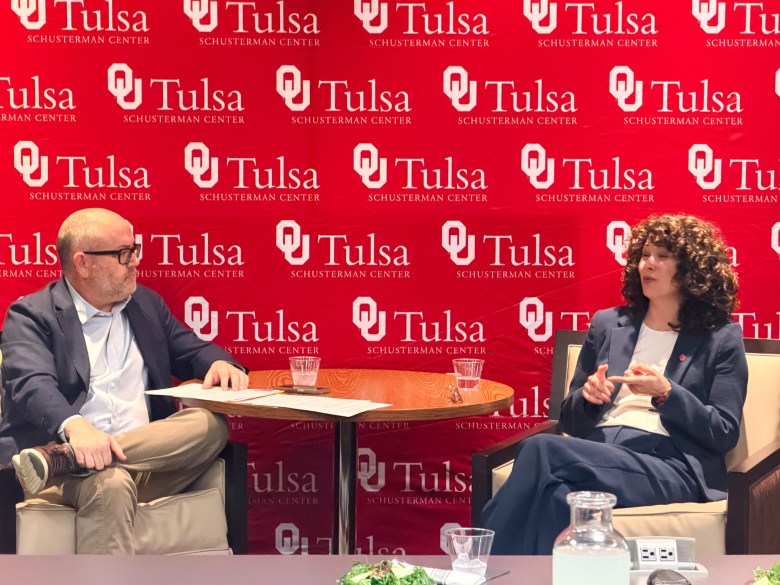
The maneuvering in Tulsa’s higher education landscape to capture more undergraduate students hasn’t changed the strategy for the University of Oklahoma-Tulsa, says the administrator responsible for the campus.
Vice President Susan Bynum gave an update about the university’s projects at a Tulsa Press Club Community Conversations event Friday. The talk with Press Club President Jason Collington included the effects of Senate Bill 701, which allows public universities to offer lower-division courses in Tulsa.
Tulsa’s public higher education system has been designed with Tulsa Community College offering lower-level courses toward associate degrees and workforce certifications. The state’s four-year universities offer upper-division classes for students pursuing bachelor’s degrees.
The idea was to avoid duplication. With the new law, the idea is to create more competition and an easier path to a bachelor’s degree.
“I don’t think the restrictions ever really kept us from doing what we’re doing,” Bynum said. “I think our mandate from the county really has been that we have this structure in place where we are going with Tulsa Community College, and that’s what we do.
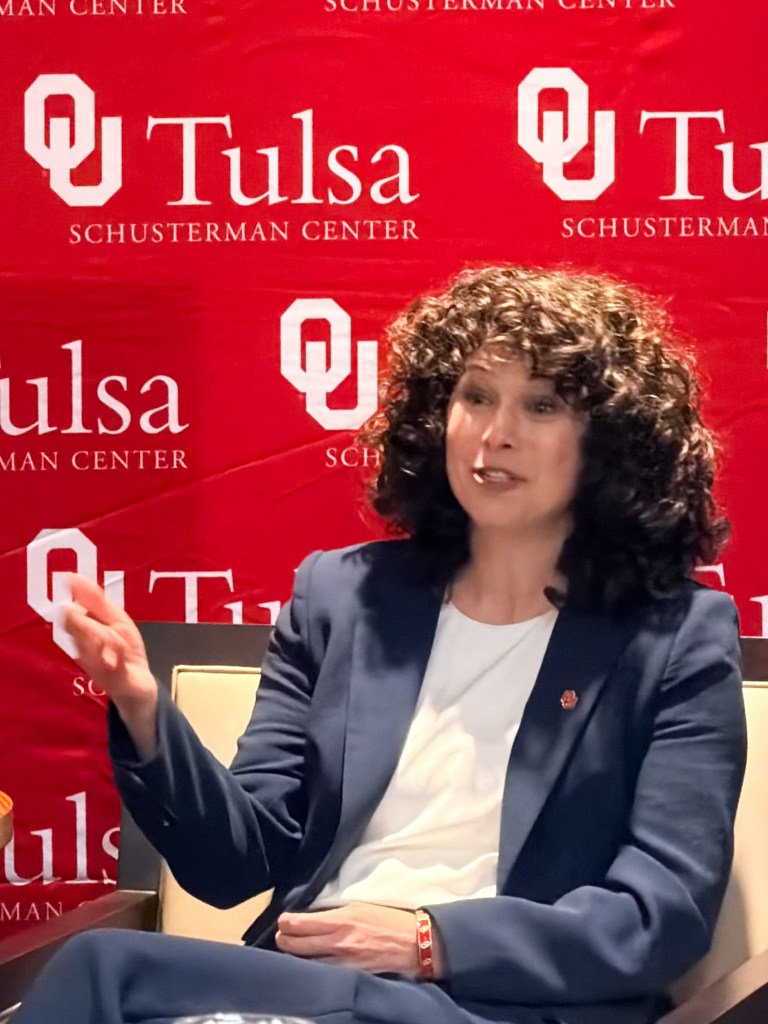
“That’s how Tulsa, for better or worse, has structured how their higher education works. We are excited to work with them. All our undergrad degrees have a matriculation agreement with TCC. Leaning into that relationship is kind of our plan for the future.”
At the club’s event in October, Oklahoma State University President Jim Hess announced a desire to merge with TCC to create a four-year university. Oklahoma Watch reporter Andrea Eger found proposals for that plan that had been in the works for months.
The University of Tulsa announced a tuition cap of $25,000 per year for its students, making it competitive with state schools. An announcement is expected next week with details of a new partnership between TCC and TU.
“The partnership will combine the affordability of TCC with university experiences and a coordinated plan to earn an associate degree from TCC and a bachelor’s degree from (TU),” a press release states.
Bynum said not to mistake OU’s status quo for lack of interest.
“I don’t think that would be taken as OU being any less involved or committed to Tulsa, because I think our strategy has been the same, which is really leaning into TCC with our undergrads,” Bynum said. “So it really doesn’t change much for us.”
Oklahoma ranks in the bottom half of the nation in college degrees obtained by residents. Research shows that on average a person with a college degree will earn about $1 million more over a lifetime than a person without a degree.
It’s estimated that the state lacks about 30,000 degrees to reach the national average.
OU-Tulsa is part of the Higher Education Consortium that brings nine area colleges and universities to the same table.
“A big point for me is that we are all in this together,” Bynum said. “For me, with this many institutions, we should be able to attack that 30,000-degree deficit, and we should be able to do it together.
“My hope is that will be what they focus on – us as a community being able to work towards that deficit.”
Other points made by Bynum:
- 83% of OU-Tulsa graduates have an “experiential learning” experience in the community.
- The average OU student is paying about 27% less than five years ago due to emphasis on scholarships and financial aid.
- The OU Onward program, which was announced recently, will provide free tuition and fees for students from households earning less than $75,000. For comparison, the Oklahoma Promise cap is $60,000.
- OU’s enrollment has increased about 45% in five years in Norman and held steady at OU-Tulsa.
- OU launched a systemwide Project 200 that seeks to recruit 200 researchers from across the globe. The economic outcomes are expected to offset the loss of Devon Energy from Oklahoma City.
- The National Cancer Institute-designated Stephenson Cancer Treatment Center, which is under construction, is expected to bring in patients from nearby states. Research shows that treatment at an NCI center improved outcomes by 25%.
News decisions at the Tulsa Flyer are made independently of our board members and financial supporters. Read more about our editorial independence policy here.