

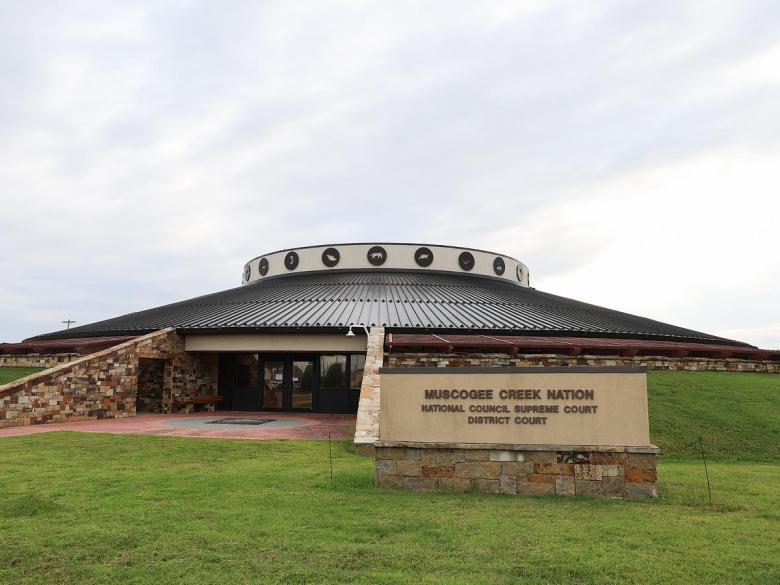
Descendants of Black people enslaved by the Muscogee Nation are continuing a legal fight against the tribe to acquire citizenship in federal court.
Rhonda Grayson and Jeffrey Kennedy, two Freedmen descendants, filed a lawsuit against Principal Chief David Hill and the Muscogee Citizenship Board in the Western District of Oklahoma over the summer. They argue the tribe must follow a Muscogee Nation Supreme Court decision affirming it must grant citizenship to Freedmen descendants.
Grayson and her attorney, Damario Solomon-Simmons, held a virtual briefing last week. Grayson said their case isn’t about receiving benefits, but being able to participate in the community and elections.
“Our ancestors endured removal and displacement alongside other Muscogee Creek people, rebuilt their lives in Indian territory” Grayson said. “ … It is about who we are, where we come from, and what our ancestors passed down to us. We were part of this history, and we still are.”
Grayson and Kennedy cite Article II of the Treaty of 1866, which extends citizenship to formerly enslaved people of African descent. The Muscogee Nation Supreme Court unanimously ruled in their favor last year, but the executive and legislative branches of the tribe have since logjammed Freedmen enrollment.
Hill filed a brief earlier this month asking the federal court to dismiss the case over lack of jurisdiction. He argues the tribe has sovereign authority to dictate its membership derived from its 1979 constitution.
“And nothing in the Treaty of 1866 constitutes a clear and express abrogation by Congress of the Nation’s sovereign immunity from suit,” Hill’s argument reads.
But Solomon-Simmons argues the tribal constitution establishes supreme court decisions are final and that the Treaty of 1866 is the supreme source of law for Muscogee Nation.
“This effort is to prove the sanctity of our sovereignty,” Solomon-Simmons said during the briefing. “[A]nd we fear that what Chief Hill and others in leadership are doing is putting the entire Creek Nation sovereignty in jeopardy, because if the Creek Nation can decide that they don’t want to adhere to Article II of the Treaty of 1866 … what’s going to stop the state of Oklahoma or the United States government from not adhering to other articles within the Treaty of 1866?”
Solomon-Simmons also compared Hill to former Alabama Gov. George Wallace, who was a staunch supporter of segregation, accusing him of not wanting to allow Black Muscogee members. Solomon-Simmons said they hope for an answer before next year’s tribal elections.
Hill released a statement saying tribal officials are trying to defend the constitution.
“Amendments can be made in only one way, by the will of the people,” Hill wrote. “We remain hopeful that the federal court will respect the Nation’s sovereignty and uphold the core principle that Indian tribes have the inherent authority to determine their own citizenship.”
Background
The Muscogee Nation District Court ruled in Grayson and Kennedy’s favor in 2023, when judges affirmed they were entitled to tribal citizenship.
The Muscogee Nation Citizenship Board then appealed the decision, leading the case to the tribe’s supreme court. In 2025, justices ruled 5-0 in favor of Freedmen descendants, striking a line from the tribe’s 1979 constitution limiting membership “by blood.”
Hill issued an executive order one month later pausing the issuance of citizenship cards, arguing the judicial branch overstepped its authority.
This spring, 13 representatives in the 16-member Muscogee National Council issued a vote of no confidence against the five justices. Rep. Lucian Tiger said the 1979 constitution can not be overridden without a public vote, adding the no-confidence vote was the strongest possible action the council could take on the issue.
The Cherokee and Seminole Nations enroll Freedmen, though the latter only offers limited membership.
The Cherokee Nation Supreme Court ruled in 2021 that Freedmen were entitled to full citizenship rights, striking its “by blood” constitutional language.
This story was produced as part of a partnership between the Tulsa Flyer and KOSU. Read the original article here.