

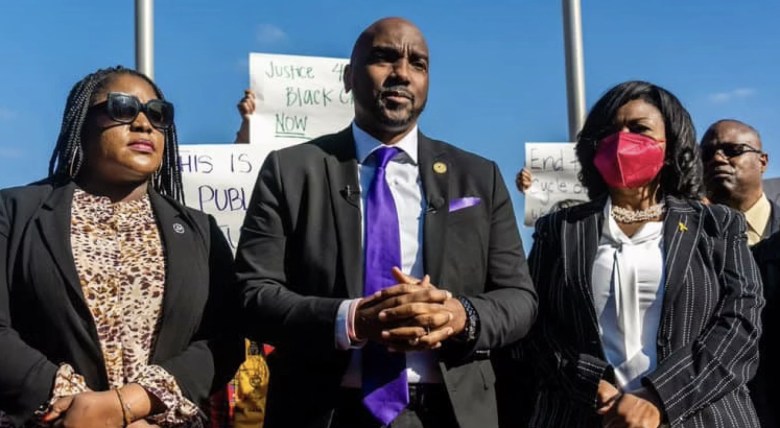
The Muscogee Nation Supreme Court denied a series of appeals Tuesday seeking to enforce citizenship for descendants of people formerly enslaved by the tribe.
Those appeals included motions to postpone the nation’s May 30 special election, hold Principal Chief David Hill in contempt of court and issue the appellants citizenship cards “immediately.”
They were filed by Rhonda Grayson and Jeffrey Kennedy, two individuals behind the Muscogee Freedmen case decided last July. That was when the tribal court ruled Freedmen were entitled to citizenship, citing an 1866 treaty with the federal government. In the process, the justices rejected language from the 1979 constitution limiting citizenship “by blood.”
In August, Hill signed an executive order pausing the issuance of citizenship cards to Freedmen descendants, stating the court overstepped its authority and that the tribe must first update its laws in accordance with the ruling.
But the tribe’s Supreme Court wrote Tuesday that the executive branch is working toward citizenship, and that it doesn’t have the authority to resolve Grayson and Kennedy’s appeal.
“The evidence produced to the Court in response to these orders for status reports has shown conclusively that the Appellant and the Executive Branch have taken steps to comply with this Court’s Order and Opinion (though, perhaps not in the manner or at the speed desired by the Respondents, and, to be frank, not at the speed this Court would prefer),” the order states. “However, the Court finds that the Respondents’ pending Motions should be denied.”
It argues the matter is non-justiciable, meaning it can’t be resolved in the same way because it’s a matter of enforcement, not interpretation.
“Judgments concerning necessary legislation to implement the Court’s decision, commissions that may be necessary to prepare for expected changes resulting from the sudden influx of new citizens, and how much time is necessary to responsibly implement these changes are political questions that must be left to the branches of government assigned those tasks under the Nation’s Constitution,” the court wrote.
Within the order, the court included a message directed at the political branches of its government and its citizenry.
The court wrote the Muscogee Nation is a sovereign nation due to the actions of its ancestors, including the signing of the Treaty of 1866. It argued ignoring certain aspects of the treaty poses a “danger” to sovereignty.
Last month, the Muscogee National Council issued an overwhelming vote of no confidence against five of its Supreme Court justices, arguing the judicial branch’s Freedmen decision violated the 1979 constitution. Only one member opposed the measure.
“It is clear to this Court that, like our ancestors, many among our citizens today are also dismayed at the prospect of this Court’s Order and Opinion, and would have preferred that the Court had ruled differently,” the order reads. “Also like our ancestors, this Court’s fervent hope in this case, and in every case that finds its way to our docket, is that our decision will secure a better future for our Nation, and make clear to all that the Judicial Branch of the Muscogee (Creek) Nation produces just results to all parties, honoring both our tradition and our legal precedent, even if some results may be hard.”
A spokesperson for the Muscogee Nation said the tribe would not comment on the court’s decision. Representatives for Grayson, Kennedy and the Muscogee Creek Indian Freedmen Band did not immediately respond to requests for comment.
This article was originally published by KOSU. You can see the original story here.