


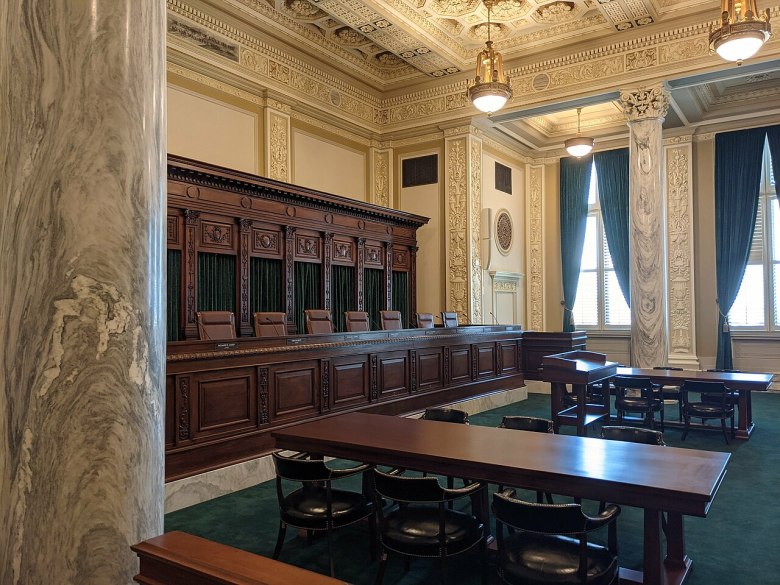
About 60 years ago, a bribery scandal sent one Oklahoma Supreme Court Justice to prison, another resigned and a third was impeached and removed from office. Voters wanted to get politics and nepotism out of the courts, so they created the Judicial Nominating Commission through constitutional reforms.
Voters are asked to reconsider parts of that original framework in State Question 845 on Nov. 3.
What is the Judicial Nominating Commission?
It is a bipartisan group of 15 members that provide recommendations to the governor to fill seats on the state’s top courts: Oklahoma Supreme Court, Oklahoma Court of Criminal Appeals and Oklahoma Court of Civil Appeals.
Its composition is specified in law. The goal was ensuring the balance of the commission not be dominated by attorneys or one political party. This was created when Democrats held a supermajority control of the state.
The Oklahoma Bar Association elects six attorneys to the commission, one from each of the state’s six congressional districts as they existed in 1967. They serve six-year terms staggered at two-year intervals.
The governor appoints six non-attorneys with no more than three from the same political party. Those appointees cannot have immediate family members who are lawyers. They serve six-year staggered terms.
The three remaining spots are considered “at-large” members. The Oklahoma House Speaker, Oklahoma Senate President Pro Tem and the judicial nomination commission each appoint one member. No more than two of those can belong to the same political party.
What does SQ 845 ask to change?
The state question seeks four amendments. A “yes” vote would make these changes in the constitution:
- Remove restrictions on political party affiliation among the appointees by the governor and at-large members;
- Remove provision that prohibits governor appointees be lawyers or have family members who are attorneys;
- Allow members to serve two consecutive six-year terms; and
- Require appointments be made according to the congressional districts at the time of appointment.
How did SQ 845 end up on the ballot?
The Legislature passed Joint House Resolution 1024 sponsored by state Rep. Anthony Moore, R-Clinton, and state Sen. Todd Gollihare, R-Kellyville.
What are the arguments about the measure?
Republican lawmakers say the changes would expand the candidate pool and bring political balance to the commission. They contend the bar association skews left-leaning, a notion denied by the organization.
Critics argue it would eliminate guardrails that have kept Oklahoma scandal-free for 60 years and inject partisanship into the judiciary.
Has the Judicial Nominating Commission law ever been changed?
Since its creation in 1967 through 52% approval of State Question 447, voters have considered one amendment. In 2010, Oklahomans approved State Question 752 with 63% of the vote, adding two at-large members and specifying non-lawyers could not be related to attorneys out-of-state as well as in Oklahoma.
News decisions at the Tulsa Flyer are made independently of our board members and financial supporters. Read more about our editorial independence policy here.