
This article is a part of Snapshot: Election Guide, a collaborative journalism project between Tulsa Flyer, The Oklahoma Eagle, The Frontier, KOSU, La Semana and Focus Black Oklahoma designed to help Tulsa voters make informed decisions ahead of fall elections set for Aug. 25 and Nov. 3.
We’re tracking outside groups that are spending money in Oklahoma elections this year at readfrontier.org/ads. Send questions and tips to info@readfrontier.com.
Q: How can you tell who paid for an ad?
A: All campaign advertisements are required to contain disclosures about who paid for an ad. But groups that buy political advertising often take steps to hide the identities of their funders. Super PACs are legally required to publicly report contributions, but they can also accept contributions from 501(c)(4) dark money groups that don’t have to disclose their donors. The U.S. Supreme Court ruled in 2021 that these dark money do not have to publicly disclose their donors, making it hard for voters to find out who is actually buying ads.
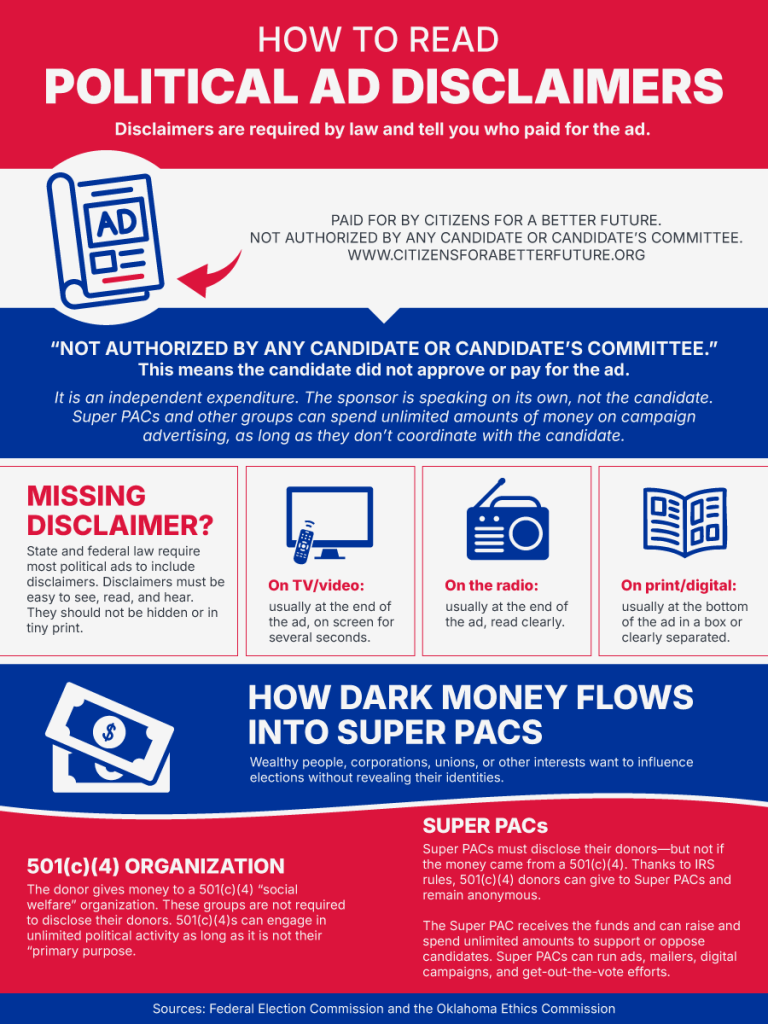
Q: Why are there limits on individual campaign contributions when dark money groups can spend unlimited amounts of money on advertising?
A: After the Watergate scandal in the 1970s, Congress created the Federal Election Commission and placed limits on how much an individual could donate to a politician. In 1975, the U.S. Supreme Court took up the issue of campaign contribution limits in the Buckley v. Valeo case, and upheld direct contribution limits to candidates. But the court ruled that independent expenditures do not pose the same threat of buying political influence.
In 2010, the Supreme Court issued its Citizens United v. FEC ruling, which struck down a law banning corporations from making independent political expenditures. The court held that limits on corporate spending in an election ran afoul of the First Amendment’s protection of speech, and that “independent expenditures do not give rise to corruption or the appearance of corruption.” In 2021, the Supreme Court ruled in Americans for Prosperity v. Bonta that a California law requiring nonprofits to publicly report their donors in tax documents was unconstitutional, effectively killing most donor disclosure requirements for independent expenditure groups.
Q: Is it legal to lie in political advertising?
A: Yes. There are federal truth-in-advertising laws that ban false or misleading ads about consumer products. But the First Amendment protects political ads, even if they contain untrue statements. The targets of negative political ads can still sue for defamation.