


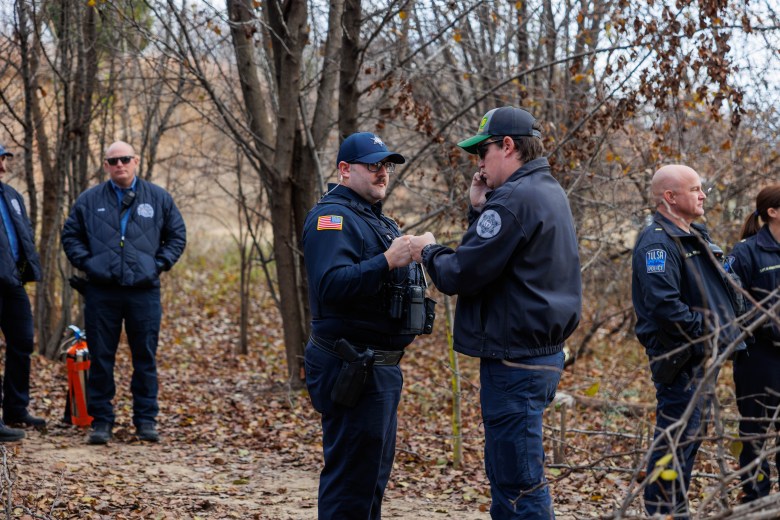
Tulsa Police Capt. Malcolm Williams says he’s married with four children. Psychologist Xavier Amador calmly explained his reality wasn’t real — and faced arrest with possible court-ordered treatment.
The ensuing conversation would be familiar to thousands of Oklahomans with a loved one or friend unaware they have a mental illness. No amount of court orders or documented proof could change Williams’ mind. He didn’t need medicine. The whole episode escalated in frustration.
Fortunately, this was a role-playing exercise during a Monday first responder training to show the view of a person with anosognosia and mental illness.
“I’m seeing things through a different perspective,” Williams said. “If I gave in to court-ordered treatment, it was only out of fear of arrest, but in my mind I’m still married with four kids. … Even though it was role play, I still had anxiety and goosebumps popping up on my arm.
“You have this aha moment: This is what these people are going through. I stress that we always treat people with compassion. By understanding, you get how this is real for them.”
Williams helps oversee the mental health unit in the Tulsa Police Department’s Special Operations Division. He first heard the term anosognosia a year ago from staff at Tulsa Day Center, the downtown homeless services organization.
Sponsored by the Maxine & Jack Zarrow Family Foundation, the training at OU-Tulsa is the first significant effort to educate first responders and social workers together on anosognosia and mental health.
“It’s not often you get all of us in the same room, training together and being able to talk,” Williams said. “We are able to build on relationships with each other. Because at the end of the day, what we’re all trying to do is make sure we get the people we encounter going through a crisis the help they need.”
Amador is an internationally recognized pioneer in linking anosognosia to mental health disorders. Anosognosia is a neurological condition that causes patients to not recognize an illness. It was first referenced in 1919 to describe patients with paralysis but didn’t realize it.
Amador applied it to mental health and developed the LEAP method: listen, empathize, agree and partner. More than 200 studies in brain research validates his approach.
This small subset of people not understanding their mental illness often end up in a delusional state and homeless on city streets or encampments. People on the schizophrenia spectrum are more prone to having anosognosia.
Amador has visited Tulsa twice previously to meet with providers at the Tulsa Day Center and Mental Health Association Oklahoma. He called it “wonderful” to see so many law enforcement and first responders at the training.
“It really takes a community to help people who have serious mental illness and don’t understand that they have a mental illness,” Amador said.
The old way was to convince people they were sick and needed treatment. The LEAP method emphasizes relationship building to influence people to choose treatment.
In Oklahoma, Amador estimates about 1,000 people fall into this category, with Tulsa having about 40 from this group.
The Tulsa Day Center formed the Blue Team four years ago based on the LEAP method to target people with anosognosia and mental illness. In its first three years, about 30 people averaging 16 years living on the streets were housed by the team of seven employees.
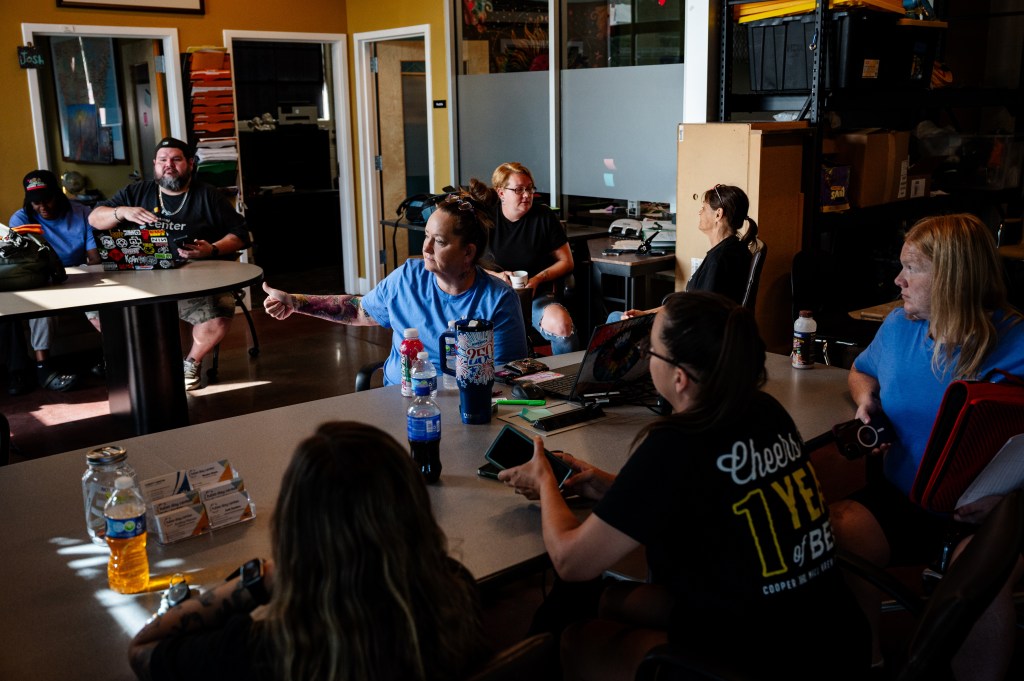
Kellie Wilson, director of the Blue Team, said 97% of them remain housed long term. She hopes the first responder training will bring a common understanding of the disorder.
“Homelessness is such a complex issue, and there is not one answer,” Wilson said. “This is something making a visible difference. We are seeing success and want to expand on it. We are seeing people get on medication and stabilize into a whole different person — the person they were meant to be.”
In attendance was Dr. Gerard Clancy, a psychiatrist and former president of the University of Tulsa and OU-Tulsa as well as dean of the OU School of Community Medicine. He is now special advisor to Mayor Monroe Nichols.
Clancy helped develop the city’s PACT (Program of Assertive Community Treatment) teams that delivered treatment to people on streets or in supportive housing. At least 75% of PACT team clients had anosognosia, he said.
“The knee-jerk response when somebody doesn’t want treatment is that they’re just resisting treatment; that it’s denial,” Clancy said. “This is a psychological factor, and they’re just playing self-defense. This is a neuro dysfunction of the brain. There’s a part of the brain not working right.”
News decisions at the Tulsa Flyer are made independently of our board members and financial supporters. Read more about our editorial independence policy here.