


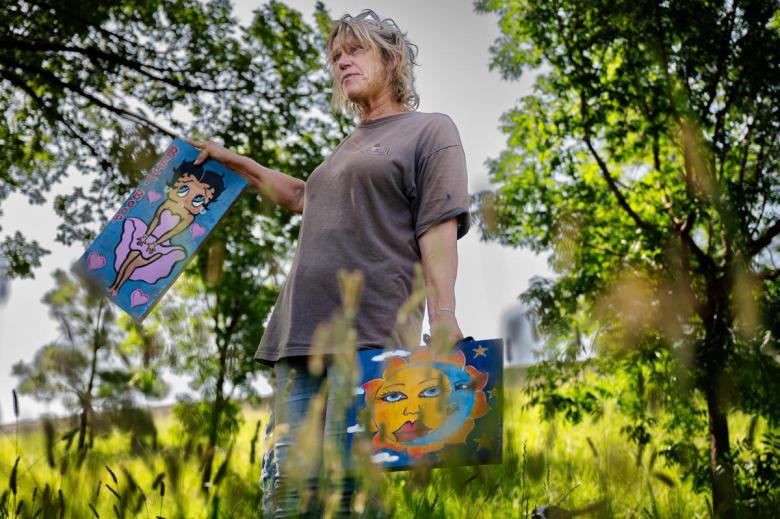
Charlotte Young had a plan on how to handle what was to be the hottest Oklahoma day in three years, reaching a heat index of 120 degrees. She’s been living on Tulsa streets for about a decade, often seen selling her art at intersections for $15.
She says cooling stations don’t allow her three dogs, so she stays put under trees by an overpass.
“You lay down and stay still. Don’t move. Let the wind move over you,” the 56-year-old said. “In the winter, I have my dogs to keep me warm.”
Tulsa’s temperature Tuesday, July 21, got to 103 degrees, pushing the limits of what a person can handle. EMSA medics responded to 20 heat-related illness calls that day and transported 13 of those patients to a hospital. Since July 1, EMSA has responded to 142 heat-related calls and taken 94 patients to hospitals for heat-related complications.
Contributed by Documenters
Tulsa Documenter Faith Harl reported on part of this story after attending the July 22 Tulsa City Council meeting. Read her meeting notes here and find out more about Tulsa Documenters here.
Weather forecasts predict extreme heat continuing this week with temperatures climbing to 100 degrees or close to that. The heat index — measuring how hot it feels to the human body by combining temperature and relative humidity — will hit between 105 to 115 degrees.
Out-of-reach cooling stations
The city has four cooling stations for Tulsans to seek safety from the heat. But all four are downtown as pointed out by at least two city councilors at the July 22 regular meeting.
District 3 Councilor Jackie Dutton, who represents northeast Tulsa, asked a representative from the mayor’s office if a station could be set up in each city quadrant.
“I did also inquire if we could stop the sweeps that are happening underneath the overpasses and provide some sort of refuse containers for individuals because it is those overpasses where they are able to escape from the severe heat,” Dutton said.
District 7 Councilor Lori Decter Wright, who represents southeast Tulsa, stressed it is not the unhoused population needing cooling places. She has received several calls from seniors who do not have working air conditioners. She suggested libraries or malls be considered as potential places.

“If I were living in an apartment where I lost my air conditioning, I’m not thinking I’m going to go downtown to the social services corridor, if I’m being honest,” Decter Wright said. “So we’ve got to think outside of the box and come up with other ideas.”
Cooling stations are open during daylight hours at John 3:16 Mission, 506 N. Cheyenne Ave.; Salvation Army Center of Hope, 102 N. Denver Ave.; and Tulsa Day Center, 415 W. Archer St. Tulsa County Social Services, 2401 Charles Page Blvd., is open 8 a.m. to 8 p.m.
Keri Fothergill, public advocate for the mayor’s office, said she would follow up on those suggestions with councilors.
Outreach doesn’t stop
Homeless outreach workers are paying close attention to weather forecasts. They are out daily searching for unhoused people to give water and ice and connect with for help.
Outreach worker Tiana Pennington saw Young move her tent to an area near Admiral and Lewis avenues the previous day. She and co-worker Blaine Denny crossed four lanes of traffic to check on her. They were welcomed.

“It’s amazing to me how someone can look forward to getting water and snack packs,” Pennington said. “It’s these little things that make a big difference.”
Tulsa’s homeless population has grown consistently during the past 15 years, prompting the first municipal investments into homeless mitigation in 2023. Previously, efforts were funded and led by nonprofits and philanthropists.
Mayor Monroe Nichols launched Safe Move Tulsa in November to more quickly de-commission encampments and get unhoused people into permanent housing. So far, at least 500 people have been moved into housing from encampments.
That is not the only homeless outreach or program operating in Tulsa, though all are working toward the same goal of ending homelessness. About 15 Tulsa Day Center outreach workers meet in the mornings to discuss specific client needs.
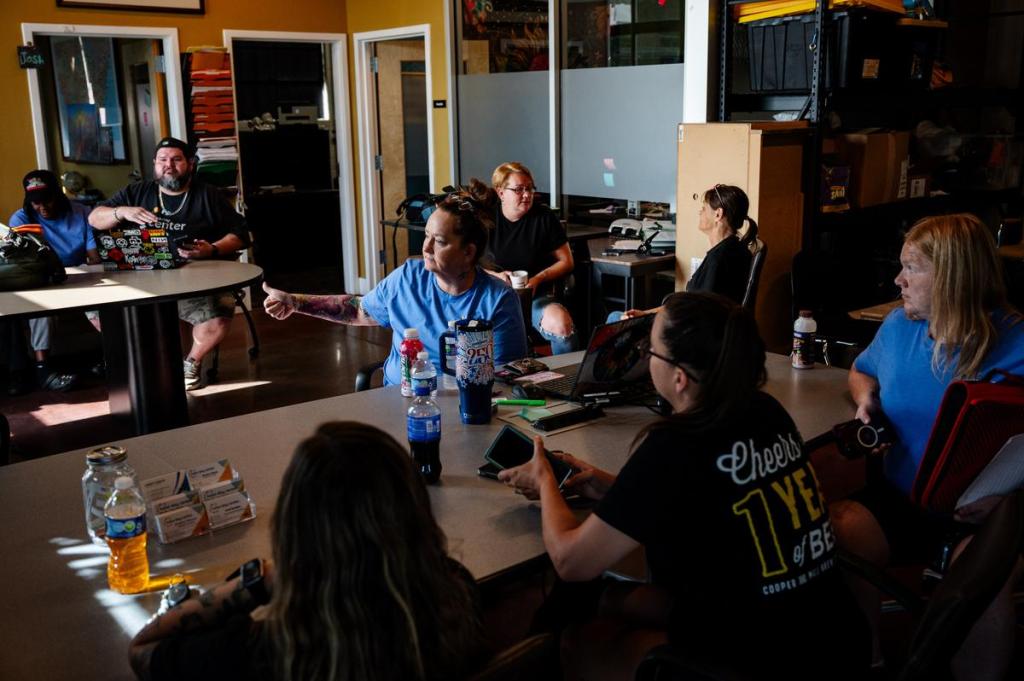
Some check on formerly unhoused people living temporarily in motel rooms. Some go to different parts of the city to make contact with people in encampments. One brought up a formerly homeless person in hospice. Another has a client facing eviction. And another has a client with bedbugs in her apartment and needing to temporarily move.
Most of the workers have what they call a “lived experience,” meaning they were once living on the streets. They know the language. They know the violence. They know what keeps a person homeless.
“A majority of homeless individuals are out there because they lose that support. They’ve lost that resource and connection,” said program manager Tara Rubio, who has been in recovery for seven years. “I don’t think I would have stayed in my addiction as long as I did if I had somebody to help me a little bit — somewhere to take a shower, somewhere to get an ID, somewhere to get a snack pack.
“A lot of our clients don’t have that one person who will show up every day, no matter what the situation is, and truly be there.”
Workers say they have more success getting people off the streets in winter storms than in extreme heat. The past few winters have opened up a low-barrier shelter outside downtown operating 24 hours a day.
“We’re going to see more people fall out, more with dehydration and heat stroke,” said outreach worker Tawny Knight.
Denny doesn’t have lived experience and works with clients showing anosognosia, a neurological disorder in which people do not realize they are ill. He says effective mitigation starts with the basics.
“We aren’t solving homelessness, we are solving the problems they have. If you ask them what they need, they will tell you. And, we have to meet their needs consistently, every day,” Denny said. “Once you get those taken care of, the housing issue will solve itself.”

Nestled between a fence and sidewalk along north Peoria Avenue is Crystal Shumake’s fence. She says “ice, water and God” are keeping her safe from the heat.
“This is the most peaceful spot,” Shumake said. “These people coming out here are really sweet and we don’t have a lot of that here. There’s a lot of hate. But we need more love, and they bring it to us.”
News decisions at the Tulsa Flyer are made independently of our board members and financial supporters. Read more about our editorial independence policy here.