


This article is a part of “Mental Health Snapshot,” a reporting collaboration between Tulsa Flyer, The Oklahoma Eagle, The Frontier, KOSU, La Semana and Focus Black Oklahoma on mental health and resources in Northeast Oklahoma.
All editorial decisions for this series are made by the participating newsrooms.
Major series support provided by: Healthy Minds Policy Initiative
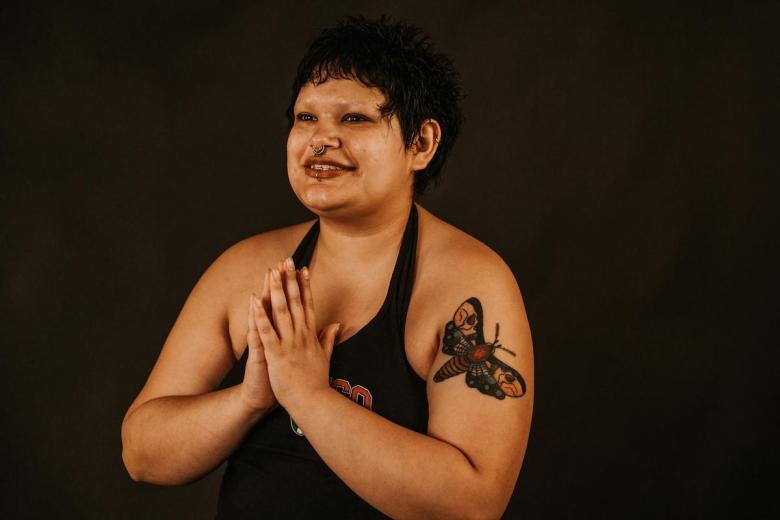
Aydra Contreras froze the last time she drove past an Oklahoma Highway Patrol car pulling over a U-Haul with Spanish words on it. She believed — without knowing or not — the troopers were trying to detain someone since the driver appeared to be pleading for their life.
She drove mindlessly for a while after. Before she realized it, she was crying.
“I could tell what was happening,” she said. “I don’t have to be a rocket scientist to know. It’s just like, those things give me anxiety. Even if that wasn’t exactly it, it still gives me anxiety.”
She immediately started thinking about the person’s family, and the situation reminded her of her father. He was deported to Mexico when she was about 2 years old.
Now, the 20-year-old Tulsan is dealing with the lifelong impact of being separated from her father — and the stress that comes from watching similar events unfold across the country.
Fears over Immigration and Customs Enforcement have increased over the last year as the Trump administration moves forward with its deportation campaign. But, for some people, the immigration system has been something they have dealt with throughout their lives.
In 2024, around 116,000 individuals living in Tulsa County identified as Hispanic or Latino, according to the U.S. Census Bureau’s American Community Survey. Roughly 60% of those are foreign-born. It’s unclear how many of those are in the country illegally.
“It’s definitely the children who are affected by it,” Contreras said. “There’s so much that can cause trauma in that, even if you’re so young like me … I still have a fear of family abandoning me.”
‘No control on what’s coming next’
Contreras said her father’s deportation is one of the reasons she’s being evaluated for a post-traumatic stress disorder diagnosis and suffers from paranoia and separation anxiety. She always feels like she’s on the edge of her seat and has to hide.
At times, she wants to freeze and not exist.
“I feel at a loss, like I have no control on what’s coming next,” she said.
Contreras still gets worried when her mother is gone for too long or doesn’t know where she’s at. In recent months, she had panic attacks two or three times in a single day.
“It’s crazy to say, but it drains the literal life out of me to have that many panic attacks in a week,” Contreras said. “It was like waking up there was a panic attack, going to bed there was a panic attack.”
She often sees videos online of children watching their parents being detained and it feels as if a weight is placed on her shoulders, she said.
“I never would have thought my life would be this kind of almost like, ‘the outside is almost a nightmare,’ that I thought when I was a child,” she said.
‘I like to forget’
Following his deportation to Mexico, her father was given a 10-year-ban. He returned to the United States when Contreras was a teenager.
“I think sometimes I like to forget that it even happened,” she said. “‘He’s here now, so let’s not even think about that ‘cause then it’s going to happen.’ I’m always like that, like if I think about it or speak about it out loud, because then it’s going to happen. That’s how much anxiety I have about this.”
She still fears for her dad, though, since he is back in the country illegally.
“He’s like literally in construction. That’s probably one of the most targeted groups of people,” she said.

Nowadays, their relationship seems to be getting better. She’s talked to him about her mental health struggles.
“I found out that a lot of it stems from his family too, that I have my mental struggles and as well as just the situation that has been brought upon me,” she said.
Separated from her culture
Contreras grew up speaking on the phone with her dad while he was away in Mexico. He often reminded her he loved her.
“But he never really knew me because he wasn’t around me that much so he doesn’t know what I like. He doesn’t know all these things,” she said.
The deportation ultimately led her parents to divorce. It also separated her from Mexican culture since her mom is white as well as a Cherokee Nation citizen.
“Growing up, me and my brother were supposed to know Spanish, but since all this has happened, like even growing up now, I get told all the time like you’re not Mexican enough,” she said.
Her family doesn’t relate to the issues she’s faced. Most of her family identifies as conservative, she said.
“My dad was deported and this exact thing that you’re going to vote for is going to make it 10 times harder than it already was,” she said.
A sense of hope
There are many ways Contreras manages her mental health. She listens to Woody Guthrie’s music and sees a psychiatrist and therapist. She enjoys makeup and crocheting to relax her nerves.
In the future, she wants to feel less like she’s in survival mode. The medication she is on is also finally starting to work. She hasn’t had a panic attack, she says, in a few weeks.
Those not impacted by the immigration system should consider the long-term mental health impacts of deportation on children, Contreras said. While she’s feeling better, she knows her anxiety will continue.
“Seeing your parent being taken away from you like that is not an easy thing to get over,” she said.
Angelica Perez is the Eastside/La Semana reporter for the Tulsa Flyer. This article was produced as part of a partnership between the Tulsa Flyer and La Semana, a Tulsa-based bilingual Spanish-English newspaper serving Latino communities in Oklahoma.
Additional series support by: Oklahoma Women in Technology