


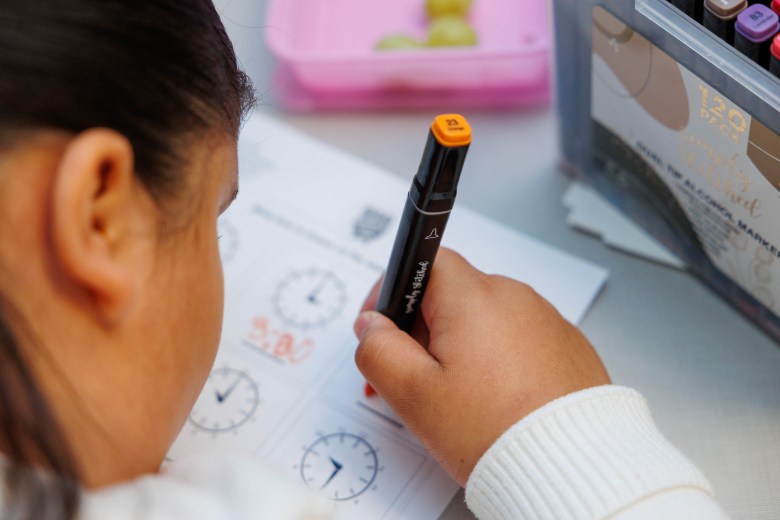
All 22 kids in Whitney Hester’s third grade class are at different learning stages — but she doesn’t mind. Now in her 18th year as a teacher, she finds joy in solving each student’s puzzle.
When the state landed at 50th in education last year, Hester pulled up the data. Oklahoma’s students experience higher rates of poverty, food insecurity and health care shortages than most other American youth — factors she believes should be at the center of turning education outcomes around.
“The children that are coming to us now look different, not because school has changed that dramatically, but because home has,” said Hester, who teaches third grade at Rosewood Elementary in Broken Arrow Public Schools. “The school is having to take on more responsibility for the community, outside of just educating children, which then draws away our resources and our focus.”
Other teachers in the Tulsa metro agree.
Michele Lee has been an Oklahoma educator for more than 30 years with a decade teaching third graders. She’s “embarrassed” by the state’s education ranking.
“You feel defensive because you pour everything into this, and then that’s what people see,” said Lee, who also teaches at Rosewood. “It’s sad for our profession.”
A lot has changed in three decades, Lee says. Attention spans have dwindled and social emotional difficulties that used to be rare are now the norm.
As the legislature turns its attention to Oklahoma’s educational outcomes this spring, educators hope lawmakers listen to voices from the classroom.
“When they go into session, they have good intentions,” said Brittni Rea, a reading specialist at Owasso’s Northeast Elementary. “However, there can often be a gap between a policy that looks beneficial on paper and its practical application in a complex classroom environment.”

Literacy intervention and third grade retention
In third grade, students transition from learning to read to reading to learn. That inflection point has drawn various statewide approaches for years. In 2011, third grade retention became law in the Reading Sufficiency Act, but the legislature repealed the policy last session.
Only 27% of Oklahoma’s third graders scored proficient or higher on state reading tests that spring. This year, several bills aim to bring it back.
“I don’t love that it is back on the table,” Rea said.
Third grade is just too late for intervention, she says, and testing expectations change the atmosphere in schools.
“Anytime we can identify a student who is struggling with our basic foundational skills that we know they’re going to need to become a strong reader for the rest of their life, I will always advocate for early intervention,” Rea said.
Hester agrees. At Rosewood, they cover 61 literacy objectives in third grade — a task that’s already “near impossible,” she says, as they fill holes from previous years but cause new ones with additional lessons.

“That’s hard to do when some of your kids are still struggling with those foundational skills,” said Wendi Rutz at Union’s Peters Elementary. “All of our kids do not learn at the same rate.”
At Peters, teachers meet monthly with a “child study team,” including the principal, a reading specialist, speech pathologist, school psychologist and special education staff to discuss student progress.
Another program, Mastery Connect, shares data with educators on a weekly collaborative schedule. Every Friday, Union educators use the platform to pinpoint skills needing intervention, then work with other district staff to get it done. Rutz, in her 31st year as an educator, says this keeps the district “a step ahead.”
Owasso uses intervention program Really Great Reading, but the district added Heggerty after teachers requested more support for phonics instruction.
“Not every district is able to do that, but also not every district is able to have that open conversation with their teachers,” Rea said.
Along with Heggerty, Broken Arrow offers increased training for teachers on the science of reading. Rosewood teachers see marked improvement from math and reading specialists and hope state support can extend those one-on-one interventions to other districts.
Several educators also want to see changes in Oklahoma’s testing system, arguing it places too much stress on students and doesn’t represent the work of teachers. Rutz would rather see the student and school success evaluated by their growth over a year.
“Our kids and our teachers would be able to celebrate those small jumps of growth instead of being deflated at the end of year,” Rutz said. “We celebrate with our kids daily when they’ve learned something — we have kids who make themselves sick to take that one test a year when they’ve been showing gains all year.”

An evolving profession
Technology plays a bigger role in the classroom today, and teachers are constantly adjusting.
Lee doesn’t want to use a smart board to keep students attention — but instruction around the carpet with physical books just won’t do it anymore. Rutz goes with the flow, designing lessons to keep students engaged and problem solving with her team.
“Technology is amazing, but it can also be a double-edged sword,” Rea said. “Learning is not an instant answer.”
Thirteen years in, Rutz became an instructional coach to help other teachers. Now she’s putting everything into practice by returning to the classroom. But she’s still helping other educators with a new program coordinating mentors for new teachers.
“I think if you help these new teachers feel comfortable, get on their feet and guide them along the way, I think the retention will help,” Rutz said.
Oklahoma has seen rising rates of emergency-certified teachers, employing more than 20,000 fast-tracked educators in the last five years. Hester urges lawmakers to see they have a heart for the work.
“You have somebody that’s chosen to be in this profession and whether they’re qualified or not, they’re here,” Hester said. “Instread of talking down to them, support them.”
Every year, Lee asks herself if it’s time to retire.
“I still have good in me, you know, but it’s not a secret. It takes a lot,” Lee said.
She thinks about leaving the classroom to advocate for teachers. But she loves Broken Arrow. She graduated there — and now she wants to end her career there.
“Community is everything,” Rea said.
Teachers need top down support for their work, she says, and the kids do too.
News decisions at the Tulsa Flyer are made independently of our board members and financial supporters. Read more about our editorial independence policy here.
