


About five years ago, Tulsan Valencia Payne inherited the house her mother lived in for more than three decades. That also was when she became fully disabled, requiring three days of dialysis weekly and a wheelchair for mobility.
“It was like a domino effect after that,” the 57-year-old said.
Her inability to work and reliance on Social Security Disability Insurance made it hard to keep up with costs of daily life and rising healthcare costs.
In 2023, a $560 property tax bill on the 1,000-square-foot home near 36th Street North and North Peoria Avenue was too much to handle. State law prohibits property tax payments be broken into installments like Payne asked. So, it just lingered.
The next year’s bill of $601 wasn’t within her budget and neither was last year’s $652. Penalties ended up averaging about $1,200 yearly. A lien was placed on her home, and the notices from the Tulsa County Treasurer’s Office kept arriving.
It takes about 3.5 years of 17 different property tax nonpayment notices to lead to the property being sold at auction. Time was up for Payne this year.
“It’s not that I ignored the notices, they just had me shaking in my boots,” Payne said. “I didn’t know what to do. It was too overwhelming. I couldn’t wrap my mind around being homeless and dealing with everything. I thought, ‘My God, the end is coming.’”
“I tried to mentally prepare for it, but without sounding too morbid, I really just figured I would give up. I would just stop going to dialysis and call it quits.”
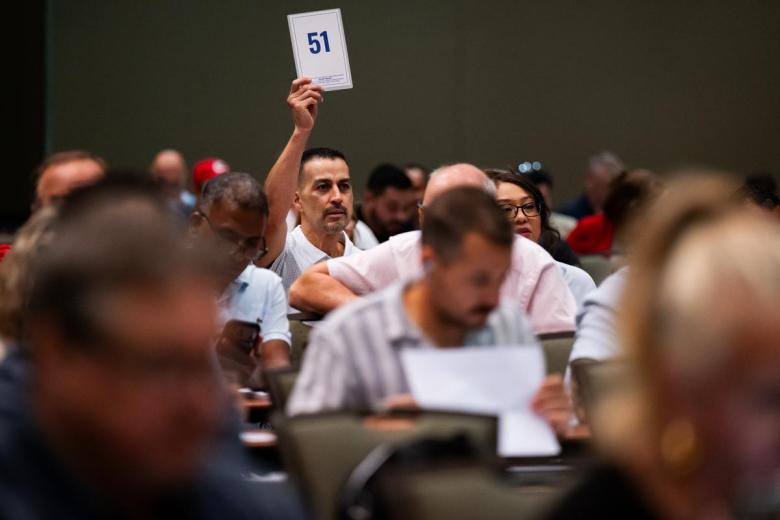
Payne’s home was set for sale at the annual Tulsa County Treasurer’s Office auction held Monday. She attempted to get a home equity loan but was denied. She called to plead her case and again see about payment options.
That’s when the county treasurer’s staff realized Payne’s situation was the first they had encountered.
Tulsa County Treasurer John Fothergill says a small change in Oklahoma law could save her — and others — from homelessness.
“The county has to have a hammer like the auction, otherwise no one would pay their taxes,” Fothergill said. “But at the end of the day, I’m human, too. This is a sad story. You can’t save everybody but you can save a few.”

The limits of Oklahoma law
Oklahoma law allows for an exemption to the sale of property due to delinquent taxes. On average, 50 Tulsa County residents receive an exemption.
This doesn’t mean they won’t owe taxes. It only means their property won’t be forced into an auction. The lien on the property means the taxes owed will be recouped from its sale or from the estate when the homeowner dies. The other way to be removed from the auction list is to pay off the owed taxes and penalties.
To qualify for the exemption, the property must be a single-family home not used as a rental and with a fair market value under $180,000. The owner must also be 65 or fully disabled with an annual income not to exceed federal poverty guidelines.
Historically, the federal poverty guidelines — adjusted annually based on inflation and other factors — aligned closely with Social Security Disability Insurance levels. People living exclusively on SSDI qualified for the Oklahoma property auction exemption.
In April 2025, the Trump administration eliminated the office within the U.S. Health and Human Services Administration that updated federal poverty guidelines by laying off 70% of its staff and merging it with another department, which also lost 70% of employees. Those guidelines determine various benefits for about 80 million Americans.
The current guidelines set the poverty level at $15,960 a year for one person. Payne, who used to work as a corporate travel agent, receives about $22,000 from SSDI as her sole income. Because she is not 65 and over the poverty level, she didn’t qualify for an auction exemption.
“This is the first time our office has run into this specific situation, where a medically disabled person met everything else in the eligibility but didn’t meet the income threshold,” Fothergill said.
Fothergill would like state lawmakers to amend the law to help Oklahomans in similar positions.
The law currently sets eligibility for an auction exemption for people with income that “cannot exceed” the federal poverty guidelines. Fothergill proposes a change to “cannot exceed 1.5 times” the poverty guidelines if disabled. That would bring the poverty level for one person to $23,460 annually.
If lawmakers update that language in the next year and add an emergency clause, it could go into effect by June 1, 2027. That would save Payne’s home from auction later that year.
“If someone is on SSI disability and they have a house they can stay in, let’s keep them there as long as we can,” Fothergill said.
“I don’t know each individual situation, but if someone is on SSDI disability, the last thing I want to do is kick her out of her house. What is she going to do? Where is she going to go?”

Still awaiting policy change
Tulsans started sharing Payne’s story by word-of-mouth. It reached Tulsa resident Shelley Cadamy, who started a now-closed online fundraiser to pay a year’s worth of taxes to keep Payne from homelessness.
The pair didn’t know each other until they met at the treasurer’s office to pay the bill just days before the auction.
“The law needs to be changed to help people like Valencia,” Cadamy said. “Oklahomans are generous, and I was happy to help her out. But policy drives everything. With a tweak in the law, we can prevent people like her from losing her home. Public policy drives everything in our communities.”
Delinquent property taxpayers don’t have many options for relief.
Some nonprofits during the pandemic used federal relief funds to help with rent payments, tax assistance and other housing costs to keep people from homelessness. That funding has now run dry.
After Payne’s address appeared on the tax delinquency list, she noticed more cars driving by her house — seemingly to check out the property they could buy soon.
“You’d think there would be help out there,” Payne said. “It’s an embarrassing situation to begin with and then you have people coming by to size you up. Some were taking pictures of my house thinking that’s an option for them. ”
With a year of taxes paid, Payne still owes $2,200 to get caught up. If the law isn’t changed by 2027, her home will be back on the auction block.
The house means more to Payne than just shelter. It’s a memory of dinners, celebrations and conversations with her parents. With a grown son and two grandchildren, she wants that home to be in their memories of her.
“I wanted to keep something in the family that the grandchildren can look at and see a connection to their past,” Payne said.
News decisions at the Tulsa Flyer are made independently of our board members and financial supporters. Read more about our editorial independence policy here.