


Emily Wade’s calling as a special education teacher came early.
Wade met Jessica, an 18-month-old with Down syndrome, while working at a day care in high school. She soon became Jessica’s babysitter, spending hours caring for her — even helping her learn to walk. At 17 years old, Wade knew she wanted to work with people with disabilities.
“It is a very rewarding job,” Wade said. “The things that we celebrate are little, but they are so worth the celebration.”
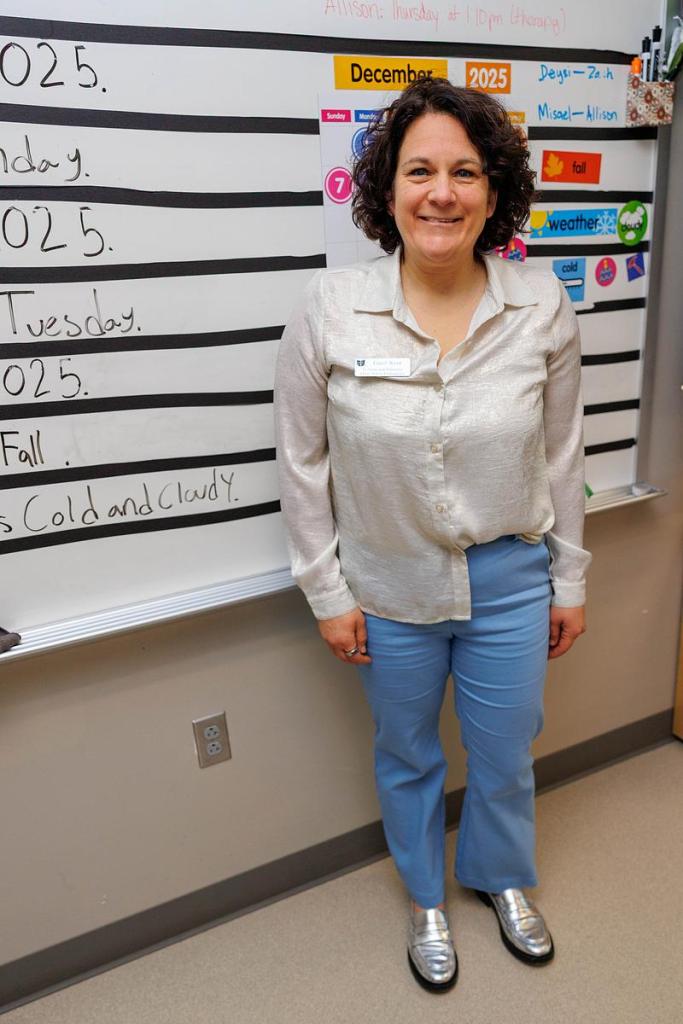
Wade is Ellen Ochoa Elementary’s Teacher of the Year, one of four special education teachers honored across Union Public Schools for the 2025-2026 school year. She’s taught in the district for more than two decades.
“We are in an era right now, particularly within the state and I think on a national level, where teachers don’t stay in the classroom very, very long,” said Lindsay Smith, executive director of special services at Union. “Veteran teachers matter, and they matter a whole lot.”
Wade started her Union career teaching students with high support needs at Anderson Elementary but shifted when Parks Elementary opened. There, she spent 15 years teaching students with lower support needs.
Then the pandemic hit and enrollment dropped. Union needed a special education teacher to move buildings. Wade took a chance and made the move, seeing it as an “opportunity to try something new” while also returning to students with high support needs.
“The first two years were a challenge,” she says, but the third was “beautiful.”
She now has a new goal: deepening inclusion for her students.
Last year Wade started a chapter of Unified Champions at Ellen Ochoa, a Special Olympics after-school program that pairs special and general education students together for athletic activities.
She’s part of a districtwide effort to increase Special Olympics participation, growing the Ellen Ochoa team to 75 students. They hope 100 students will participate in 2026.
Classroom wins through individualized teaching
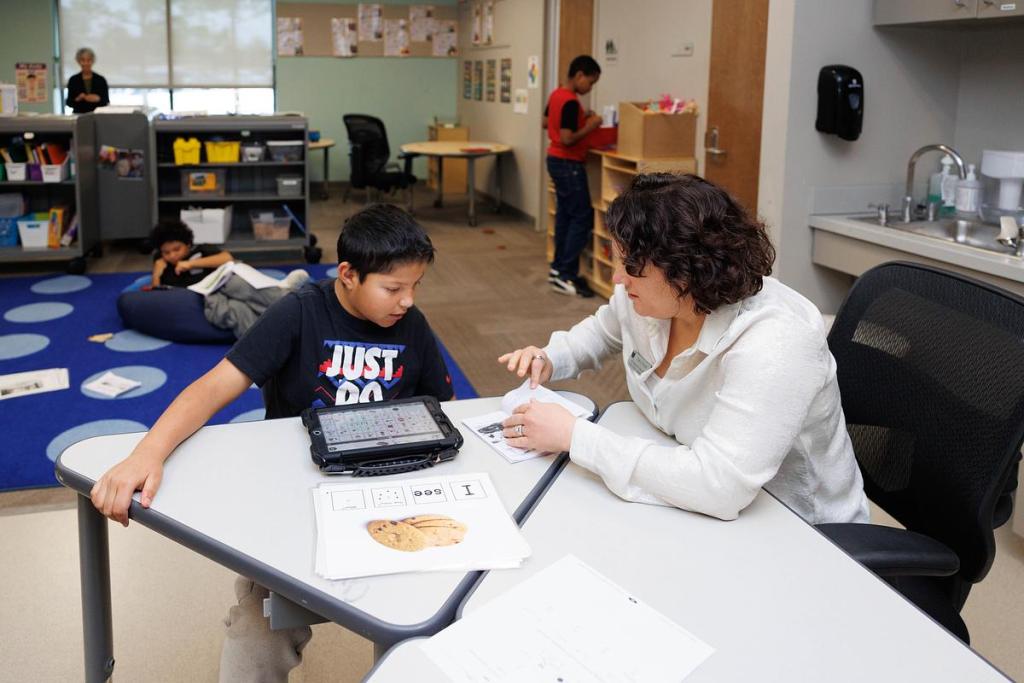
Wade is teaching 10 students with high levels of need this year alongside paraprofessionals Alexia Eastham and Judith Bailey. The trio moves nonstop between tasks and students, managing four different student schedules, scrupulously planned in five-minute increments.
“Even though they’re all fourth and fifth graders, they’re all over the place,” Wade said. “It takes a lot of trial and error, I have a toolbook and if one thing doesn’t work, then I pull another one — you have to think on your feet.”
While many of her students learn with individualized lesson plans, the cycle of work follows a similar structure for all. Students must complete three tasks to receive three stars before they’re rewarded with a break and an activity they enjoy, like coloring or building with Legos.
As they move from task to task, there’s still an emphasis on autonomy. Wade offers them choices: “work or play,” “table or floor,” “coloring or tracing,” “numbers or nouns?”
She’s quick to get on a student’s level. After completing a noun recognition exercise, one student is rewarded with a weighted blanket and beanbag. Wade is on the floor too, playing with him.
As another student returns from a general education classroom feeling overwhelmed, Wade jumps in. He’s soothed by timers, and she helps him put five minutes on the clock for him to adjust. Before it’s up, he’s already calmed down.
It’s about giving students confidence and control, especially for those who will likely need supportive services throughout their lives.
Her approach makes a substantial impact. One of this year’s students was nonverbal when he started in Wade’s class. Now he’s reading aloud, even if he’s a little shy. Another just finished her first chapter book last month, dutifully sounding out words and demonstrating clear comprehension skills. Wade hopes that student will be placed in a less restrictive environment next year with more interaction with general education classes.


Simultaneously, Wade collects data. She keeps a daily tally of one student’s cursing habit with a small tracker on her finger. He went from 72 times by 9 a.m. one day to 20 the next — a marked improvement.
The beginning of the year is toughest, Wade says. Not only does she receive an influx of new students, but those she’s worked with for two to three years often “regress” over the summer. It takes weeks to get the system up, running and working well for each student.
“To teach a child with disabilities and sometimes complex medical needs, that parent and teacher trust has to be so high,” said Smith.
Smith now supervises all of Union’s special education programming but worked alongside Wade when Smith was early in her teaching career. Then and now, Smith said, Wade’s close contact and collaboration with families sets her apart. Wade regularly texts and calls parents throughout each day to share updates or brainstorm ways to help their child.
“She can build that trusting relationship,” Smith said. “I know that her parents feel 100% confident in her and comforted when their child gets to go into her class, go into her classroom.”
Growing challenges in special education
Even with support and competitive pay at Union — the district’s special education teachers are paid 10% higher salaries than general education teachers — Wade says there’s still room for the district to grow.
Her students don’t learn to read, write or communicate the same way others do, forcing Wade to constantly adapt with resources she doesn’t always have. Her specialty tools include personalized story books for students, allowing them to face their behaviors and learn to self-soothe.
“Having everything at my fingertips would probably come before more personnel,” she said. “But that’s a very close second.”
Wade says behavior issues are also rapidly worsening as teachers face a persistent shortage of staffing and materials.
“It’s getting more and more challenging,” she said, but she’s not deterred. “I like a challenge.”
The Union Teachers of the Year will be publicly announced and celebrated Jan. 16.
News decisions at the Tulsa Flyer are made independently of our board members and financial supporters. Read more about our editorial independence policy here.
