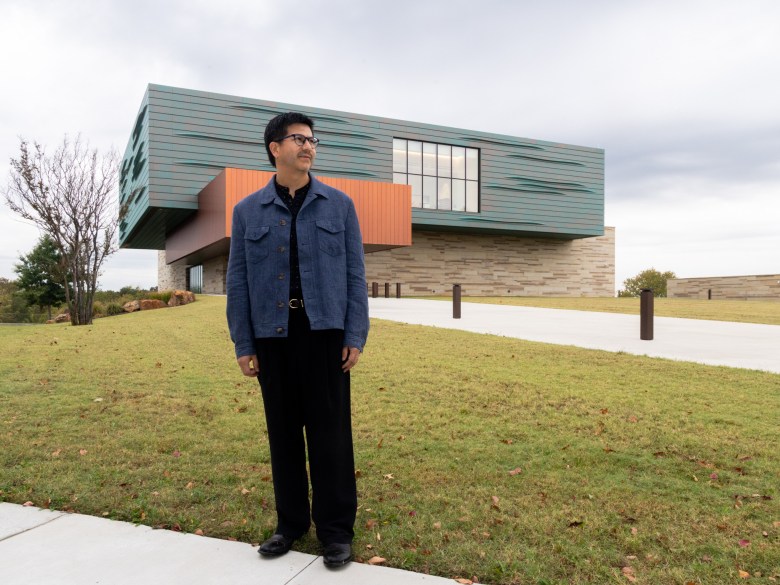
Alejandro Garay Celeita didn’t feel a connection with any piece of art during his first trip to a museum. There were no reflections of his home country of Colombia – not even a photo of the Andes.
“That was a shock for me,” he said in Spanish.
That was during his second year of university when a class required students to visit a museum and find an artwork that spoke to them and then research it.
That experience led him to his new position as Gilcrease Museum’s inaugural assistant Latin American curator ahead of the museum’s March reopening. In his role, his goals are to help expand representation for Oklahoma’s Latino community, grow Gilcrease’s presence as a Latin American collector and expand its collection.
“Unfortunately, in the history of museums they were not as open and only represented certain communities or certain themes, but I believe in the last 20 years that’s changed a lot,” Garay Celeita said. “I believe Gilcrease, especially, is attentive, and now with me here, we’re very attentive to what we can present, represent and, above all, listen to Latino voices.”
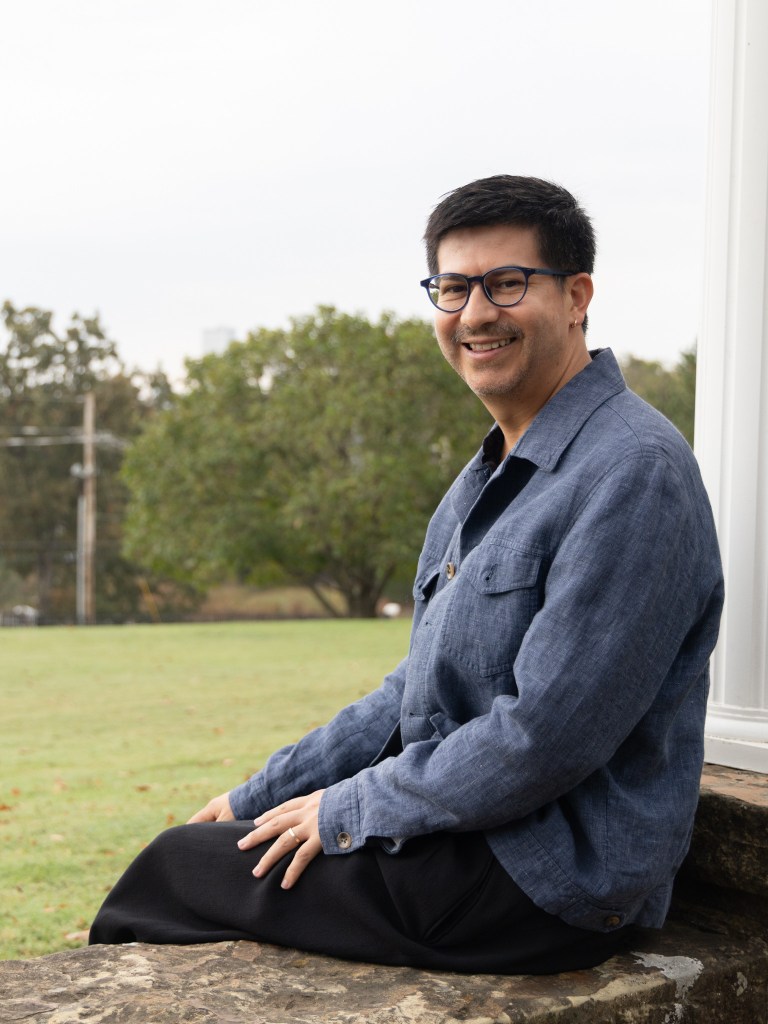
Gilcrease Museum will introduce Garay Celeita Nov. 12 at 101 E. Archer with a discussion about his book, “Constelaciones Visuales,” starting at 7 p.m. The book explores how 19th century foreign travelers helped shape images and ideas of Colombia. Register for the Spanish-friendly program here.
“I want to present my book almost as an example of how I’m going to continue my work as a researcher and as a curator here in the Gilcrease,” he said. “I think because my book focuses especially on representation of Indigenous and Afro-Latinos, I’m gonna create these connections within the collection here, but also with my initiatives to include more voices in the future.”
The museum wants area Latino communities to be more involved and bring in more local and non-local contemporary Latino artists, he said.
“One of the goals of the museum itself is to be transformed by the voices of the community and to listen and to change and to open new exhibitions that reflect the diversity and reflect the complexities, of course, of the histories in Tulsa and in the region,” he said.
Bruce Willis, director of The University of Tulsa’s Oklahoma Center for the Humanities, will moderate the conversation. The center is an academic and public program and explores “what it means to be human,” individually and collectively.
For a long time, no one knew about the museum’s large Latin American collection, Willis said.
The collection includes 125 rare manuscripts, archival materials and works of art connected to the history of Latin America and the broader Americas. A core part of the collection came to Gilcrease in 1956 from the library of George Robert Graham Conway, according to a presentation Garay Celeita gave in October to the Greater Tulsa Area Hispanic/Latinx Affairs Commission.
The museum has inquisition records, trials of enslaved and Indigenous persons, Cortés family suits and documents, royal correspondence and more.
“It’s impressive, and it’s great that it’s now more widely understood that they have that collection,” Willis said. “And a big part of that is going to be having someone who can advocate for getting the word out about it.”
Gilcrease wants to position itself as a leader in the region when it comes to Latin America, Garay Celeita said. One of his objectives is to research more of the collection, while also making connections between South, Central and North America and bringing conversations into the mix.
“We are going to do, I think, many projects that reflect how we can connect the archival, the paintings, the collection within the community, too,” he said.
Garay Celeita recently moved to Tulsa from California, where he was completing his Ph.D. program. He migrated to the U.S. nine years ago from Brazil but was raised in Colombia.
He’s been tasked with listening to the community’s wants and needs. Garay Celeita started with immersing himself in the community, with activities ranging from visiting different neighborhoods and markets to presenting at the Greater Tulsa Area Hispanic/Latinx Affairs Commission. It’s been a positive experience for him and his future initiatives, he said.
But seeing fewer Latinos in some areas of the city surprised him since it’s different from California, he said.
“I’m so happy sometimes to hear Spanish. In California, it’s more normal, but sometimes here not so much, but when I’m in the supermarket and you hear the Spanish and the different accents in Spanish, I feel so at home,” he said.
Garay Celeita is curious to know more about the history of Latinos in Tulsa and potentially create an exhibit out of it, he said.
“I’m really, really engaged with the idea that the best exhibition has to be with voices that come from the communities,” he said. “And we need to tell more stories of our communities.”
This article was produced as part of a partnership between the Tulsa Flyer and La Semana, a Tulsa-based bilingual Spanish-English newspaper serving Latino communities in Oklahoma.
News decisions at the Tulsa Flyer are made independently of our board members and financial supporters. Read more about our editorial independence policy here.