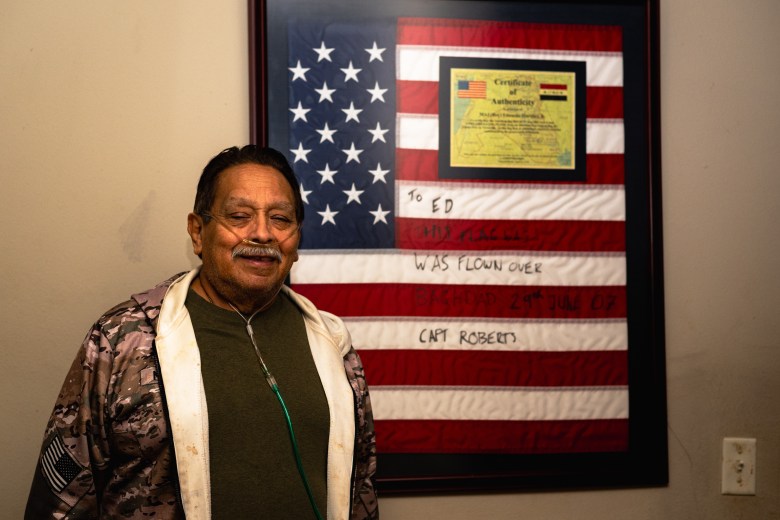
Eduardo “Ed” Martinez, 76, still remembers Feb. 23, 1991, as clearly as if it was yesterday. It was the day he led his soldiers into a battle that would later be known as the Persian Gulf War.
He was an infantry officer, nearly two decades into his career and in charge of 6,000 soldiers, many of them half his age. His unit was one of the first to come into contact with Iraqi troops. It took them 50 hours to get to the point of contact, and every nine hours they would have to stop for gas. With only 30 minute increments of sleep at each stop, he led them into battle.
“But once we got to battle, I didn’t want to sleep anymore,” he said in Spanish. “I was prepared. We fought for about 30 hours. We fought against Iraq forces.”
The Persian Gulf War, also known as Operation Desert Storm or the First Gulf War, began in 1991, after Iraq President Saddam Hussein had ordered the invasion and occupation of neighboring Kuwait in August 1990. Saudi Arabia and Egypt called for intervention from the United Nations Security Council.
Martinez recalled his scouts calling him at one point and telling him they had found four Iraqi tanks.
“Don’t ask me for permission,” he told them. “If you see someone and you know them as an enemy, shoot at them. At that moment, I heard POM! POM! POM! POM!”
His unit killed about 3,000 soldiers in battle. In the days that followed, Martinez said, the smell of dead bodies was terrible.
“But we had an obligation to treat them well and bury them and mark where they were for when their people came, they could find their bodies,” he said.
After 42 days, U.S. President George H.W. Bush declared a cease-fire on Feb. 28, ending the war. An estimated 8,000 to 10,000 Iraqi forces had been killed, with 300 U.S.-led coalition troops killed.
Of those 300, 15 were in Martinez’s infantry.

“Even if it wasn’t a lot, for me it was a lot,” he said with emotion. “I didn’t want to lose not even one soldier. Two of those soldiers were young: 21 years old, 22 years old. … It’s really sad to me.”
He thinks about them constantly. Until recently, he would visit the Arkansas gravesite of one of the soldiers. Veterans Day often brings back memories he said he hasn’t even shared with his own children. He said it’s not because he’s not proud of his service, but the effects of the war still haunt him.
Martinez was awarded a Bronze Star for his service as an operations officer from Jan. 17 to March 4, 1991.
Nowadays, the wounds of the war have caught up to him. Martinez stays in his Bixby home, recovering from a surgery and relying on an oxygen tank to help him breathe.
Martinez was exposed to low-levels of sarin and cyclosarin nerve gas chemicals after the destruction of an Iraqi storage complex during the Gulf War. He was one of 100,000 soldiers affected, according to a study by the National Library of Medicine.
“I didn’t feel anything until recently,” he said. “When I applied for veteran’s assistance, they told me that I was classified as a person with disabilities. What I breathed in damaged my heart, my lungs and my liver, and that chemical is eating me.”
The chemical is affecting his lungs the most. The amount of oxygen he needs to survive doubled in the last year.
“It’s getting worse,” he said, tearing up. “When God wants, I’ll die, but I’ve had a very good life.”
His father, who also served in the military, always told him it was an obligation for him to serve his country.
“When I was young, I wanted to be just like him,” he said.
The military is close to Martinez’s heart, but he doesn’t agree with the Trump administration’s decisions.
“He started a war that he never should’ve started,” he said of the current war with Iran. “Because he didn’t have a complete plan, he never presented a reason for why we were going to war and how they were going to do it.”
Martinez voted for Trump before his first administration because he believed that Trump, who was a businessman, could help. That changed with the administration’s immigration enforcement across the country, along with the president calling immigrants “drug dealers” and his plans to build a border wall, he said.
Immigrants have improved Tulsa in various ways, he said, including work in construction and in restaurants and through creating their own businesses.
“I hope what happened (Nov. 3) happens more and more,” Martinez said, referring to the midterm election results across the country. “I would want to stay alive to be able to see that great success, but we’ll see what God wants me to do.”
After 20 years in the Army, Martinez retired shortly after the war. He moved from Fort Leavenworth, Kansas, in the mid-1990s to become the first Mexican American to open a State Farm insurance branch in midtown Tulsa.
“Here in Tulsa, when I moved here there was nothing,” he recalled.
Throughout the first decade of living in Tulsa, he saw the Hispanic and Latino population continuously grow. He was part of the group that created the first Hispanic Chamber of Commerce and helped establish the Community Health Connection.
He retired at 66. People feared that he wouldn’t be able to drive anymore because of his age, he said.
“I wouldn’t have left,” he said. “You know, a Mexican never retires. He dies. He retires the day before his death, and then he dies. We don’t retire.”
He still has some energy left in him. He’s always dreamed of opening a cantina, similar to a bar, where his friends, family and neighbors could gather – “where people can come, drink and chat and possibly even eat snacks,” he said.
His commitment to the community isn’t done, either.
“I still want to find people who can run for city, county or state (offices),” he said. “The only way we can win is if we have selected people who can help us, and that’s what I want to do. I’m going to focus on that.”
This article was produced as part of a partnership between the Tulsa Flyer and La Semana, a Tulsa-based bilingual Spanish-English newspaper serving Latino communities in Oklahoma.
News decisions at the Tulsa Flyer are made independently of our board members and financial supporters. Read more about our editorial independence policy here.