

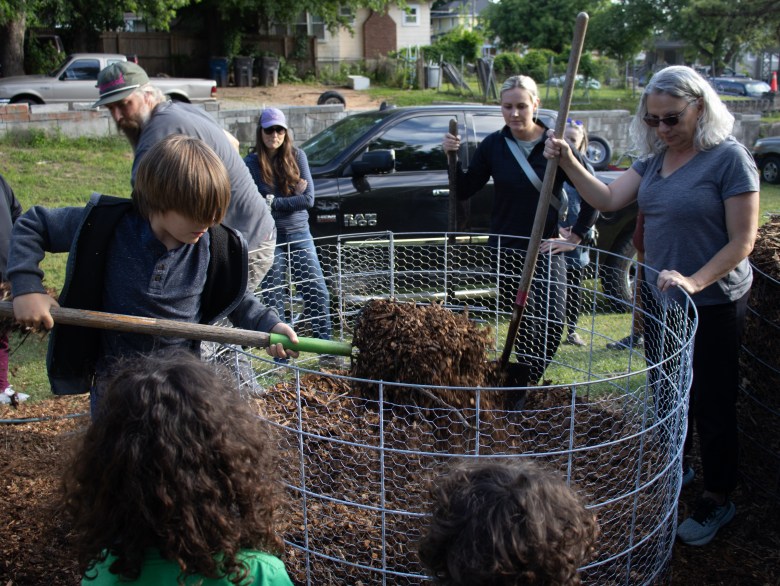
Tulsa will host the Oklahoma Compost Conference for the first time Nov. 5 in what local advocates are calling a major milestone toward creating a more sustainable city.
Ali Kalenak, the education outreach manager at the Tulsa-based Metropolitan Environmental Trust, is a long-time attendee. She expressed her excitement about the conference coming to the Chandler Park Community Center since Tulsa has “traditionally been behind Oklahoma City” in the composting scene.

Kalenak isn’t the only one excited. This will be the 12th annual conference put on by the Oklahoma Compost and Sustainability Association — and, according to board president Amanda Scofield, this is the first time the conference had to increase their attendee limit because seats sold out weeks prior.
The full-day conference is packed with educational topics and discussions. Workshops feature emerging compost technologies, such as municipal waste sludge composting, mushroom inoculation, and a collaboration panel with tribal Environmental Protection Agency managers. Local businesses and partners are also contributing food, utensils, recycling and composting to make the conference a zero-waste event.
Scofield said the conference historically is geared toward industry interest, but anyone is welcome to attend. They also hold workshops throughout the year that are more geared toward the backyard composter. So far, these workshops have been held in OKC.
James Taylor, an OCASA board member as well as the founder of SCRAPS Community Composting and The Heights community garden, helped bring the conference to Tulsa.
OCASA currently exists as a resource for all of Oklahoma, though their training and workshops have predominately occurred in Oklahoma City.
Holding the conference in Tulsa is a testament to their growth, Scofield said, and one of their goals is to continue expanding their programming across the state. She believes in “spreading the compost gospel across the state and connecting (the) compost community.”
How to get involved
OCASA wants to fill vacancies within its board of directors as well as their working committees. Individuals and entities can also become a member for a small fee. Members receive exclusive benefits and early access to all workshop, training, conference, and festival registration. Plus, every member gets a cubic yard of compost they can pick up for free.
Food waste composting faces barriers in Oklahoma
The City of Tulsa Mulch Site offers land waste composting services to residents, including tree branches, grass clippings and leaves. There are also two commercial composters, Gem Dirt and Organic Recyclers, that accept land waste.
Currently, SCRAPS is the only option that accepts food waste composting in Tulsa — but not because Tulsans refuse to compost their food. Until recent years, it was difficult for noncommercial operations to receive state permitting.
“The (Department of Environmental Quality) had commercial waste classified in a way where if it came from a commercial kitchen, then it had to go to a commercial permitted composting site,” Taylor said.
The strict permitting process led to previous composting operations, like Full Sun Composting, to close their doors. While there are options for land waste, Tulsa still does not have a commercial food waste composter.
Within the last few years, the Oklahoma Compost and Sustainability Association successfully advocated to update state rules on community-level composting, Scofield said. The association pushed to create a small-scale permit exemption, or operations under 100 tons or 200 cubic yards, for community composting.
With the changes, small-scale composters can accept food waste from restaurants and commercial kitchens.
Tulsa has held other zero-waste events by utilizing these small-scale composters. That included the Billie Eilish concert at the BOK Center back in 2025.
The scale of the food waste issue
The Environmental Protection Agency estimates 66 million tons of food waste is generated annually, according to 2019 data. About 60% of that waste is sent to landfills. When food decomposes in a landfill, its nutrients never return to the soil and are responsible for nearly 60% of landfill methane emissions.
Composting returns food to its natural decomposition cycle and can help extend the life of municipal landfills by diverting waste, among other benefits cited by the EPA.
Potential benefits for pocketbooks
Many members of the Oklahoma Composting and Sustainability Association look toward Kansas City, Austin and Fort Worth for their community gardens and municipal programs as examples. Fort Worth, for example, launched a residential composting program that works directly with local community gardens. Austin collects a food waste bin with trash and recycling in their municipal composting program.
While Tulsa has a municipal facility for composting yard waste, there aren’t many options for food waste.
City-wide food composting efforts could financially benefit Tulsa residents, according to Kalenak of the Metropolitan Environmental Trust. Keeping food waste out of the trash reduces the trash processing fee that hits people’s wallets, she said.
“The city has to pay the trash processor every year … to dispose of how much waste we dispose of, so if it can be less, then the city pays less, then (residents’) rates don’t increase as much,” she said.
For a municipal composting program to exist, there would need to be public interest, plus a facility large enough to support it. Contamination is another real concern — which is currently the largest challenge for the city’s recycling program.
“If you want to see compost happen on a larger scale, then we need to be talking to our representatives, city council, legislators … and telling them this is what we want,” Scofield said.

Options available to Tulsans
Tulsa residents can sign up with SCRAPS to receive a compost bucket and pick-up services for a suggested monthly donation of $25. Beyond Tulsa, there is GROwasso, a volunteer-run initiative where Owasso residents can drop off scraps that are then used for community gardens.
You can also begin composting right at home, if you have the space and resources. Several local institutions provide composting guides, education, and training.
The Metropolitan Environmental Trust provides educational resources and a beginner-friendly composting guide. The Oklahoma Recycling Association also provides guides and additional resources.
You can also find a database of factsheets on composting, fertilizing and mulching at OSU Extension. Through OSU Extension, Tulsa Master Gardeners provides resources to backyard composting, a guide to vermicomposting and a survey to find out which method is best for you.
If you want to go beyond the guides and get your hands dirty, Tulsa Master Gardeners provides an eight-week Master Composter Training program.
News decisions at the Tulsa Flyer are made independently of our board members and financial supporters. Read more about our editorial independence policy here.