


Throughout a career that spanned more than 50 years, Tulsa artist Otto Duecker pursued a single goal — to find the extraordinary in the ordinary.
Duecker, who died Jan. 23 at the age of 77, would often focus his penetrating gaze on people and objects that most people at best took for granted and at worst simply ignored.
His paintings might be of a stick of wood and a length of twine against a cloud-dappled blue sky; of a grizzled, portly fellow squatting on a box, a sandwich cookie in his hand; of a love note scrawled on a crumpled piece of paper, then taped to a wall; of an ashtray holding a smoldering cigarette setting atop a TV set tuned to a cartoon; of a well-worn trench coat hanging limply from a peg, or a finely pressed tuxedo, highlighted by the gleaming textures of its silk accents.
Duecker’s life and work is being celebrated with two exhibits, one at Tulsa’s M.A. Doran Gallery and the other at the Oklahoma State University Museum of Art in Stillwater.
More than 130 images drawn from about 20 collections make up the OSU exhibit, “Look Again: Encountering the Art of Otto Duecker,” which runs through Jan. 23, 2027.
The M.A. Doran Gallery titled its exhibit “Otto Duecker: Illusions with Paint,” which consists of 36 images, most of them from the artist’s own collection. The exhibit is on display through Nov. 7.
Both locations have particular meaning for Duecker and his work. Duecker, a native of Wisconsin whose family ultimately settled in Tulsa when he was a youngster, earned his Bachelor of Arts in Arts Education from OSU in 1970. He began showing and selling his work through Doran’s gallery in the early 1980s.
“Otto was one of the first artists I featured,” said Doran, who at the time was operating the Arts Signature Gallery at the Tulsa Performing Arts Center. “I wanted to showcase local talent, and Otto was an obvious choice, because his work was already well-known around the country.”

What had earned Duecker national attention was the series paintings of what he called “Independent Men,” slightly larger-than-lifesize images depicting individuals Duecker would see and photograph on city streets.
These paintings were done on masonite board, which Duecker would cut so the experience was like encountering these people in the flesh.
“From the start of his career, Otto wanted to put the emphasis entirely on the subject,” said Kirsten Olds, director of OSU Museum of Art and an OSU arts professor who curated the exhibit. “He said he was never all that interested in what was in the background of an image.
“The exhibit starts with one of his earliest paintings, which is at the entrance to the gallery here,” Olds said. “It’s called ‘My Wife, My Car and My Chair,’ and all those elements are there, but you can see how he was fascinated with capturing the textures of an item of clothing, or how light reflects and refracts off a surface.”
Duecker taught art at Tulsa’s Edison High School until 1982, when his wife Ellen convinced him to devote himself full-time to his art. Duecker described his work routine in a Tulsa World interview as “from 8:30 to 6:30, six days a week, and I’ll try to put in another five or six hours on Sunday if I don’t play golf or something.”
“Otto had a truly incredible work ethic,” Olds said “One of his paintings could take him between 100 and 200 hours to complete. And yet, he was extremely prolific, which is why there is such an incredible body of work from which we could draw for this exhibit.”
Duecker would often work in series; among the subjects he used for his cut-out paintings were people at their jobs — maids, waiters, chefs, even a violinist (an image familiar to visitors to the Tulsa PAC since the facility purchased in 1989).
One series, “Intruders,” depicts often masked and always armed figure, designed to look as if they are just coming around a corner and ready to inflict some kind of harm.
“I remember coming to the gallery each morning of that first show of Otto’s and always being startled,” Doran said, with a rueful laugh. “It was one of his ‘Intruder’ series, and it always gave me a shock, because it was so life-like.”
For the “Intruder” series, Duecker did not use men featured in the “Independent Men” series as models but instead chose “respectable” individuals to portray these threatening figures, according to Olds. Those included Pulitzer Prize winner and former U.S. Poet Laureate Mark Strand, one of the few “Intruders” who is unmasked.
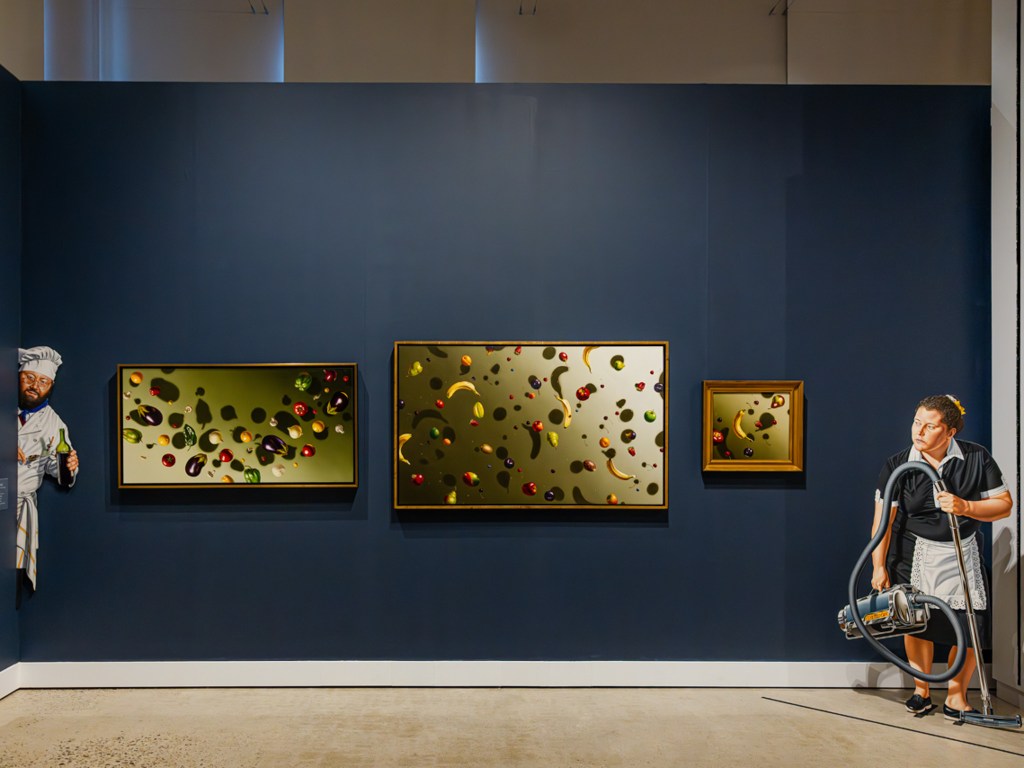
In 1991, Duecker debuted what would become another signature series, known as “Floating Fruit.” The first such painting — seven Granny Smith apples that look otherwise be captured on canvas after being tossed in the air — was shown as part of the Tulsa Invitational Gallery at Mayfest that year.
“I always get a kick out of listening to people in galleries, looking at these paintings and trying to figure out how they were done,” Duecker said in a 1993 interview with the Tulsa World. “They imagine that I have 50 pieces of fruit, hanging by invisible wires from the ceiling, all of them arranged just so, and I work like that.”
Olds noted viewers still marvel at these images, trying to determine, for example, which shadow goes with which piece of fruit.
Other series include a collection of trompe l’oeil paintings of photographs, handwritten notes and other items taped to walls; still-life paintings that combine exacting beauty with a puckish sense of humor; and what is known as the “Nature Bound” series — paintings of sticks and twine that, like a number of Duecker’s images, involve elements of collage.
“For example, one painting has actual twine attached to the sides of the image, but the twine that stretches across the surface of the painting is painted — and it’s very difficult to tell where the ‘real’ string ends and the ‘painted’ string begins,” Olds said.
“There is always so much going on in one of Otto’s paintings,” she said. “And it will reveal itself to you if you pay attention. That’s why we titled the exhibit ‘Look Again’ — as incredible as the surface of these images are, there is so much more to be found.”
As for Duecker’s own philosophy about his work, he described it in that 1993 interview with the Tulsa World.
“For 15 years or so, I was trying to make statements with my work,” he said. “Then I came across a quote by (the 17th century artist Nicolas) Poussin: ‘Art’s sole purpose is to delight.’ And I realized that you don’t have to be embarrassed about painting something that makes people happy.”
Find the exhibits
“LOOK AGAIN: ENCOUNTERING THE ART OF OTTO DUECKER.”
Through Jan. 23, 2027
Oklahoma State University Museum of Art, 720 S. Husband St., Stillwater
Hours: 11 a.m. to 4 p.m. Tuesday to Saturday.
Admission: Free
“OTTO DUECKER: ILLUSIONS IN PAINT”
Through Nov. 7
M.A. Doran Gallery, 3509 S. Peoria Ave.
Hours: 10:30 a.m. to 6 p.m. Tuesday to Saturday
Admission: Free
News decisions at the Tulsa Flyer are made independently of our board members and financial supporters. Read more about our editorial independence policy here.