


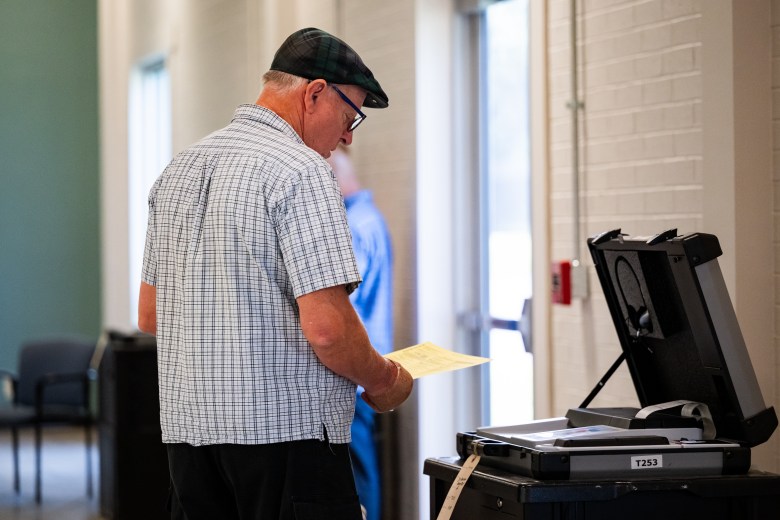
Voters decide Nov. 3 whether nine Oklahoma appellate judges stay employed. The judges run unopposed on a nonpartisan ballot and cannot launch campaigns or raise campaign funds.
Of the nine, four judges are from the Supreme Court, four from the Court of Civil Appeals and one from the Court of Criminal Appeals.
A “yes” vote favors them keeping the job. A “no” opposes them staying in the role.
Early voting runs from Oct. 28-31. Find more information about your ballot and how to cast it on our voter guide.
Why does Oklahoma have a judicial retention ballot?
About 60 years ago, a bribery scandal rocked the state’s judicial branch that led to national headlines and removal of three Supreme Court justices through prison, impeachment and resignation. The results were reforms that have largely remained the same.
Members of the state’s Supreme Court and Court of Criminal Appeals are appointed by the governor from a list provided by the Judicial Nominating Commission. State Question 845, also on the Nov. 3 ballot, could change aspects of that process.
Every six years, voters choose whether those judicial appointees should keep their jobs.
What if voters decide not to retain a judge?
Voting no on a candidate creates a vacancy. To fill the seat, the Judicial Nominating Commission will go through its vetting and recommendation process to provide the governor three potential replacements.
This has only happened once. In 2024, conservative groups fueled by dark money launched campaigns against three justices describing them as liberal activist judges. Of those targeted, Yvonne Kauger was not retained after serving for 40 years.
Stitt appointed Travis Jett, cousin to former Sen. Shane Jett (R-Shawnee), in April 2025, to fill the role. Jett is on the ballot to serve the rest of the term.
Where can I find information about their rulings?
The Oklahoma Supreme Court Network posts all court opinions. When a judge writes the majority opinion on a case, it is listed next to their biography on the website. Those are located under the “courts” tab at the top of the site.

Supreme Court
M. John Kane IV (District 1) was appointed by Gov. Kevin Stitt in September 2019. Originally from Pawhuska, he received his undergraduate degree from Oklahoma State University and a law degree from the University of Oklahoma. Previously, he served as an Osage County District Judge, establishing the county’s first drug court. He also worked as an assistant prosecutor and an administrative judge for the Oklahoma Department of Human Services in child support enforcement.
Travis Jett (District 4) was appointed by Stitt in April 2025. A graduate of Laverne High School, he earned a bachelor’s degree in agribusiness from Oklahoma State University in 2008 and a law degree from Georgetown University. He is on the ballot to serve a term expiring in January 2031. Before the appointment, he had an appellate and civil litigation practice.
Dana Kuehn (District 6) was appointed by Stitt in July 2021. A Tulsa native, she received her undergraduate degree from OSU and law degree from the University of Tulsa. Previously, she served as a Tulsa County prosecutor, associate district judge and Court of Criminal Appeals. She is the first woman to serve on both of Oklahoma’s highest courts.
Richard Darby (District 9) was appointed by Gov. Mary Fallin in April 2018. Previously, he served as a district judge for 23 years, special judge for four years and associate district judge for four years in a five-county district around Altus. He grew up in Duke and earned a bachelor’s degree at Southwestern Oklahoma State University and law degree from OU.
Court of Criminal Appeals
Oklahoma has a separate appellate court for criminal cases made up of five judges. They review criminal convictions and sentences.
Robert L. Hudson (District 2) was appointed by Fallin in 2015. He grew up in Guthrie and graduated from OSU with two undergraduate degrees and a law degree from OU. His previous experience included serving Payne and Logan counties as district attorney for 15 years and two years as a special judge. He also worked as first assistant attorney general.
Court of Civil Appeals
In 1970, the state Legislature established this court to review the majority of civil cases, which are assigned by the Supreme Court. It is composed of 12 judges, broken into four panels. Two are located in Oklahoma City and two are in Tulsa.
Stacie L. Hixon (District 1, Office 1) was appointed by Stitt in March 2020. A Tulsa native, she completed bachelor and master degrees from OSU then a law degree from OU. She previously worked at the Steadley & Neal law firm.
Jane P. Wiseman (District 1, Office 2) was appointed by Gov. Brad Henry in March 2005. She received an undergraduate degree from Cornell University, master degree from the University of North Carolina and law degree from TU. She started her judicial career in 1977 as a special judge in Tulsa County then served as a district judge for 24 years, overseeing nearly 1,000 civil cases before her appointment to the state’s bench.
Deborah B. Barnes (District 2, Office 1) was appointed by Henry in 2008. She received undergraduate and law degrees from OU and worked in civil litigation, administrative law and commercial and business law before the appointment.
James R. Huber (District 2, Office 2) was appointed by Stitt in April 2023 to replace Judge Keith Rapp who died in August 2022. He earned an undergraduate degree from OU and a law degree from TU. He served as president and managing partner of the J.R. Huber law firm for 10 years and the Collier & Huber law firm for 14 years. In 2019, he became a special judge in Tulsa County and the following year Stitt appointed him as a district judge, where he served until joining the state’s appellate court.
News decisions at the Tulsa Flyer are made independently of our board members and financial supporters. Read more about our editorial independence policy here.