



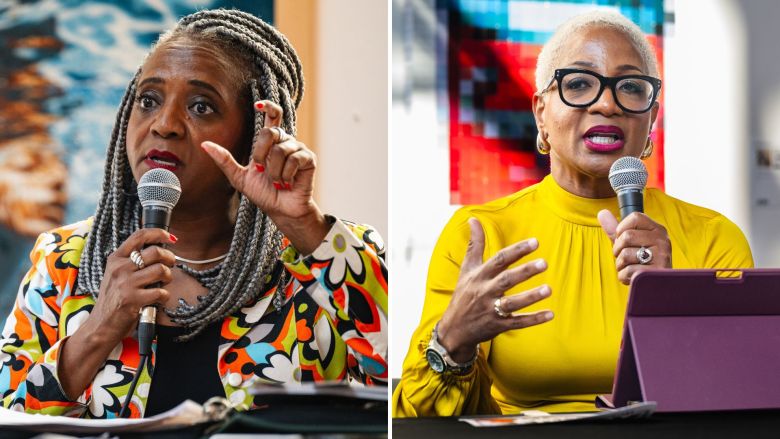
With just two weeks until the Nov. 3 election, District 1 Tulsa City Councilor Vanessa Hall-Harper faced off against Corinice Wilson in a candidate forum Monday night.
The conversation, hosted by Northside Neighbors executive director Reggie Ivey, touched on topics like housing affordability, public safety and dilapidated property in north Tulsa.
Here are four takeaways from the conversation.
‘Own the land’
Ivey asked the candidates to share their thoughts on development and some people’s fears that they may be priced out of their neighborhoods. North Tulsa has seen a wave of new development, particularly homes and apartments, in recent years.
Wilson said, if elected, she would utilize community benefit agreements for developers looking to build in north Tulsa. CBAs are contracts between developers and community groups used to ensure residents have a say in what is happening in their community and can hold developers accountable.
“If you’re doing large-scale development, now that’s where we’re utilizing city approval, city dollars, then that’s when we step in,” she said. “That’s when, as a city councilor, we can start saying that we want to ensure through community benefit agreements that you do have options that are affordable.”
In the case of Phoenix at 36N, a mixed-use redevelopment project at the former Comanche Apartments, 271 of those units were first offered to former tenants of Comanche who wanted to return.
Ultimately, Hall-Harper said, individuals and groups must prioritize ownership to have a say in what happens in their community.
“At the end of the day, you can’t do anything until you own the land. We have to own the dirt. One thing we have to do as a community is be very intentional about that,” Hall-Harper said. “When we own it, then we can determine what happens to that land, for us and by us. Otherwise, we are going to be subject to those who are buying and developing in our community.”
She previously championed the Saving Our Homes initiative, an effort awarding up to $4,000 for homeowners at risk of losing their homes due to tax debt.
Oversight of public safety
Ivey asked the candidates their thoughts on neighborhood safety and community-based solutions to public safety.
“It is incumbent on each and every one of us to start thinking about prevention,” Wilson said. That could look like more support for programs like Secure Tulsa, a community-based violence prevention effort.
Wilson said she is also “a firm believer in transparent and effective oversight of our public safety officials.”
Hall-Harper supported an initiative to enact an independent monitor to oversee the city’s public safety departments. It failed Oct. 14 after councilors could not reach a majority vote to pass the proposal.
But that fight is not over, she said.
“For 10 years, we — as a community — have been fighting for oversight. Of the themes in the Equality Indicators report, the justice theme is the one theme that has not improved. In fact, it has gotten worse,” Hall-Harper said, adding this data is one justification for oversight of public safety officials.
“We are actively, right now, working on a second iteration of oversight of public safety,” she said.
‘Can’t govern what TPS does’
Ivey asked the pair their thoughts on how Tulsa Public Schools can repurpose shuttered school buildings in north Tulsa. TPS’ board voted Monday night to close or consolidate 17 schools across the city next fall, including eight north Tulsa campuses.
“I can’t govern what TPS does with their property, but I can facilitate a discussion and talk about how we connect the building usage to benefit the residents that live in District 1,” Wilson said.
During an Oct. 8 community meeting at TPS’ Parent Resource Center, Superintendent Ebony Johnson said she wanted to see the buildings used to fill the gap for ongoing community issues like housing, childcare and food insecurity.
Hall-Harper agreed, adding she’s been in communication with Johnson about how school districts in other cities are repurposing vacant buildings into affordable housing for people aging out of foster care.
“Will Tulsa Public Schools be able to do that? No. But they can partner with developers to have access to be able to implement programs like that,” she said.
Black-owned bank, financial institutions in Tulsa
Ivey asked the candidates about the lack of financial institutions in north Tulsa.
Economic opportunity is one of the six themes highlighted in the Equality Indicators report. It outlined the disproportionate amount of payday loan servicers in north Tulsa versus banks and credit unions in south Tulsa.
The ratio of banks and credit unions to payday lending businesses is nearly 15 times higher in south Tulsa than in north Tulsa, 2025 data shows.
“Lack of access to traditional financial institutions like banks and credit unions, paired with a profusion of high interest charging predatory lenders magnify the financial hardship of many North Tulsa residents,” the report states.
There is a need for a Black bank in Tulsa, specifically on the north side, Hall-Harper said.
“There are communities, certainly in larger cities, where they have these enclaves where they control their economics,” she said. “And a part of controlling their economics is that they own banks. So that’s the mindset we have to start thinking with for north Tulsa, whether it’s a credit union or it’s a bank. We need both.”
Early voting runs from Oct. 28-31, with Election Day set for Nov. 3. Find more information about your ballot on our voter guide.
