


Getting the most out of the simplest materials could serve as a description of two-thirds of the Tulsa Symphony Orchestra’s concert held April 4 at the Tulsa PAC.
The third item on the program, the Horn Concerto, Op. 58, by English composer Ruth Gipps, was the comparative outlier — a piece designed to wring just about every note and tone that might be drawn from a French horn, in a setting that ranged across a broad musical spectrum.
The orchestra’s principal French hornist, Rebekah Lorenz, was the soloist for this piece, and her performance was a marvelous example of virtuosity.
Passages that ranged from the lyrical to the guttural to the comically flatulent followed each other in rapid succession through the first movement, which also contained moments of jazz-inspired melody, martial march music and even something akin to a bugler summoning the hounds to the hunt.
The phrasing in this first movement tended toward brevity, due to how rapidly Lorenz had to vault among the instrument’s registers. The second movement, a scherzo, featured more elegant music, especially when Lorenz’s horn is given a melody that allows her to soar musically over the orchestra in the middle of the movement.
The finale returns to the wide-ranging virtuosity of the first movement, although the effects become more purposeful, as if the horn has discovered its true purpose and presents it in the most triumphant way.
While the horn is definitely the star of this 1968 piece, Gipps’ writing for the orchestra is equally challenging. Conductor Daniel Hege, a long-time collaborator with the Tulsa Symphony, guided the players in a sensitive yet robust performance.
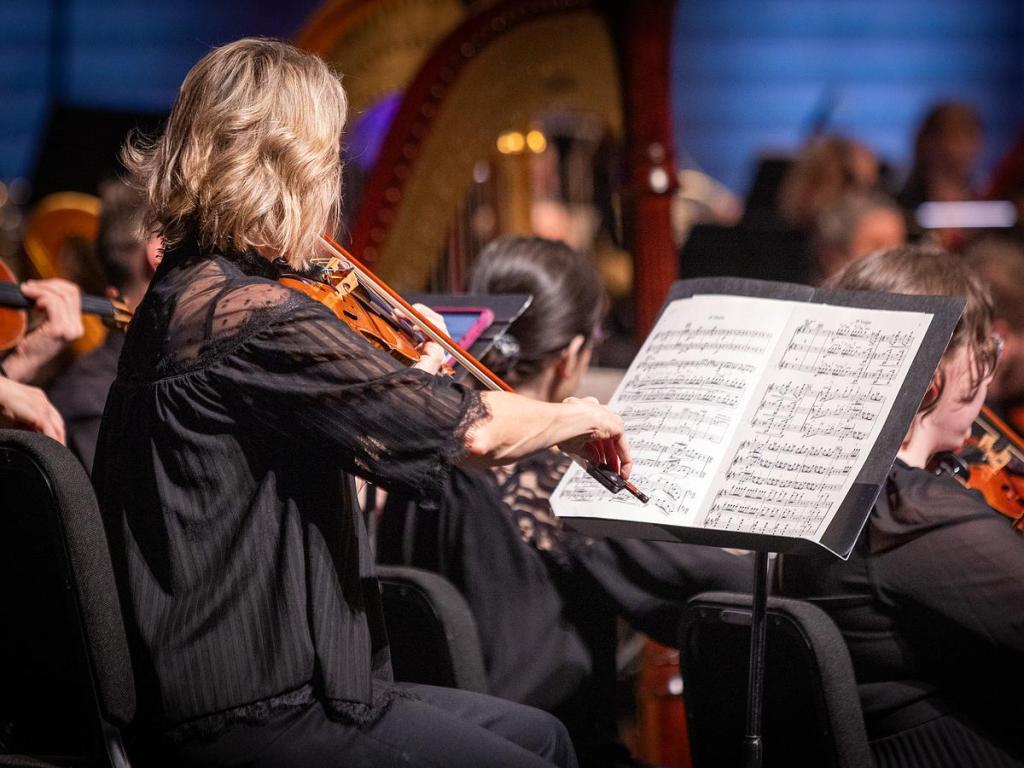
Hege is also the conductor to whom the symphony turns when a concert features a massive work, and the Symphony No. 9 in C Major, D. 944, by Schubert certainly deserves its appellation of “The Great.” Originally the name was to differentiate it from a previous, more compact work in the same key (the No. 6), but Schubert’s Ninth Symphony is “great” in many ways, size being only one of them.
For one thing, it represents Schubert, at the end of his foreshortened life, moving from the strictures of the classical world toward the more expansive and richly emotional world of Romanticism.
But Schubert’s method is a bit surprising. Rather than showcase his seemingly inexhaustible ability at creating melodies, Schubert builds each movement around relatively simple musical ideas that get developed and refined, layer upon musical layer, that create this enormous cathedral of sound — what one critic described as a “dynamic bulk of joy and belligerence.”
The results, when performed with the enthusiasm and expertise of Hege and Tulsa Symphony, were exhilarating. Each movement pulsed with a unique, insistent rhythm upon which the orchestra would sculpt captivating phrases growing in complexity and power, and that held the audience’s attention throughout the 50 or so minutes it took to reach the explosive finale.
Opening the concert was the Prelude to “Khovanshchina,” the unfinished opera by Modest Mussorgsky. Like the Schubert, this ethereal piece was constructed from simple, folk-like melodies that undergo subtle variations as they pass from instrument to instrument, like singers adding an individual twist or two as they offer up a verse of a well-known song.
In this case, that song was designed to evoke “Dawn over the Moscow River,” with such sounds as a rooster crowing and other natural elements. But the impression this piece truly left was one of repose, as the music slowly faded away as softly and as gently as it began.
The concert was the fifth in the orchestra’s Patti Johnson Wilson Classics Series, which will wrap up May 2 with Mahler’s Symphony No. 2.
News decisions at the Tulsa Flyer are made independently of our board members and financial supporters. Read more about our editorial independence policy here.