

Tulsa taxpayers have spent at least $30 million in city funds on Route 66 projects. But, determining an exact total and details on some attractions is, well, difficult.
The city’s Route 66 projects have been implemented by multiple departments across multiple mayoral administrations, various funding sources, changing city council compositions and city staff members.
The result?
There’s no central place where city officials can go to tell you how much taxpayer money has been spent on many Route 66 projects.
The Tulsa Flyer made a request three months ago for a list of Route 66 projects in the city, the amount of funds spent on each and the origin of those dollars. City officials found no comprehensive accounting but, after our request, started working on one to be completed by Nov. 11 — the official date of the Mother Road Centennial, said city spokesman Carson Colvin.
“Those projects are all accounted for through the city’s normal budgeting and records processes,” Colvin said. “Centralizing these all to a ‘Route 66 projects’ umbrella is not something that is easily pulled, as that is not how the work was administered operationally or financially. However, the lion’s share of the work is centered on projects from the Vision packages, so that’s a little easier to classify.”
Funding sources include capital improvements like the Vision Tulsa sales tax increase package, grants, streets funding, economic development initiatives and private partnerships, Colvin said.
Route 66 Alliance CEO Ken Busby has been involved in nearly every Mother Road project in Tulsa.
“With the passage of time, people forget, records are moved, staffs change and people don’t have a history of what happened,” Busby said. “There has been no ill-intent at all. Every project was done with committee oversight within the balance fund available and restrictions within the public processes.”
Several projects in the spreadsheet the city provided to the Flyer are broadly described with amounts missing or estimated. Some line items appear to have duplicate figures. Those blank spots and discrepancies are expected to be ironed out by November, Colvin said.
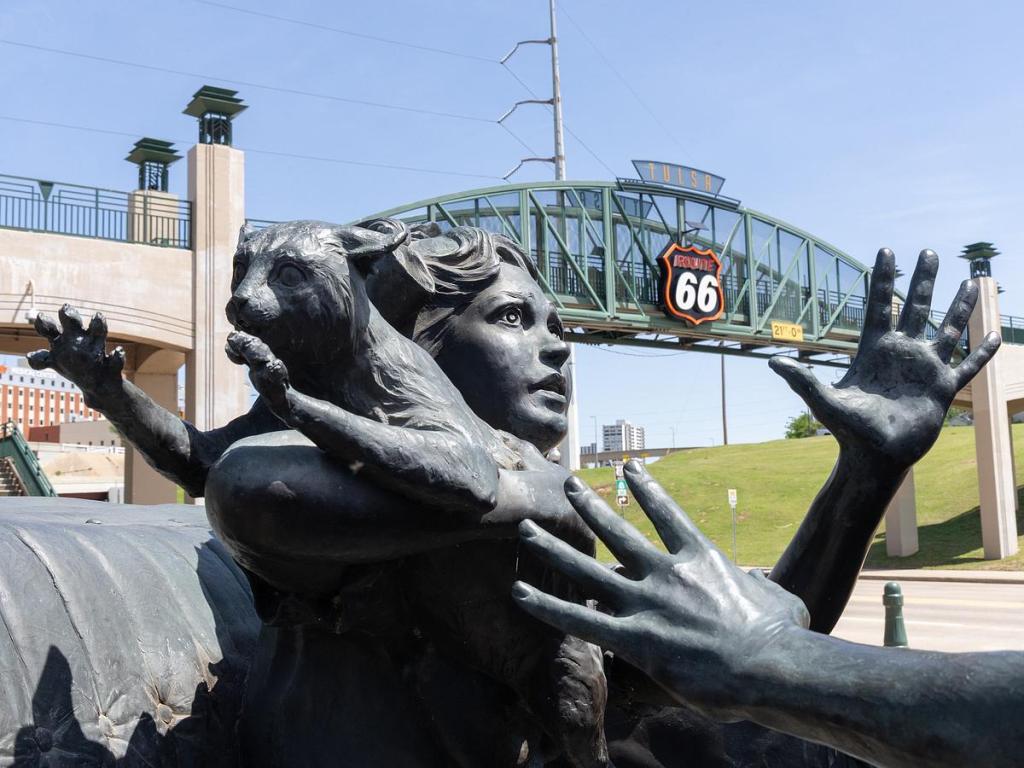
Among them are three $2.2 million expenditures for Cyrus Avery Plaza, neon shields for a skywalk and “Vision 2025.” Eleven projects did not list a source of funds — such as $620,000 for Historic Village Train Depot landscaping and $791,688 for Route 66 Rising sign lighting — and 18 assets don’t list a project, amount or funding source.
The $2.2 million expenditure is likely one payment for several aspects of the Cyrus Avery Plaza west of downtown, Busby said. Some locations listed as city assets don’t appear to have a Route 66 attraction and will eventually be removed from the list.
The accounting gaps fit into a broader perspective when it comes to Tulsa and Route 66: There is so much of the Mother Road here that it’s hard to know who is responsible for which aspect.
City Councilor Christian Bengel has been part of the Route 66 Commission for about three years and was made chairman last year. He said getting a list of city-owned property related to Route 66 was a challenge until recently.
“There was no comprehensive listing of city assets along Route 66 and no understanding of responsibility about who was actually going to maintain the assets,” Bengel said. “It felt like this pay-as-you-go system. As things would crop up, we would have to go figure out who was to maintain them.
“We’ve had people come to the commission with proposals for public, private or both. At some point, nobody knows who owns it, maintains it or what the cost is to replace it. That’s where we’re at now, figuring out funding and maintaining things we’ve built in the past.”
Route 66 projects are being slotted into responsibilities under the parks, asset management or public works departments, Bengel said.
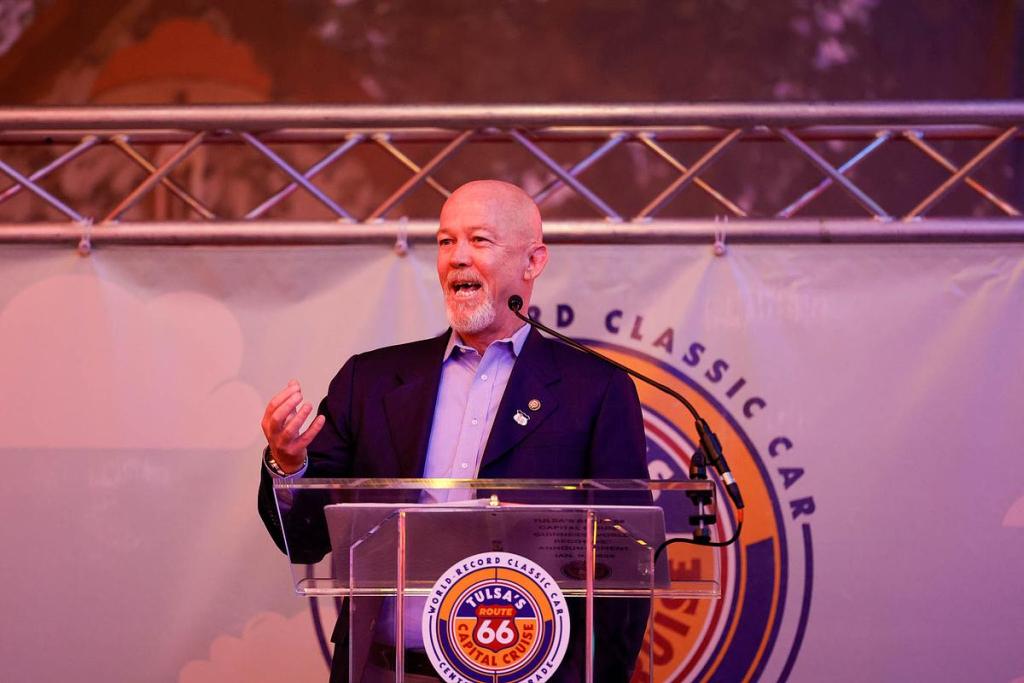
In one case, Bengel said, a Route 66 monument in west Tulsa was damaged by vandals. No department took ownership of getting it fixed until the Route 66 Commission intervened.
“Now we have an asset list of what we’ve built, and those are being baked into (department) budgets for maintenance and costs associated with that,” Bengel said.
Where the money comes from
Taxpayers approved $11 million for citywide and Route 66 beautification projects in the Vision Tulsa 2016 tax package and $15 million from the Vision Tulsa 2025 package. About $5 million came from the 2006 sales tax and $500,000 from the Improve Our Tulsa package.
Non-city funds for Tulsa Mother Road projects include $365,000 from Oklahoma Scenic Byways, nearly $800,000 from the Oklahoma Centennial Commission, $90,000 in an Oklahoma Route 66 Revitalization grant, $12 million from the Rebuilding American Infrastructure with Sustainability and Equity (RAISE), $430,000 from the Oklahoma Main Street Incentive Program, $20,000 from the Small Area Plan and $200,000 in federal pandemic relief funds.
A tax increment financing district was established at 11st Street and Lewis Avenue in 2016 to expedite infrastructure and beautification near the Mother Road Market before the Route 66 centennial. A TIF is an economic tool that uses future property tax increases to pay upfront costs for improvements. This TIF was estimated to provide $23.6 million.
The accounting so far shows specific information for some projects, such as 34 historical marker plaques ranging from $4,247 to $432,500 and 93 neon signs from $1,100 to $10,000.
The Route 66 Capital Cruise — the Saturday parade seeking to break a Guinness World Record — was funded with a shared $1 million grant from the Oklahoma Route 66 Centennial Commission within the Department of Commerce. The grant is also paying for the Oklahoma City Kickin’ It on Route 66 event that day in Scissortail Park. Other funding from the classic car parade comes from sponsors, entry fees and vendor tables.
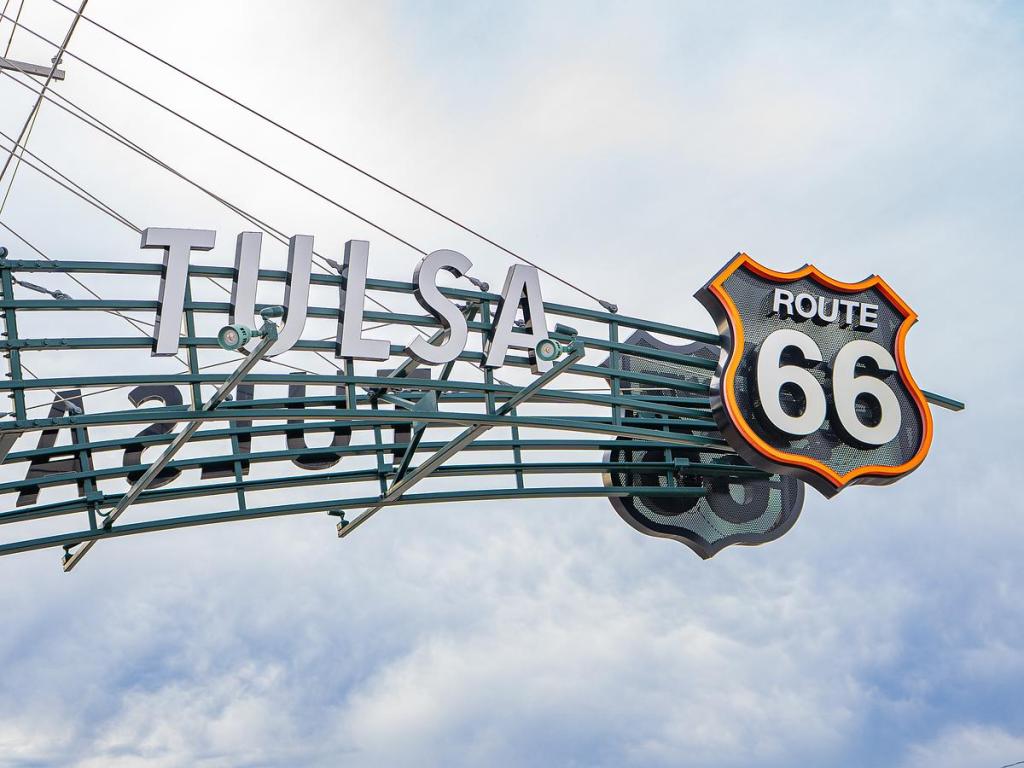

The neon sign grant program was established in April 2019 to pay for 50% of costs for a new or restored sign. The grant total for neon signs is $603,860. With the business owners’ investments, $1.7 million in new and restored neon signs dot the city.
Other projects include the Howard Park dinosaur roadside attraction at $525,000 from two state grants and private donors; the musical road on Southwest Boulevard at $110,000 from city and state funds; and the Route 66 Rising attraction at Admiral Place and Mingo Road with $791,688 from Vision 2025 funds for a sculpture and lighting.
Tulsa’s biggest Route 66 properties are the Cyrus Avery Plaza located just west of downtown off Southwest Boulevard and the Historic Village Train Depot at 3770 Southwest Blvd. Current information shows the Cyrus Avery Plaza cost around $5 million, and the Historic Village Train Depot closer to $4.5 million. That is subject to change pending final numbers.
A ‘starting point’ for improvements — and maintenance
Many projects appear before the city’s 19-member Route 66 Commission, established by an executive order in 2016 by then-Mayor Dewey Bartlett. The commission promotes tourism and economic development along the historic highway in the city.
Bartlett said the commission was formed to coordinate city efforts and provide a framework for planning.
“I was very confident Tulsa would be a big part of Route 66 because of the people involved,” he said. “It certainly has evolved into something that is quite a big deal.”

The commission does not have a dedicated source of income, prompting projects to have a mix of source funding. Projects not receiving city funds may not have much commission input.
“This is a starting point, and we still have significant portions of the route that haven’t seen investments yet,” Bengel, who represents most of east Tulsa, said. “We’ve built a lot of things and are planning on paying for that maintenance so we can hand it off to future leaders.
“Future generations can put their own ideas into it or have a say in the undeveloped portions. Or, they could let it go. But, for now we are capitalizing on the fact we are the Capital of Route 66 and putting much of our effort and investment into it.”
Sorting through the accountability process didn’t dampen Bengel’s enthusiasm for Route 66 projects. He said the commission experience showed him a good return on investment.
“We have people from all over the world coming to Tulsa for Route 66. It’s an asset of the city,” Bengel said. “If we are the Capital of Route 66, there is a bigger economic impact. My district does not benefit a penny from it, but I see the bigger picture in these investments that bring tourists to our city.”
Busby has been on the commission since the beginning and said the work is shifting away from new projects. He said the centennial year provides a good time to take stock of Route 66 city attractions to ensure each has a long-term maintenance plan.
“I’m looking at the broader picture,” Busby said. “We have so many Route 66 assets in this town and need funds to maintain them. We’ve built art, not had money for maintenance and administrations pass the buck to the next one. Route 66 could be an example of how to address this from the start. We can find a way to do this forever.”
News decisions at the Tulsa Flyer are made independently of our board members and financial supporters. Read more about our editorial independence policy here.