

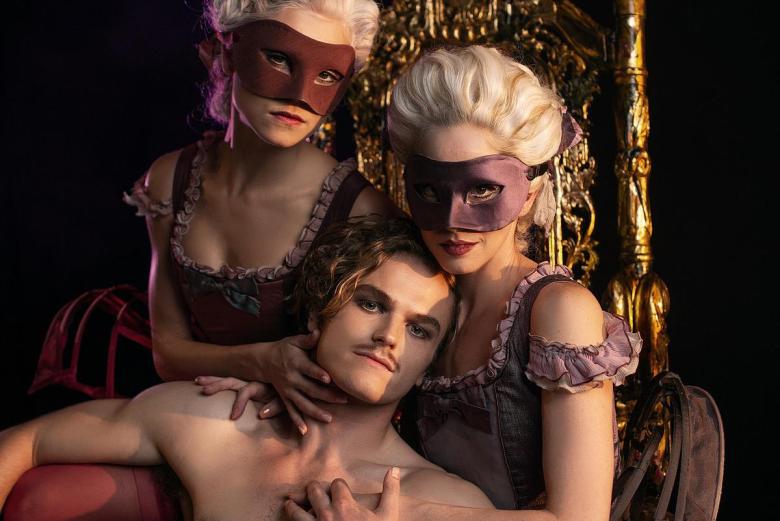
Kenneth Tindall began work on what would be his first-ever full-length story ballet with little more than a title.
Granted, it was a name he was certain would strike a chord with audiences: “Casanova.” That, and he had seen the 2005 Heath Ledger film and liked it.
“I thought it was a fantastic commercial title,” Tindall said. “But other than that, and the common notion of ‘Casanova’ as shorthand for a lady’s man, I really had no idea who this person was … What really made me go forward with the idea was that I could not find another ballet with Casanova as a subject. So this would be a way of truly creating something new for the ballet world.”
Now, Tulsa Ballet will present Tindall’s take on “Casanova” March 26-29 at the Tulsa PAC.
This is the fourth work by Tindall the company has performed, and the first one created for Tulsa Ballet. His previous works include “Carmen,” a powerful distillation of Bizet’s opera, and the wonderfully surreal take on “Alice in Wonderland” — as well as the one-act “Tennessee Whiskey,” set to a quartet of popular country songs.
Tindall originally created “Casanova” in 2017 for England’s Northern Ballet, where he serves as resident choreographer.
The ballet is set to an original score by American composer Kerry Muzzey. It features set and costume designs by Christopher Oram, who also designed Tindall’s “Alice in Wonderland” and took home a Tony Award for his work on the Disney musical “Frozen.”
One of Tindall’s first tasks in creating the ballet was to reach out to Ian Kelly, a historian and Casanova biographer with whom he would craft the ballet’s synopsis.
Working with Kelly was “when I got this rich education into Casanova, and discovered how misunderstood he was in lots of ways,” Tindall said. “To me, there is nothing better than bringing to an audience a story where they think they know what they’re getting, and you’re able to offer them a much richer, deeper look at this person’s life.”
The man born Giacomo Girolamo Casanova in 1725 was an Italian adventurer and writer whose pursuit of pleasures both intellectual and physical took him throughout Europe during the course of his 73 years.
“This was a man that spoke seven languages, wrote more than 40 books, including a translation of ‘The Iliad,’” Tindall said. “He was trained as a priest and as a lawyer, was an accomplished violinist, helped create the first state lottery in France and possibly helped Mozart with his opera ‘Don Giovanni.’”
Casanova would ultimately recount his adventures in lavish detail in his “History of My Life,” a 3,500-plus-page autobiography that also provides a comprehensive look at life in 18th century Europe.
It also includes detailed chronicles of Casanova’s myriad romances, exemplifying his statement: “Cultivating whatever gave pleasure to my senses was always the chief business of my life; I have never found any occupation more important.”

Tindall said having such a wealth of detail about the ballet’s main character meant the primary challenge was finding ways to present Casanova’s story in a way that would highlight his complexity without overwhelming the audience in details.
“I mean, there’s no way you’re going to pack 18 volumes of autobiography into a single ballet,” Tindall said, laughing. “That was one of the great things about working with Ian on the synopsis — he really helped pick out those key elements from Casanova’s life that would provide a more nuanced and balanced perspective of who he was.”
One of the main threads running through the ballet is Casanova’s writing and his efforts to be taken seriously as an intellectual.
“That he was never accepted into that community of thinkers — people like Voltaire, whom he saw as an ideal, and Goethe — was devastating to him,” Tindall said. “But writing was always the thing that saved him, to the point that at the end of his life, his writing was all he had.”
Another element of the ballet “Casanova” is the time during which the main character lived, and the various strata of European society through which he moved, from palaces to prisons, salons to seraglios.
This gave Tindall the opportunity to create ensemble scenes that “were actually part of the story, and not simply having a moment where you have 18 people dancing on stage,” he said. “‘Casanova’ offers all sorts of opportunities to create pas de deux, pas de trois and ensemble dances that have their character and personality, from Venice and its masquerades to the gambling dens of Paris.”
Still, Tindall said, any work titled “Casanova” is going to have to deal with sex and seduction.
“We don’t want to shy away from the sex, because it’s absolutely part of his story, but it’s only one part of his story,” he said. “And to be honest, Casanova was something of a failure as a libertine, because after all his affairs and liaisons, he ends up dying alone.”
After seeing a video for the ballet, Tulsa Ballet artistic director Marcello Angelini told Tindall: “If we put this on in Tulsa, we’ll probably get arrested.”
“He did say that,” Tindall said, laughing. “But I think he based that reaction on the video, which is a very different perspective than what you see in a theater. Still, we did discuss how we could bring this production to Tulsa, and made some changes here and there.”
It could have been potentially a “much steamier show” in some ways, Tindall added.
“Even so, the very act of having beautiful dancers moving in close proximity with that degree of physicality is always going to inspire people’s imaginations in ways that no one can predict,” he said.
Tindall says he hopes “Casanova” is a ballet that will appeal to those beyond the die-hard ballet audiences because it “is a story about that most universal theme, to love and care about humanity on the best possible level.”
“I know there are people who think ballet — that any classically based art form — is too old to be relevant,” he said. “I would challenge people who believe that to come see ‘Casanova’ and see if it doesn’t change their minds … It will be presented with the highest degree of artistry in its sets and costumes, the music is cinematic in the best possible way and the dancing will challenge the very boundaries of what we think we can do with classical ballet.”
Tulsa Ballet Presents “Casanova”
Choreographed by Kenneth Tindall. Music by Kerry Muzzy. Designed by Christopher Oram.
Performances: 7 p.m. Thursday, March 26; 7:30 p.m. Friday-Saturday, March 27-28; 2:30 p.m. Sunday, March 29.
Where: Tulsa PAC, 101 E. 3rd St.Tickets: $57.50-$164.25 (Thursday preview performance tickets, $38-$66.25). 918-749-6006, tulsaballet.org.
News decisions at the Tulsa Flyer are made independently of our board members and financial supporters. Read more about our editorial independence policy here.