

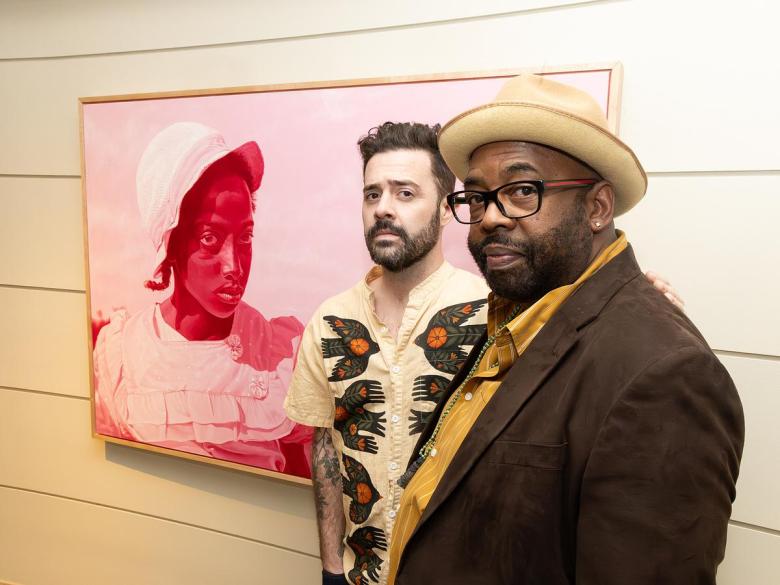
Two things link together the images in Philbrook Museum of Art’s newest exhibit, “Killing the Negative.”
One is artist Joel Daniel Phillips’ use of photographs from the 1930s and ‘40s, made under the auspices of the Farm Security Administration to document the devastation wreaked on rural and small town America during the Great Depression, as the basis for his large-scale, intricately detailed works.
The other, more obvious element is the large black dots that appear in every drawing and painting.
In some images, the dot hovers like an inverted sun in the monochromatic sky. Other times it obscures the face of the original subject or appears to be a gaping, if inordinately neat, wound on a person’s body.
But the dot represents something at once mundane and troubling. It is the mark of a hole punch, used to show the image was not considered usable for the Farm Security Administration’s purpose — attempting to make sure the country’s movers and shakers were aware of how terrible conditions were for many Americans at that time, and convince them to support the “New Deal” programs proposed by President Franklin D. Roosevelt.
“Killing the Negative: A Conversation in Art and Verse,” which opened Feb. 21, is on display in the Rotunda Gallery on the museum’s second floor through May 24.
About 25 of Phillips’ paintings and drawings make up the exhibit, accompanied by about a dozen poems inspired by the images by such acclaimed writers as former U.S. Poet Laureate Joy Harjo, and Tulsa poet, historian and educator Quraysh Ali Lansana.

Phillips, who came to Tulsa in 2017 as a Tulsa Artist Fellow, first encountered these mutilated photographs in 2019.
“At that time,” Phillips said, “a lot of the work I was doing was going through these lesser-known archives, looking at images that had been censored or discarded for some reason. I was scrolling through a photography blog and came across this one image of a cornfield with this big black dot in the middle.”
A bit more research revealed the 1936 image was by Walker Evans, one of some 15 photographers who produced more than 150,000 black-and-white negatives for the Farm Security Administration. Evans is best-known for his collaboration with novelist and critic James Agee on the 1941 book, “Let Us Now Praise Famous Men.”
Another exhibit currently on display at Philbrook, “Homeward to the Prairie I Come,” features works by photographer and filmmaker Gordon Parks, who also worked for the FSA.
Phillips began exploring the FSA archives at the Library of Congress. He found more and more mutilated images, and he began doing sketches of certain images.
One he found especially compelling was of an elderly black man tipping his derby hat as he looks directly into the camera’s lens. Several sketches of this image hung on the walls of his studio at Tulsa Artist Fellowship when Lansana, also a fellow at the time, happened to stop by.
“I asked Joel to tell me about this gentleman, what he knew about his story, and he couldn’t,” Lansana said. “Because these images were never published, the Library of Congress didn’t have much information other than the name of the photographer, the location where it had been taken and the year it was taken.”
That lack of context for these images was in part a result of the FSA program. Photographers would be sent out to areas throughout the country and would mail back their undeveloped rolls of film to Washington, D.C., where FSA information director Roy E. Stryker would select images to show the plight of rural Americans in the 1930s.
Some have become iconic images of the Great Depression, as well as the art and power of photography, such as Dorothea Lange’s “Migrant Mother.”

“I said to Joel, ‘These people need agency — they need a voice, a story,’” Lansana said. “I said I would like to write some poems about this particular gentleman, and that was the start of a conversation that’s been going on now for a good five years.”
It’s a conversation that explores issues of class and history, of truth and propaganda, of the value of the individual and serving the greater good of society.
Phillips and Lansana agree that Stryker’s process of selecting and discarding photos brings up issues that are disturbingly contemporary.
“These photos were created as a way to sell the country on the New Deal — to ‘sell America to Americans,’” Lansana said. “Looking at the photos that were discarded brought to mind a lot of questions: What were these people’s stories? Why weren’t they considered important or significant? What exactly was being sold here? These are questions we are still asking today.”
In the five years Phillips has spent combing through the FSA archives, he’s come to the conclusion the image of the derby-hatted man (known officially as “Untitled Photo, possibly related to Agricultural laborer who lives at Eighty Acres, Glassboro, N.J.”) is one of the most striking images in the whole archive. He still can’t figure out why the image was killed.
“The only reason I can think of is there is a sense of agency in the directness of the man’s gaze that didn’t fit the narrative Stryker was wanting to tell,” Phillips said. “It’s not that Stryker was a racist — we’re not saying that at all. But he was someone who was very aware of the narrative he wanted to tell, and what it would take to sell that narrative to people at that time.”
To achieve that goal, Phillips said, Stryker thought the image of a “distraught white mother and her children would be more effective than, say, a picture of a Black musician playing on the streets in Arkansas, or a Native American mother and her children picking blueberries.”
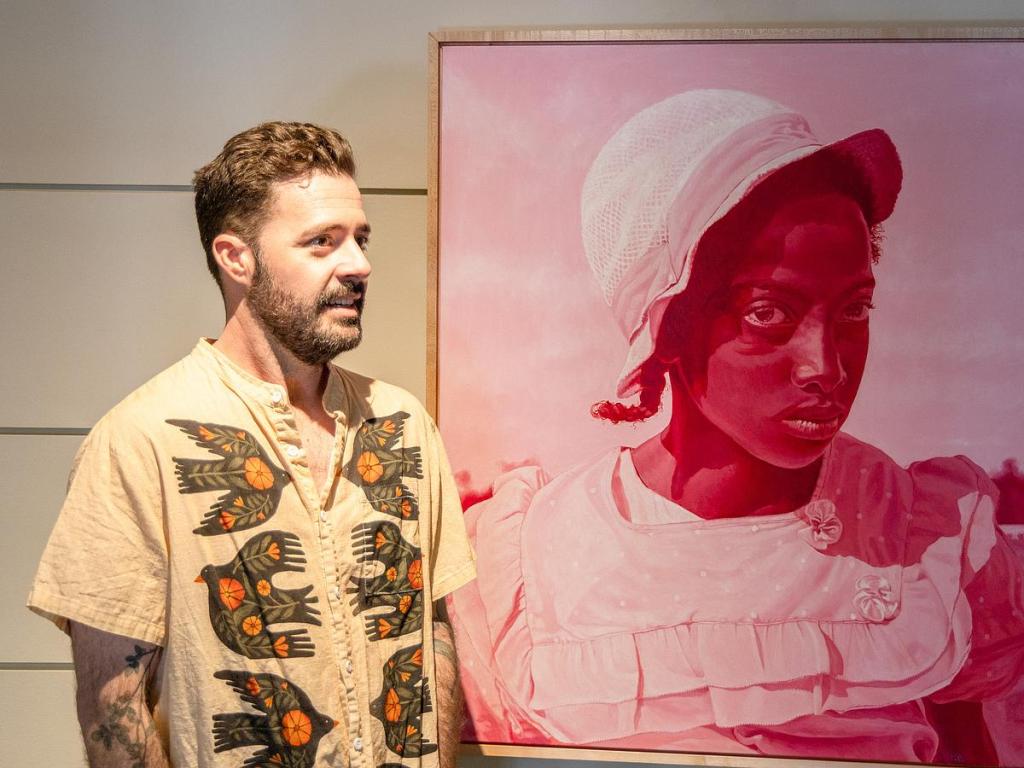
In all, Phillips has produced more than 100 images as part of the “Killing the Negative” series, ranging from charcoal, graphite and ink drawings to oil paintings that continue his penchant for monochromaticism.
Works from the series have been shown around the country, including the National Portrait Gallery. Lansana and Phillips also created a book of the series, which Left Field Books published in 2023.
Given the scale at which Phillips works, along with meticulous detail that has been a hallmark of his art, each image could take between 100 and 200 hours to complete.
“Le Corbusier said that the best way to understand anything is to draw it. And I’ve found that to be deeply true,” Phillips said. “These drawings take such a long time that, especially with portraits, when I finish a piece I feel that I have this understanding of the person — a deep sense of connection — that I wouldn’t have had otherwise.”
Paired with Lansana’s poetry, the portraits help viewers understand “who these people are,” Phillips said.
“I think portraiture, when it’s done well, has this magical ability to build these empathic bridges with the audience, so that they can have not (just) a sense of who this person is, but maybe even have a little bit of love for them,” he said.
News decisions at the Tulsa Flyer are made independently of our board members and financial supporters. Read more about our editorial independence policy here.