


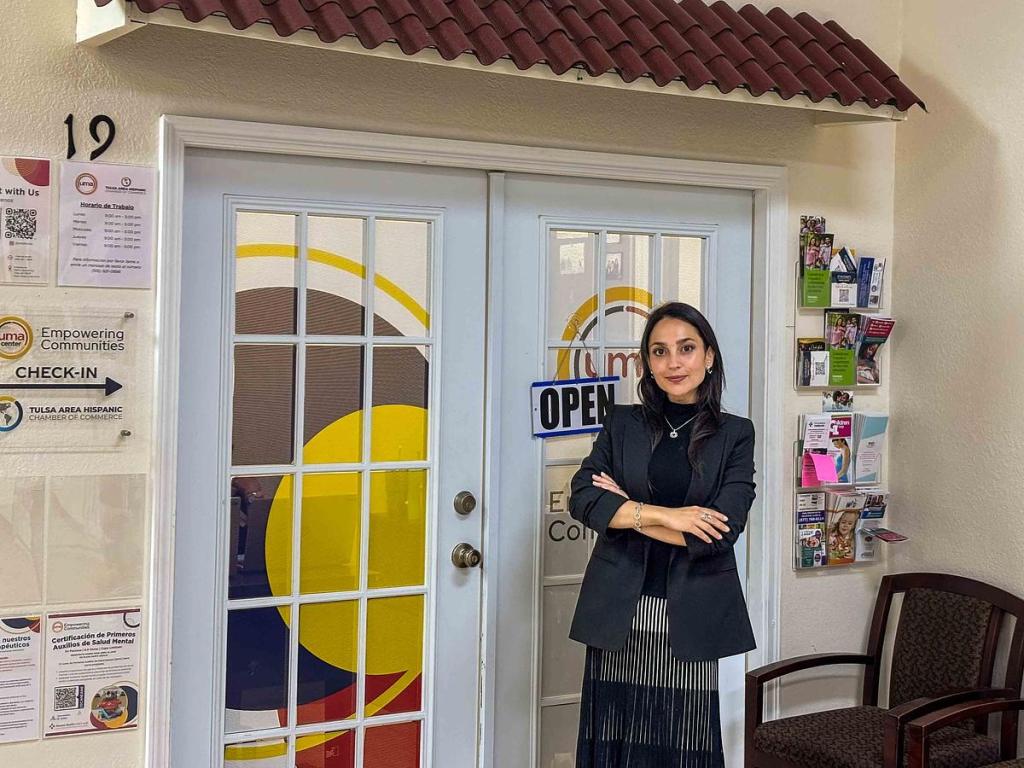
Carolina Hernandez is poised to take the UMA Center into its next era as the Tulsa-based organization’s new executive director.
Founded in 2020, the nonprofit aims to empower Tulsa’s Hispanic community through economic development, education and advocacy. Hernandez assumed the position in early February after founding executive director Martha Isabel Zapata stepped away from the organization.
“Right now, I have the responsibility and, also, the intention to take UMA to the next level,” she said.
Honing in on mental health, business
Hernandez wants to make sure the center understands the true meaning of its pillars.
Ensuring employment is a focal point can help them strengthen their approach to working with entrepreneurs, she said.
She wants to make sure the organization includes everyone in the community. That includes community members who are creating businesses but may not be great at marketing or other strategies as well as those skilled in the trades.
“One of my greatest talents is seeing where there are gaps and creating strategies to close them,” Hernandez said.
Another priority for her is to create legacy programs that create sustainability and bring funds back to the nonprofit.
The organization recently partnered with Ebony Skillens, a north Tulsa native and founder of Amayesing Skillz. The counseling services practice operates Skillz on Wheelz, a mobile mental health clinic.
UMA coordinated with Skillens to have a bilingual therapist at their location in Plaza Santa Cecilia once a week. The therapist is booked beyond April, Hernandez said.
“That’s something we are definitely going to keep within our goal to maintain, but also expand in the future,” she said.
Expanding beyond east Tulsa
One of her goals is to break the geographical barriers of where the organization has typically focused its services. Hernandez wants people to understand that the Latino and Hispanic community is not only in east Tulsa, she said.
There have been conversations with partners to expand to north Tulsa, she said.
“Hispanics are all over Tulsa,” Hernandez said. “We work, surely, all over Tulsa.”
The organization launched a new program this year called the “The Health Navigator & Behavioral Health Interpreter Pathway.”
People can receive a Physical and Mental Health Navigator certification and move onto the next stage of the program to receive a Behavioral Health Interpreter certification. Hernandez views the program has a way to expand services to health care professionals and advocates across the city.
Finding connections to Asian Tulsans
Later this year, Hernandez hopes to make more connections with the Asian community.
Hernandez recognizes that east Tulsa has a large Latino population, but she said organizations are not filling the gap of serving the growing Asian community.
“I am willing to begin exploring how to attend to those needs,” she said.
UMA has the opportunity to work with partners to replicate their work into other languages, she said. Bilingualism is integral to the work they do.
She is open to connecting with Asian community members and preparing them to do similar work.
“The worst they could say is no,” Hernandez said.
This article was produced as part of a partnership between the Tulsa Flyer and La Semana, a Tulsa-based bilingual Spanish-English newspaper serving Latino communities in Oklahoma.
News decisions at the Tulsa Flyer are made independently of our board members and financial supporters. Read more about our editorial independence policy here.