


Samuel Ramirez, owner of V’Fresco, added a fire suppression system to his food truck in mid-October to comply with the new Oklahoma laws impacting mobile units. It cost him $6,200 — more than he originally thought it would, but he had no choice.
The owner of the authentic Mexican food truck had to keep his business running and provide for his family.
“I understand that it’s for our safety and the public’s safety, and I completely agree, but I think above all they did it to motivate us to close our businesses rather than help us,” Ramirez said.
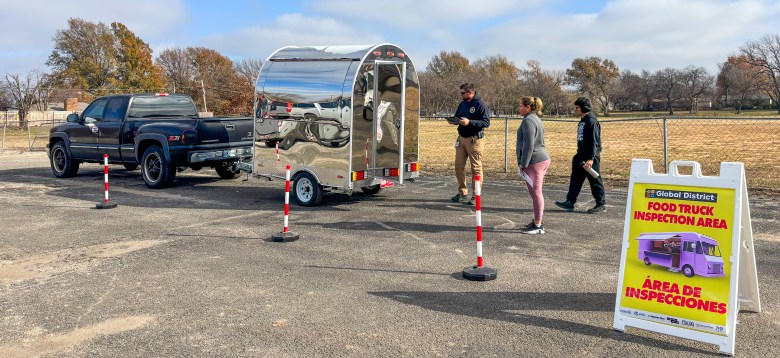
Tulsa Global District, an organization focused on revitalizing the 21st and Garnett area, hosted an event Monday to educate people about the new laws affecting food trucks. Executive director Alejandro Garcia said there are 20 food trucks within the district’s boundaries and an additional 10 businesses on its border.
Oklahoma passed two laws earlier this fall around food truck licensing and fire safety. House Bill 1076, also known as the Food Truck Freedom Act, streamlines licenses statewide for food truck vendors. Since Nov. 1, any food truck operator with an approved Oklahoma State Department of Health Food Establishment license can operate anywhere in the state, rather than obtaining permits in each municipality they operate in.
House Bill 2459 requires mobile food stands using propane to maintain and obtain a permit from the Oklahoma Liquefied Petroleum Gas Administration. Mobile food vendors will have to renew their permit and be inspected annually. The law also requires fire suppression systems.
Beginning Jan. 1, 2026, mobile food trucks who produce grease-laden vapors will have to add the suppression systems to be fully code compliant. They will also have to carry a “Class K-type” fire extinguisher, which is designed to fight grease fires and a “Class ABC” fire extinguisher, which covers three types of different fires.
Fire professionals and Tulsa Fire Marshal Chuck French previously told the Tulsa Flyer and La Semana that the fire suppression systems help prevent deaths in the event of gas leaks and grease fires. Grease-laden vapors can also cause fires to spread more and faster, they said.

Food truck owners complain of costs
Despite support from lawmakers and fire officials, the laws have caused confusion and drawn criticism, especially in the Latino community.
Ramirez immigrated from Mexico City to Tulsa 22 years ago. He launched V’Fresco roughly six years ago, but he wasn’t surprised when the new laws were announced because he heard rumblings about it ahead of its adoption.
It cost him $3,500 to outsource the system from Texas and another $2,700 for it to be installed.
These new laws felt part of the larger agenda happening in the country toward the Latino community, he said. He might be dramatic, he said, but it feels like a way to demotivate Hispanic entrepreneurs.
“We represent an important part of the system,” he said. “Although many people don’t have (legal status), they open businesses, pay taxes, hire employees and add more money to the system.”
Many food truck owners have expressed concern about how businesses installing the system have been forced to raise prices.
Gustavo Vazquez, owner of Tulsa’s La Coshi, told the room filled with lawmakers and other food truck owners Monday that it’s not easy to find thousands of dollars to install a fire suppression system in a month’s span.
Most food truck operators in the community didn’t have the systems installed prior to the law going into effect, he said. Through financial help from Avanzando Juntos, an organization supporting small businesses in east Tulsa, Vazquez was able to install the system.
But the Nov. 1 deadline caused installers to take advantage of people, Vazquez said. He saw $3,000 estimates jump to $6,000.
What comes next for food trucks
State Rep. Derrick Hildebrant, R-Catoosa, represents the 21st and Garnett area and was a key architect of the Food Truck Freedom Act. In 2026, he expects the legislature to introduce bills addressing burdens food truck owners are facing with the new laws.
This could include expanding who can inspect food truck fire safety. A potential fix would allow propane plumbers to conduct inspections around fire suppression systems rather than only the state fire marshal.
During the next legislative session, Hildebrant also wants to discuss if there’s an actual need for fire suppression systems in food truck establishments.
Jose Bamaca, president of 918 Maples Group that operates restaurants and food trucks across the city, asked Tulsa officials how many fires they address at food truck establishments. LP Gas Administration and City of Tulsa Fire Department did not immediately provide that data.
“In my observation, food trucks operated safely with two fire extinguishers,” Hildebrant said. “Food trucks are different than sit-down restaurants, and have one to two occupants in the truck. We want to start that conversation in correlation with our fire department.”
Food truck owners must call the state fire marshal at 405-522-5005 to schedule an inspection.
It might take them two to six months to schedule the inspection, but there’s no guarantee since they work it into their usual schedule, said Nicholas Nadeau, deputy administrator and safety code enforcement officer with LP Gas Administration.
LP Gas Administration will focus on conducting inspections at several events hosted throughout Oklahoma due to limited staffing. The only event currently listed is set for Dec. 9 in Mustang, southwest of Oklahoma City. Future events can be found here.
Vazquez raised concerns over how the state is conducting inspections, citing disorganization following the law’s rollout. He has a 26-foot mobile truck, and to move it for an inspection event in a different part of Oklahoma is difficult.
“We need to find a simpler way for all of us,” he said. “It’s not easy for the people from the state fire marshal and LP Gas to go from not inspecting trailers to inspecting 7,000. It’s too much work.”
This article was produced as part of a partnership between the Tulsa Flyer and La Semana, a Tulsa-based bilingual Spanish-English newspaper serving Latino communities in Oklahoma.
News decisions at the Tulsa Flyer are made independently of our board members and financial supporters. Read more about our editorial independence policy here.