


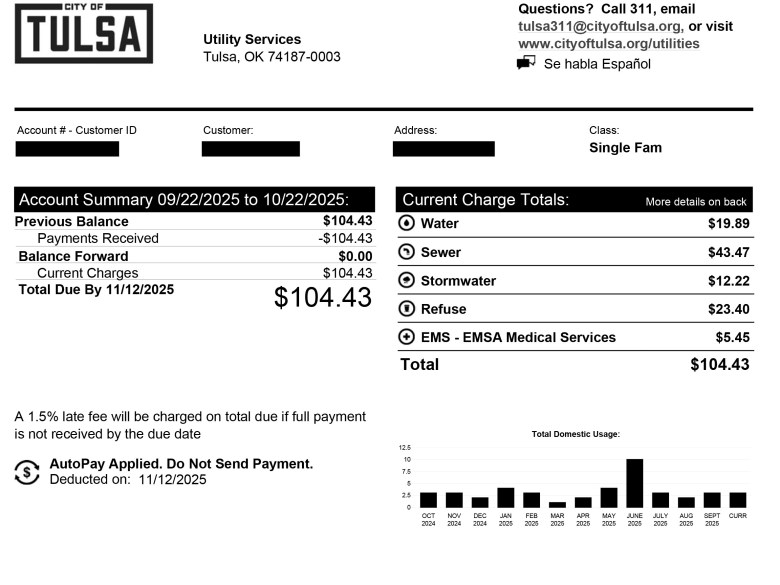
You can count on getting a utility bill every month, but do you know how it’s calculated? Here’s a breakdown of each charge in your City of Tulsa utility bill.
There are five main charges on your city utility bill: water, sewer, stormwater, refuse and EMSA medical services. The front of your bill has a basic outline of each charge while the back of your bill has more details.
You’ll notice the “balance forward” section in your account summary. If you couldn’t pay your previous bill, this is how much you still owe. Your water will be cut off if your bill is 24 days past due, and a 1.5% late fee will be added.
The City of Tulsa recommends calling 211 for financial assistance or setting up an appointment with the Financial Empowerment Center. Some churches around town also provide utility assistance.
Water

Your water usage is tracked on a meter, which you can usually find outside your home in the ground. On this meter, there are marks that show water used per 1,000 gallons and marks that show water used per gallon, per 10 gallons and per 100 gallons.
If you see any movement of these marks (and you know there’s not any water currently being used in your home), you might have a leak. To help cover the costs of a potential leak, you can read more about the credit program here.
The “water use” line on the back page of your utility bill shows all things related to your water usage. It’s tracked by the readings on your meter from two days in the last month or two. To calculate how much water you’re being billed for, you subtract the current month’s reading from the previous month’s reading. This same number should also be found in the “usage” tab.
There are three different read types: estimated (EST), manual (MAN) and actual (ACT). They are exactly what they sound like. The city has used estimates in the past when there were shortages of water reader staff.
Rates are based on your actual water usage in the readings. Exact rates depend on the type of customer you are (residential, commercial, etc.), which can be found here. Generally, single family residential customers ( homeowners) are charged $4.57 per 1,000 gallons of water used.
You are also charged a flat fee for the irrigation meter you use, which can be found under the “water use” line. Together, these two totals represent how much you’re charged for water.
Sewer
The sewer section covers the cost of getting your wastewater to the treatment facilities. The city’s water and sewage website says it’s “impractical” to measure the exact amount of sewage you produce, so this charge actually depends on your water usage. This line on your utility bill looks similar to your water use line.
Your sewer charge is based on your average water usage during the months of December, January and February over the past five years. It gets recalculated each May. This average amount is also known as your “cap” — the maximum amount of sewage you can be charged for. Each single-family residential property is assigned a cap.
If your current month’s water usage is lower than that cap, you will be charged the lower amount. But if it’s higher, you won’t be charged more than your cap. If you’re a new customer, you’ll be charged for the property’s current cap until a new one can be calculated. If there isn’t a cap, the citywide average of 5 (5,000 gallons) is used.
You can request for your cap to be reevaluated in the case of leak repairs, changes in your household occupancy or irregular irrigation patterns. There are a few notes on the City of Tulsa website.
Similar to water usage, you are also charged a fixed fee for the meter you use.
Stormwater
Households in Tulsa are each charged $13.69 for stormwater, which mostly funds maintenance of facilities, stream channels and pumping stations. A small amount also helps capital projects, utility billing and administration, according to the City of Tulsa website.
The city’s stormwater detention facilities also provide open green space for playgrounds, soccer fields and trails as well as wetlands and ponds. This charge is on the back of your utility bill in the “miscellaneous” line.
Refuse
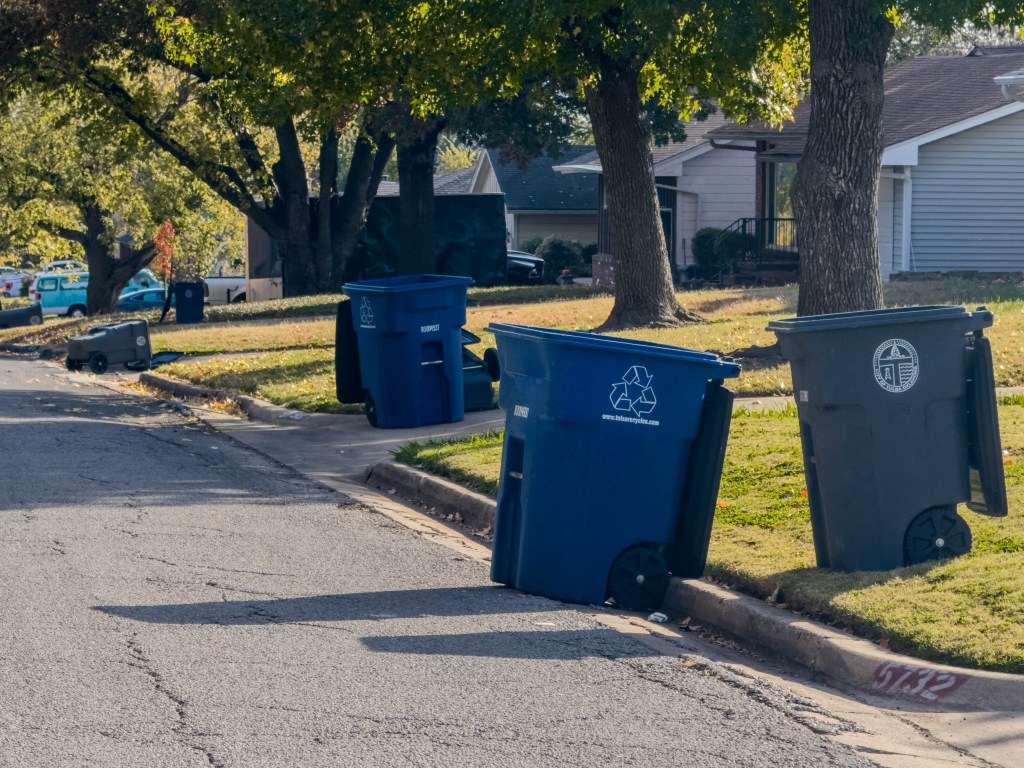
Similar to stormwater, you are also charged a flat fee for trash. But that amount depends on cart size and collection frequency. For example, a 96-gallon can will cost you $24.33 for curbside pickup. There are other options for smaller carts, backyard pickup and biweekly service.
Find those rates here. This charge is under the “refuse and recycling” line on the back of your utility bill.
EMSA
If you live within Tulsa’s city limits, you are automatically enrolled in emergency medical services. Each person in your household will receive EMSAcare benefits with no out-of-pocket costs for the emergency medical service program. It’s $5.45 per month and the only utility rate that did not increase this year.
You can opt out of this by calling 311 when you first open a utility account, filling out a Declaration of Non-Participation form. Customers can also opt out during the month of August each year. This line is under the “miscellaneous” line on the back of your utility bill.
RELATED | Your PSO bill has multiple small charges. Here’s how to read them.
News decisions at the Tulsa Flyer are made independently of our board members and financial supporters. Read more about our editorial independence policy here.
