


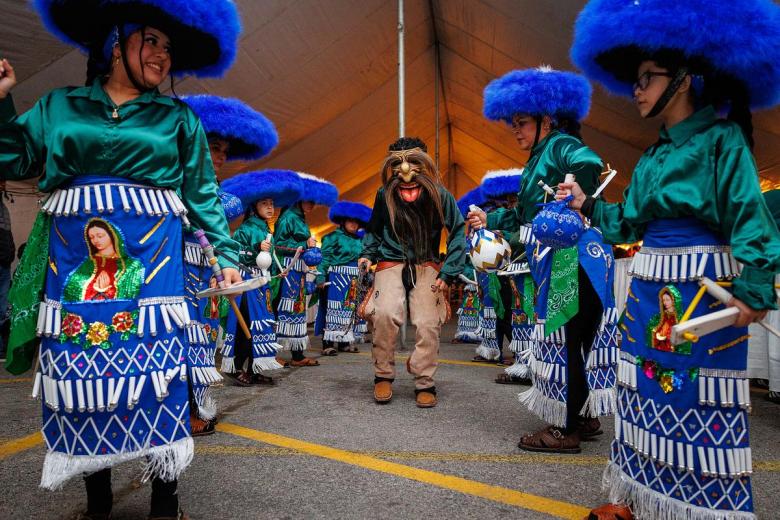
Tere Gómez stomps forward with one foot, then the other. She adds a unique sound to the danza with the maraca de guaje and the bow she carries in her hands.
Stomping, bells, drums and a violin from Danza Santa Maria on Thursday night fill the temple of east Tulsa’s St. Thomas More Catholic Church.
“The moment one danzas your body trembles,” Gómez said. “You don’t hear anything, you don’t see anything, you only feel your body trembling and nothing else matters. You forget everything there.”
Gómez’s danza group is one of 10 from St. Thomas More. They danced in honor of La Virgen de Guadalupe over the 12 days leading up to Dec. 12. The date and name refer to the first apparition of the La Virgen de Guadalupe in December 1531 in Mexico.
Founded in 2008, Danza Santa Maria is made up of 33 people, most of them children. They spend all year practicing for this celebration. Dec. 12 is the most important day for them, said co-coordinator Adriana Lopez.
“This is a fundamental moment for us to pray with every step,” Lopez said.
Dec. 11, the night before La Virgen de Guadalupe’s birthday
3:45 p.m.


Matlachines, or dancers, from the group take over Gómez’s kitchen and living room to get ready for the night.
There’s a candle burning in the corner, and it’s hard to walk through without bumping into someone. Some parents sit and catch up while others braid their children’s hair and do their makeup.
Samara Nava, 13, felt nervous. It was her third year dancing with the group. La Virgen is the one who listens and heals her, she said.
“We’ve been practicing all year long for this special day,” Nava said. “It’s really beautiful and a good experience.”
Their uniform for the night featured a green shirt and a naguilla, similar to a petticoat, with the image of La Virgen de Guadalupe. You can hear the bells across the rooms as they begin to tie their naguillas onto their waists.
4:55 p.m.
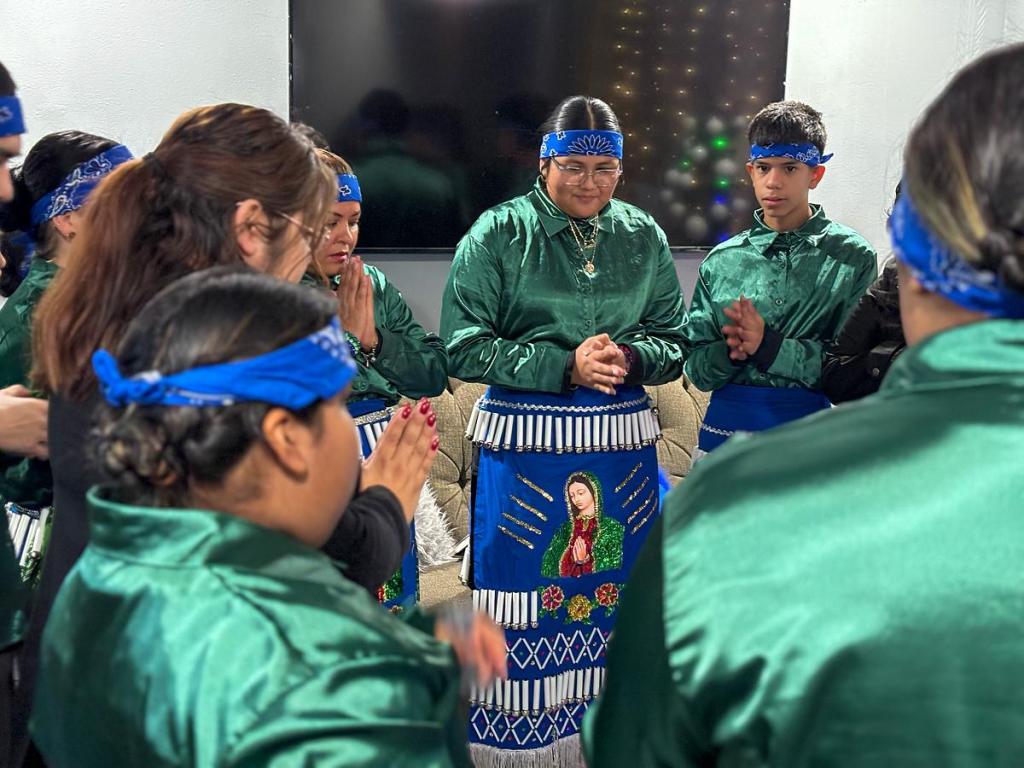
Before leaving, the room goes silent. The matlachines form a circle in the living room to pray.
Alejandro Moreno, 13, said he dances for his sick brother. He prays to La Virgen for a cure.
Amelida Miranda perseveres despite facing a lot of challenges with her knees. She prays to La Virgen and God for the safety of her family.
“When I’m doing danza, every step is a thank you to her,” she said. She feels like she’s walking on air when she performs. All the pain slips away.
5 p.m.


It’s time to head to their first performance. They gather their pieces, grab sandwiches for the road and pile into cars.
“Don’t forget anything, because we’re not coming back,” Lopez tells the group.
They drive about 45 minutes to St. Clement’s Catholic Church in Bixby.
Maria Coscatl, 16, always wanted to join this specific danza group growing up. She finally had the chance last year. Coscatl’s middle name is Guadalupe, making this a special night. Coscatl finds herself speaking to her when she’s struggling.
“My steps are for her,” she said. “She means a lot to me.”
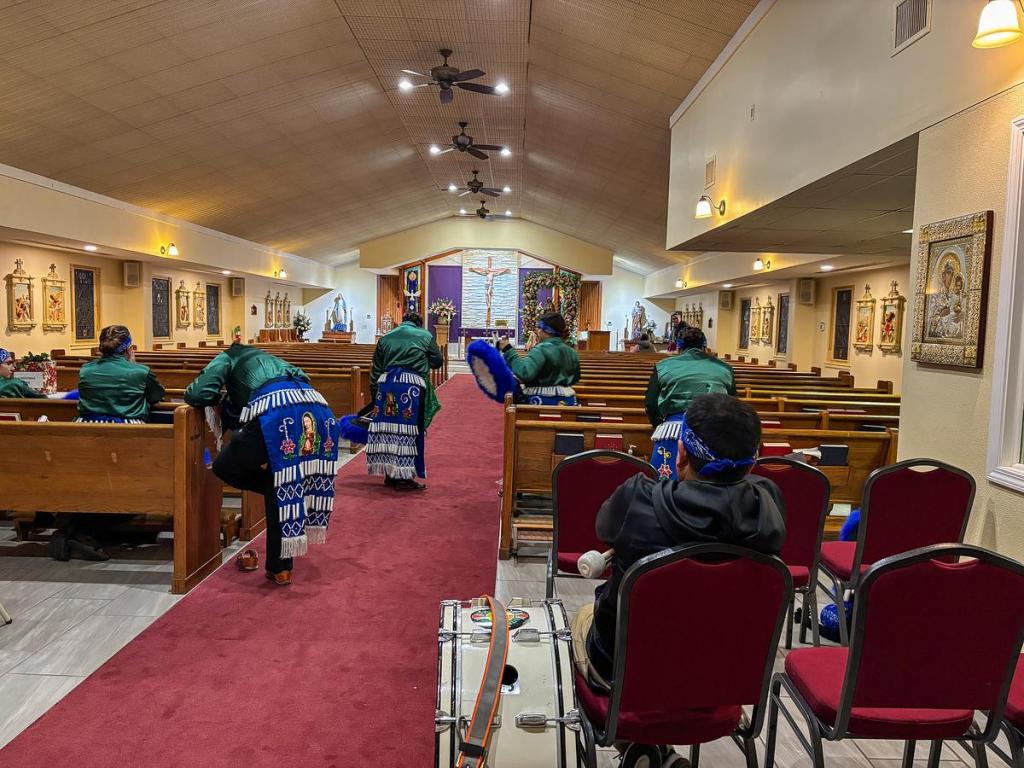
5:50 p.m.
The next hour gives them an opportunity to slow down before their first performance.
Emily Cardona, 8, is in her second year performing. She’s excited to celebrate La Virgen’s birthday.
“I like dancing for La Virgen, God and, especially, my family,” Cardona said.
The group goes on to perform at 7:01 p.m. The room goes silent until you hear the loud stomping and maracas and bells take over.
Ten minutes later, they’re done and headed to St. Thomas.
Jose Medina, 9, joined two years ago because the group looked fun. La Virgen de Guadalupe means “my heart” to him. He loves having a lot of people watching them perform.
“My legs hurt a lot sometimes,” Medina said.
7:45 p.m.
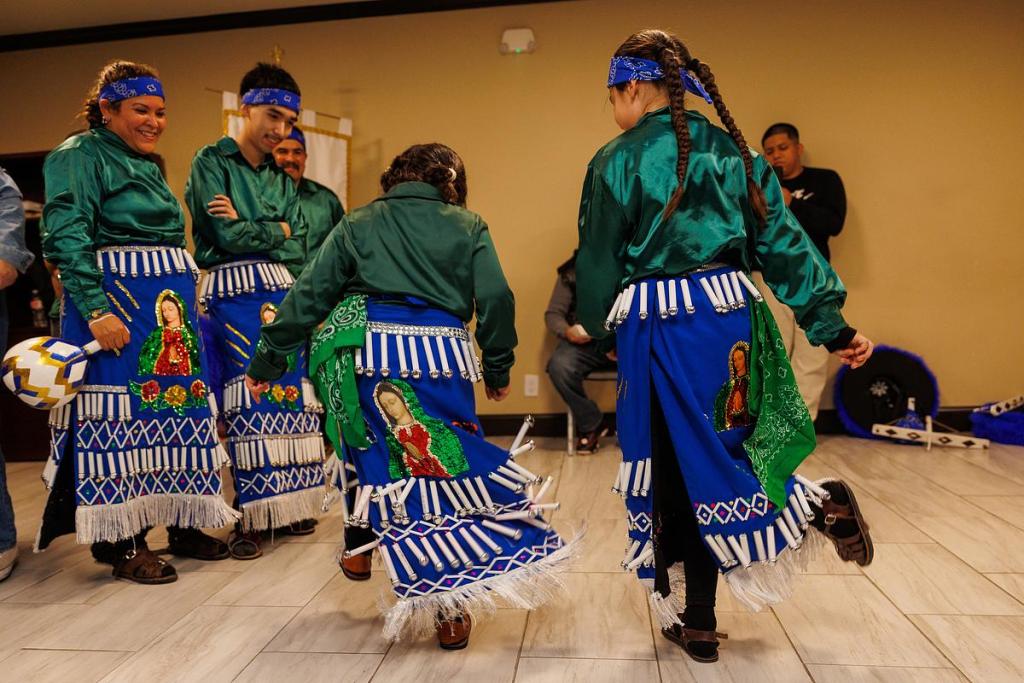
The group gets to St. Thomas before 8 p.m. to ensure they find parking.
Ma Luisa Robles, 47, is the oldest member of Danza Santa Maria. She never thought she’d be doing it because, for a long time, she didn’t like it.
Robles decided to join when they needed more members. She didn’t understand the steps at first, but her stubbornness kept her going.
“It’s, like, you’re not even yourself,” she said. “You get transformed when dancing.”
Robles’ husband has always loved danza. She said God might have used her to get him to join. She dances while her husband plays the drum for the performances.
“He doesn’t even care if I don’t cook one night because of danza,” she said. “He’s part of it now.”
8:15 p.m.
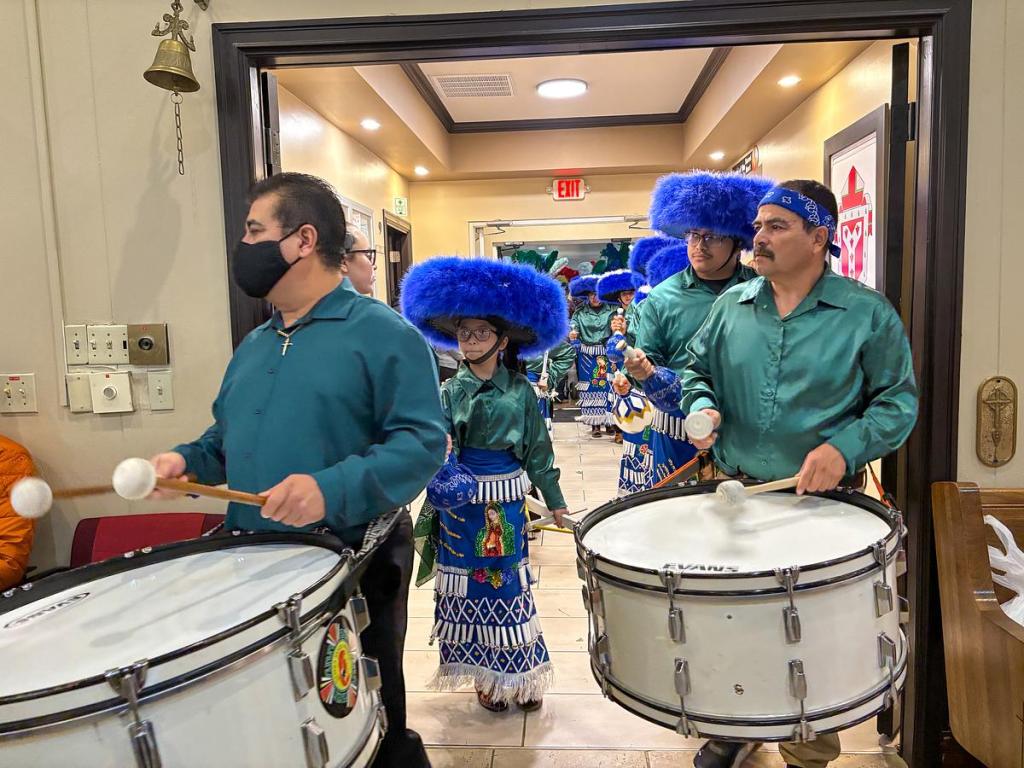
The performance inside the temple at St. Thomas is the most important since the group is made up entirely of church members.
In the moments before their performance, David Coscatl, 11, thought about the sacrifices that God and La Virgen made for him.
“She changed my life,” Coscatl said. “I was a bad kid before.”
9:15 p.m.


Alejandra Rosas Peña, 24, is the group’s violinist and one of its longest-serving members.
Roughly 11 years ago, her younger sister joined the group as a dancer. The violinist at the time was leaving soon and the coordinator asked her if she’d be interested in taking over.
“La Virgen was calling me,” Rosas Peña said.
She’s fallen more in love with danza throughout the years and plans to remain with the group as long as La Virgen allows her to.
Miguel Vences, 18, has also fallen in love with it. Danza has made him become closer to church and make social connections, he said.
“I’ve always been in a weird position where I felt left out because I’m Mexican-American,” Vences said. “Seeing other people like that was just special.”
11:30 p.m.


The group has a final performance at Saints Peter and Paul Catholic Church. Members remain there through midnight mass, ringing in La Virgen de Guadalupe’s birthday.
The night of dancing and prayer was only a glimpse into their annual activities. They sleep for a few hours before doing it all over again at 4:30 a.m.
Heber Bautista Lopez, 17, is emotional when discussing his connection to La Virgen. He joined the group six years ago as a way to honor his faith and push through struggles with his health.
Sometimes he feels tired when dancing, but then he remembers why he’s doing it — to honor his mother.
“If I could encourage anyone to join danza, I would,” he said. “It’s our way to show our culture and faith.”
This article was produced as part of a partnership between the Tulsa Flyer and La Semana, a Tulsa-based bilingual Spanish-English newspaper serving Latino communities in Oklahoma.
News decisions at the Tulsa Flyer are made independently of our board members and financial supporters. Read more about our editorial independence policy here.