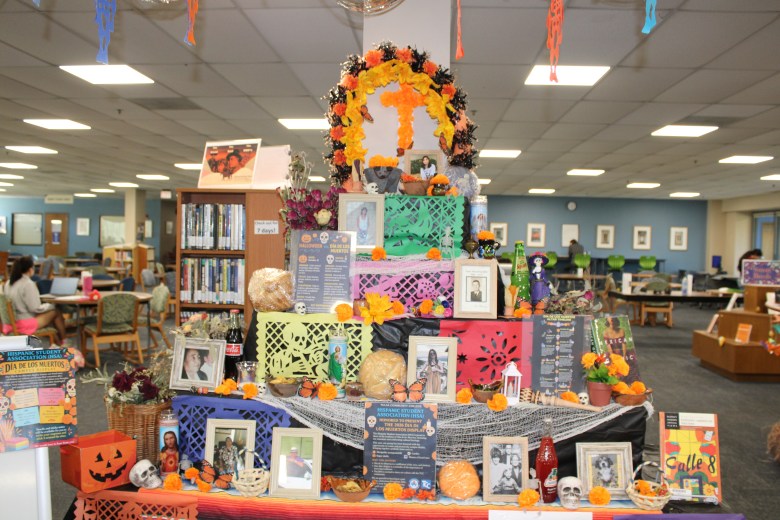
Celinda Gómez grew up honoring her ancestors and lost loved ones for Día de los Muertos. She sets up an ofrenda, or altar, in her home each year and says it’s similar to the family tradition of putting up a Christmas tree. It was a no-brainer when Tulsa Community College staff asked her to place an altar in their open space.
TCC’s Hispanic Student Association set up its altar in the center of the library on the southeast campus for students and staff to learn more about the holiday. Gómez, who is the president of the student organization, says celebrating the Mexican holiday is important to her roots and helps keep memories of loved ones alive.
“I have a 4-year-old who doesn’t know who his great-grandparents are, but now he does while setting up an altar (at home),” she said.
Celebrations of Día de los Muertos, translated to Day of the Dead, are underway across Tulsa. For most people, the holiday spans two days from Nov. 1-2. Some begin honoring lost pets starting Oct. 27 while others begin honoring deceased children Nov. 1. The following day, families celebrate and honor the lives of adults who have died.
Where to celebrate in Tulsa
- The Tulsa Global District will host its annual Muertitos Family Fest, a Día de los Muertos celebration, starting at 5 p.m. Oct. 30 at Hannah Hall, 1801 S. Garnett Road.
- The Tulsa Oilers and Living Arts will host a Living Arts Day of the Dead Night from 7 to 10 p.m. Oct. 30 at BOK Center, 200 S. Denver Ave.
- The University of Tulsa’s Latin American Student Association will host a celebration with crafts, hot chocolate and pan de muerto at 5 p.m. Nov. 2 at the Allen Chapman Student Union, 3135 E. 5th Place.
- Living Arts of Tulsa’s annual Día de los Muertos Arts Festival is from 6 to 11 p.m. Nov. 6 at 307 E. Reconciliation Way.
On the TCC campus, Gómez honored her sister-in-law, who died three years ago, with a photo on the altar.
“It’s hard, but at the same time, it feels meaningful because you still remember all those good times and laughter, the time you spent with them,” she said. “Those little things here and there. It means a lot to me all these days leading up to Día de los Muertos.”
Lesley Hernandez, a member of the Hispanic Student Association, didn’t grow up with the tradition but is participating for the first time this year. She placed a photo of her great-grandmother, who lived in California, on the altar.
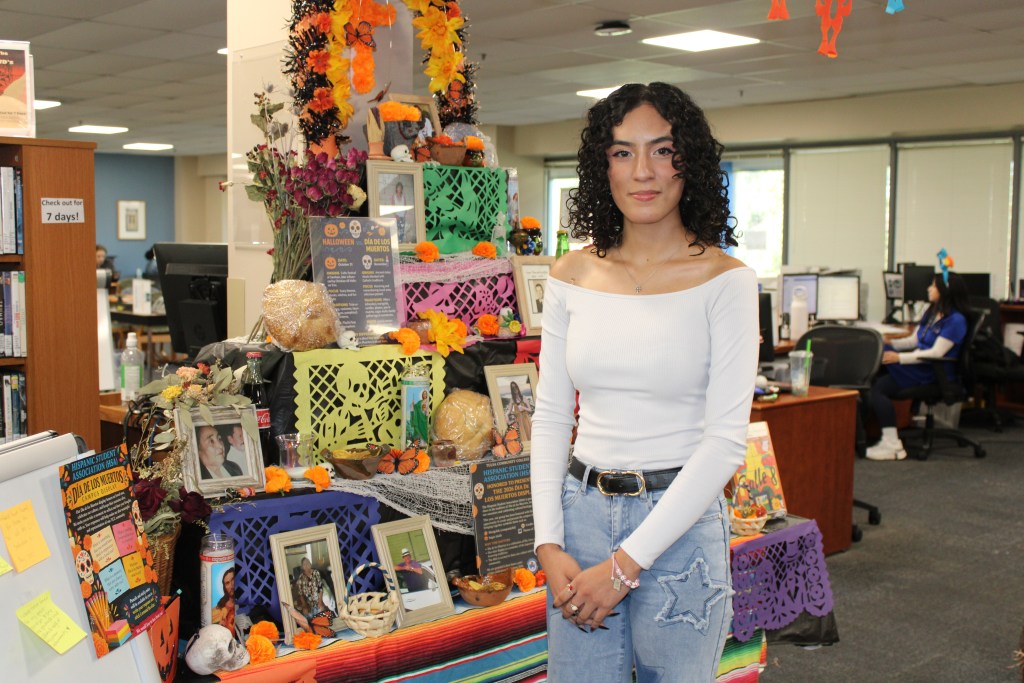
She says she never had the chance to meet her but knows how important it is for her family and her mother to honor her great-grandmother’s life. It brought her family joy knowing she was on their altar.
“She was really connected with my mother,” Hernandez said. “My mom loved her so much. She would always say that she had a solution for everything. So if she ever felt sick … she knew exactly what to do.”
Hernandez sometimes feels guilty for not knowing about the tradition beforehand. She first learned about it from Disney Pixar’s “Coco.”
“Día de los Muertos for me is the remembrance of someone I’ve loved in the past, but it’s almost like a ‘see you later,’” she said.
As president of the student association, Gómez also wanted to give other students a space to write something meaningful if their loved one wasn’t represented on the altar. She offered prompts, including:
- What is something that you would have liked to experience with a loved one?
- What is a memory that you always carry with you?
- What is something you would like to say to a loved one?
- What does Día de los Muertos mean to you?
“I just want to say I miss you more than life itself,” wrote one student. “You’re an everyday reminder to always “keep on keepin’ on!” I wish you could be here to see me finish. Until we meet again.”
“I would have loved for my great-grandpa to see me graduate and celebrate all of my other achievements,” wrote another.
A writer added: “Día De Los Muertos to me is: The ability to still connect with my Mexican heritage and a way to honor those (even if I don’t know them) who have passed. I also use it in a way to celebrate those who were forgotten.”
Gómez says it’s important to honor family members who have gone missing too.
“We have them on the altar just waiting for the day to gather their bodies and bring them back home,” she said.

This article was produced as part of a partnership between the Tulsa Flyer and La Semana, a Tulsa-based bilingual Spanish-English newspaper serving Latino communities in Oklahoma.
News decisions at the Tulsa Flyer are made independently of our board members and financial supporters. Read more about our editorial independence policy here.