

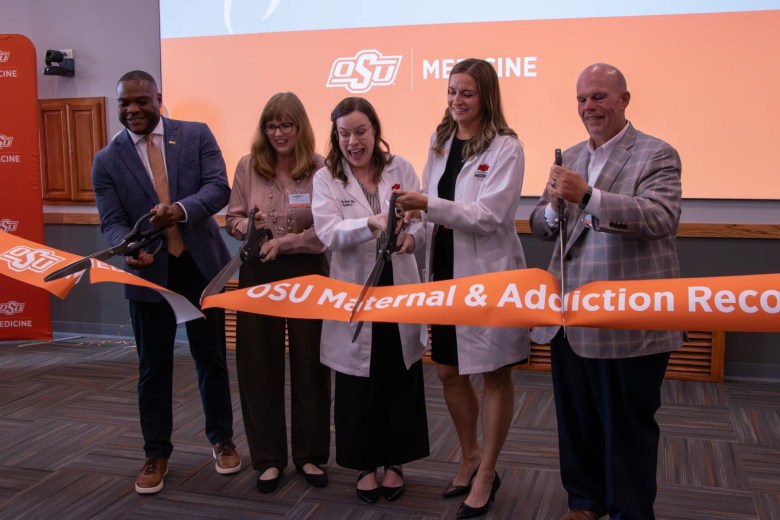
For pregnant women struggling with substance abuse, getting help can mean navigating a maze of medical appointments, treatment providers and social services. A new program at Oklahoma State University Medicine in Tulsa will combine addiction treatment and maternal care under one roof.
The OSU Maternal and Addiction Recovery Care Program is the first in eastern Oklahoma to bring together board-certified addiction medicine and OB-GYN physicians. They will deliver integrated pregnancy, addiction treatment and wraparound support for pregnant and postpartum patients struggling with opioid, alcohol and other substance use disorders.
Patients in the program will have access to doulas, lactation specialists and pediatricians during pregnancy, along with addiction treatment including medications to treat opioid use disorder. The program welcomes referrals from OB-GYN providers, primary care physicians, emergency departments, behavioral health professionals, community organizations and social service agencies.
Organizers said the effort reflects a growing recognition that maternal health and substance use treatment cannot be addressed effectively in isolation.
“Too often, people facing addiction encounter barriers that make it hard to seek help,” said Tulsa Mayor Monroe Nichols during the program’s launch event Tuesday afternoon. “… Our healthcare approach shouldn’t really require them to navigate a complicated system on their own.”
Nichols said resources should be available to pregnant mothers before they are in a moment of crisis, and that increasing opportunities for compassionate, comprehensive treatment will hopefully save the lives of women and their children.
“Providing this level of care is a shared responsibility,” he said.
The George Kaiser Family Foundation committed $100,000 to launch the program. Kimberly Butler, a senior program officer for the foundation, said it would be willing to grow that commitment, depending on need.
The program opened its doors a few months ago and has already cared for 25 patients, said Dr. Erin Brown, chair of the obstetrics and gynecology department at OSU Medicine. Participants can be seen up to 12 months postpartum.
Organizers hope to expand the program’s reach beyond Tulsa, using telehealth to partner with rural hospitals.
Addressing gaps in maternal care
Dr. Kelly Dunn, chief of addiction medicine at OSU Medicine, said mental health and substance use conditions among pregnant mothers are more common than people might expect.
Nationally, about one in seven pregnant women met criteria for a substance use disorder within the previous year between 2021 and 2023, according to a recent study. Only one in ten women received treatment.
“Those numbers represent women who deserve effective care and families whose futures we have an opportunity to change,” Dunn said.
Mental health conditions were the leading underlying cause of pregnancy-related deaths in 2022, according to most recent data from the Centers for Disease Control and Prevention. Substance use disorders were also a significant contributor to deaths.
Jill Hughes is a program director with the Oklahoma Perinatal Quality Improvement Collaborative, which works with Oklahoma birthing hospitals and perinatal providers. The group recently launched the Oklahoma Maternal Addiction and Mental Health Assistance initiative, a statewide effort to improve care for pregnant and postpartum patients experiencing mental health conditions and substance use disorders.
Hughes said the topic of maternal mental health has seen renewed focus. One notable case features former labor and delivery nurse Lindsay Clancy. The 36-year-old woman is facing murder charges for killing her three children in Massachusetts. Clancy’s attorneys have argued her mental state was impaired by postpartum psychosis. The case is still ongoing.
“I think that there’s been a lot of attention on it this past year that has led us as a nation to say, what are we doing or what are we not doing?” Hughes said. “And I think that that gives fuel to the fire in a good way, because it allows us to then all come to the table together.”
Recent data from nonprofit Pregnancy Justice found that Oklahoma prosecutors initiated at least 222 criminal cases related to individuals’ pregnancies and births from June 2022 to 2025. The majority of the nation’s 902 cases involved allegations of substance use during pregnancy, and most individuals were charged with some form of child abuse, neglect or endangerment.
Most cases involved live births and low-income individuals, and 854 of the 955 criminal charges brought against people required no proof of harm to the fetus or infant.
Medical and child welfare systems were involved in many of these cases. Dr. Brown from OSU said she hopes the program will help Oklahoma Human Services view participants more favorably.
Brown said motherhood is a meaningful and transformative experience, one that can motivate individuals struggling with substance use to seek treatment and begin recovery. Oftentimes, they don’t know where to start.
“Too many of these women go without the care they need, sometimes until they arrive at the hospital in labor,” Brown said. “But we have an opportunity to change that story.”
This article was originally published by KOSU. You can see the original story here.