

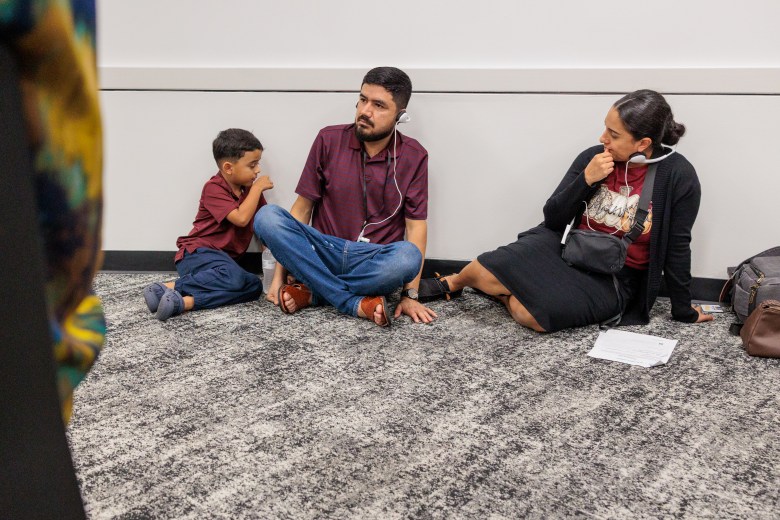
Dolores Huerta Elementary parent Beatriz Noriega learned about the potential closing of her school via email. The district’s plans were in English and Spanish and included the community meeting notice.
Though Tulsa Public Schools’ communication was comprehensive, Noriega said she felt like families didn’t have any influence.
“When they decide, I believe it won’t matter, they won’t care about our children or our opinions,” Noriega said in Spanish.
Her biggest worry is how another school will care for her son with special needs.
“Alexander is a nonverbal, autistic boy, who still doesn’t go to the bathroom, and (Dolores Huerta staff) gave me a lot of confidence in them as a team and knowing how they prepare to attend to my son’s needs,” Noriega said.
Noriega has experienced this before with TPS. Her oldest daughter’s former school, John Paul Jones Elementary, closed in 2020.
“I experienced this with another school and they didn’t care about our opinions or what we did — the school was still closed,” she said.
Aquí encontrará toda la información en español sobre los planes para cerrar las escuelas.
- Resolución del Consejo de Administración
- Transmisión en vivo de la reunión del 8 de septiembre de 2026
- Preguntas Frecuentes
- 21 de septiembre de 2026: Presentación de la propuesta del superintendente
- Transmisión en vivo de la reunión del 21 de septiembre de 2026
- 21 de septiembre de 2026: Carta del superintendente a las familias y al personal
- Presentación de la sesión informativa para la comunidad del 29 de septiembre de 2026
- Transmisión en vivo de la reunión del 5 de octubre de 2026
- Actualización de la resolución de la Junta del 5 de octubre de 2026
- Actualización sobre los servicios de educación especial
- Presentación de la sesión informativa para la comunidad del 7 de octubre de 2026
With the TPS board expected to vote on a consolidation proposal Monday, the Flyer examined efforts to reach the Spanish-speaking Hispanic community. Twelve of the 17 campuses on the closure list are majority-Hispanic, though families speak a mixture of English and Spanish.
About 30 different pieces of information have been used for outreach to the Spanish-speaking community, according to information TPS shared with the Flyer. That started with the early September board resolution translated on the TPS planning page and included several Spanish newsletter blurbs, social media posts and one community information session.
TPS administrators propose closing 17 school sites — and affecting 4,726 students — to make up a $12 million deficit. Of those schools, five are located in east Tulsa that serve mostly Hispanic and Latino communities.
Of the seven community information sessions, one was hosted entirely in Spanish. The district originally planned an entirely virtual Oct. 7 meeting focused on Spanish speakers due to fears of meeting in public spaces due to immigration enforcement, TPS spokesman Kyle Boone said. It was later made hybrid, with families invited to attend in-person as well.
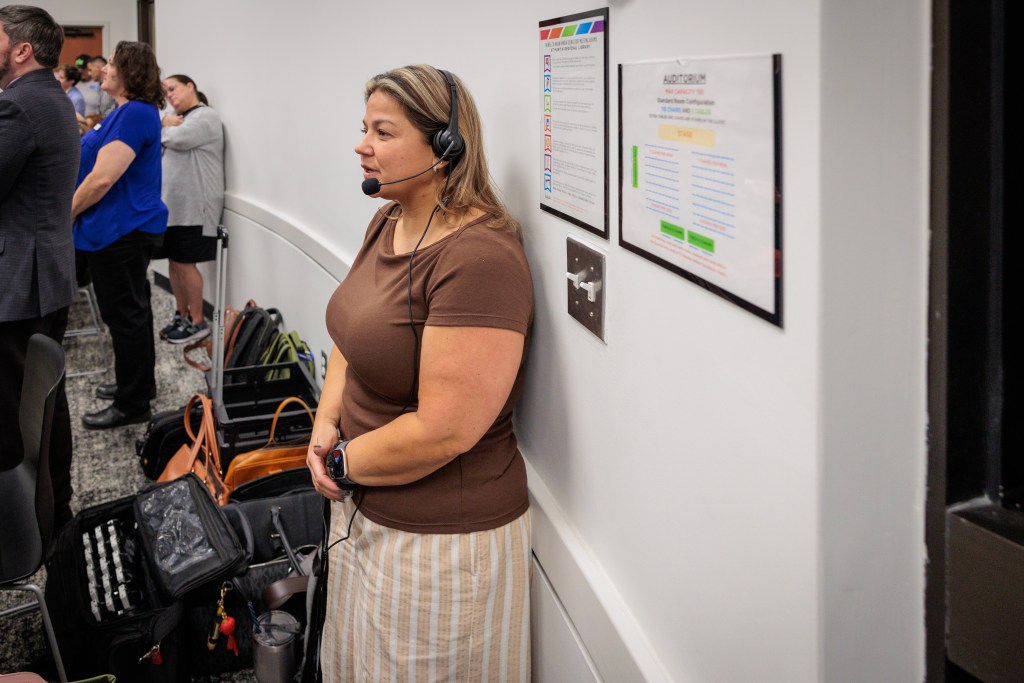

Each session included a Spanish-language interpreter and equipment to hear the information in other languages.
The first meeting offered a FAQ sheet only in English. Boone said that was an oversight.
“When we had people ask for it in Spanish, we directed them to the page and said, ‘You can view it in Spanish,’” Boone said. “That’s not good enough. So moving forward, we’ll have all of them translated into Spanish.”
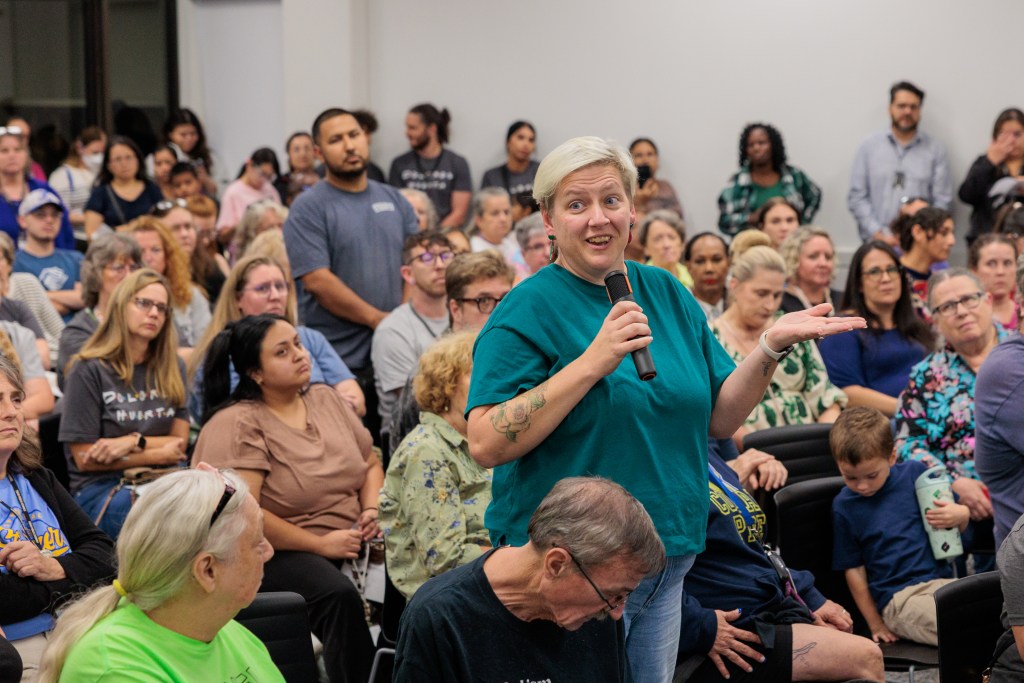
Superintendent Ebony Johnson emphasized during a Sept. 29 community information session that the Hispanic and Latino communities are the largest student population enrolled in every school.
“So then, no, it’s not targeting any one particular group of schools because there’s Latinos in those schools,” Johnson told attendees. “Absolutely not.”
Shaiba Salcedo, a parent at Dolores Huerta Elementary School, speaks English and Spanish. She found out about the consolidation plan in English on Facebook.
“They’re always there willing to give us the information,” Salcedo said. “…They’re always there translating the papers. They’ve never given us anything just in English, you know, it’s always been in Spanish.”

She was shocked by the proposal and said a lot of people didn’t fully understand what was going on, and her children were upset.
“You would think that it is just another building being closed, but it’s not,” Salcedo said. “I feel like we’re going to these meetings and we’re not getting told another, like, option, another opinion, another like, ‘Oh well if this doesn’t work or if the community as a whole isn’t happy, we can do this instead.’
“They’re not telling us that. They’re basically just telling us, ‘This is what we’re going to do,’” she added.
What translation services does TPS offer daily?
The district’s first Spanish-language outreach effort was creating the Facebook page Escuelas Públicas de Tulsa. It’s the most popular platform for reaching Spanish-speaking families, said Maricarmen Mitchell, manager of the TPS Bilingual, Immigrant and Refugee Services department.
TPS offers different languages through TalkingPoints, a two-way communication tool with families. Board meetings viewed online have a Spanish-speaking interpreter.
How to access language assistance at TPS
Parents needing language assistance can email languageassistance@tulsaschools.org or call 918-746-6730. Other numbers can connect to specific languages:
- Spanish Line: (918) 387-8580
- Hmong Line: (918) 771-9617
- Pashto Line: (918) 771-9382
- Dari Line: (918) 890-1439
- Marshallese Line: (918) 228-4944
- Arabic Line: (918) 818-3536
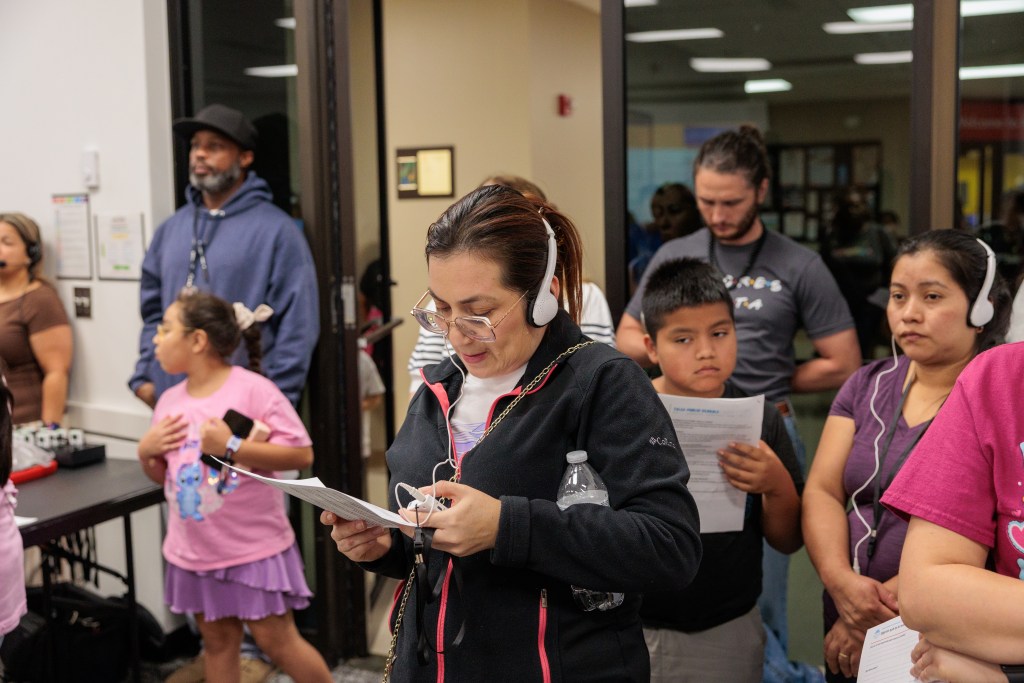
TPS has 247 certified interpreters qualified to provide interpretation services to parents and families. The district has 80 cases of interpretation equipment, with each case having 20 individual devices. These were available for use at each of the recent community sessions.
“We have more bilingual staff than that number,” Laura Grisso, executive director of Language and Cultural Services for TPS, said. “Not everybody wants to do this in addition to their regular responsibility.”
What about other languages aside from Spanish?
TPS’ most common non-English languages are Spanish, Hmong, Chuukese, Marshallese and Pashto, Mitchell said. Dari is another language used among the district’s Afghan refugee families.
Some languages have few printed resources, Grisso said.
“If somebody says, ‘Can I have a Chuukese dictionary?’ The answer is no,” Grisso said. “They are not accessible. I do not know if there is one. So what we do in those cases, because those are noticeable size populations, is we build relationships with community leaders.”
For example, a pastor at a Chuukese church is often called by TPS to help interpret at parent meetings. Sometimes, people from Arkansas or Kansas are contacted for assistance, Grisso said.
“They’re just rarer languages and that’s why we leverage a lot of the local relationships and work through the community kind of differently than we do with Spanish because it’s so prevalent,” Grisso said.
“Numbers-wise, our Spanish population is so overwhelmingly larger than everybody else. It’s in the five digits and the next group next to it is in the three digits. So, that’s why our efforts are that way, but we do it for anybody that wants it,” she said.


This article was produced as part of a partnership between the Tulsa Flyer and La Semana, a Tulsa-based bilingual Spanish-English newspaper serving Latino communities in Oklahoma.
News decisions at the Tulsa Flyer are made independently of our board members and financial supporters. Read more about our editorial independence policy here.