



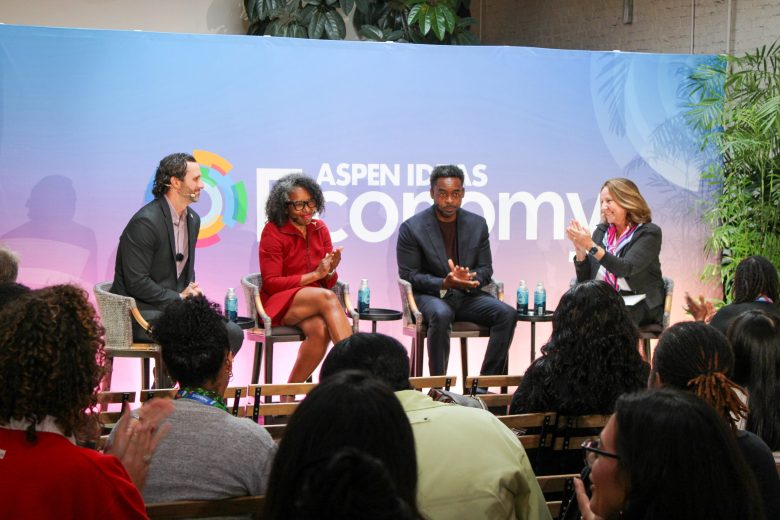
Building better health outcomes in communities like north Tulsa takes more than access to a doctor’s visit, according to experts who discussed solutions at the final day of the Aspen Ideas: Economy conference in Tulsa.
Held on the tailend of the national conference, the three-person panel featured Dr. Jabraan Pasha, the city’s chief health officer; Canaan Duncan, deputy secretary of state of the Cherokee Nation; and Dr. Kimberly Henderson, head of wealth management at Morgan Stanley.
The talk covered a range of topics under the umbrella of health, like transportation and childcare and access to healthy food options.
“Most humans spend less time inside the doctor’s office than outside the doctor’s office, so their degree of health turns on things that don’t have anything to do with the little blue pills and the amber vial that you pick up at the pharmacy,” Henderson said.
One of those things, Pasha said, is the need for healthy food options. He used north Tulsa as an example of how a lack of them can affect a community’s wellbeing.
“(In north Tulsa), you can set out in any cardinal direction, and you will run into a dollar store before you’ll run into a grocery store,” he said. “Those sorts of things impact health in a significant way.”
North Tulsa is home to only one full-service grocery store while there are more than a dozen dollar stores. District 1 Councilor Vanessa Hall-Harper led a campaign to install a moratorium on new dollar stores in 2017. The city later amended its zoning code to require all discount stores to be built at least a mile apart.
The city’s equality indicators report notes the average north Tulsan only lives for 3.3 years once they reach the age of 66 while the average south Tulsan lives for another 12 years after retirement age.
Despite the area being a part of the Cherokee Nation Reservation, Duncan acknowledged a historical lack of investment the tribe has been trying to rectify.
He noted a 2024 public health and wellness fund started by the tribe, specifically meant for capital investments. This ultimately led to the creation of the north Tulsa community center which houses a senior nutrition site where the elderly can eat for free or at a reduced cost Monday through Friday.
“In north Tulsa, they wanted access to public parks, to outdoor green spaces. They needed access to healthy and nutritional meals each and every day,” Duncan said. “We’re taking that model that we did in north Tulsa and we’re doing it throughout the reservation.”
Despite working for the city, Pasha cautioned against relying solely on government initiatives to solve health issues. He described those efforts as expensive and relatively shallow in impact.
He pointed toward the $17.3 million Tobacco Settlement Endowment Trust grant as an example of how to not stretch city resources too thin due to the nine collaborators that took part in the process.
However, the city did use some of the funding to launch its neighborhood conditions index, which showcases social drivers of health data. That information helps officials determine which neighborhoods need the most help and deploy resources there.
The panel ended with questions from the audience, which ranged from how communities can invest in new mothers, how corporations can better support their employees and identifying the main benefactors of the healthcare system.
Henderson told the audience she wanted them to leave understanding healthcare problems won’t and can’t be fixed unless people continue to discuss solutions.
Ismael Lele is a Report for America corps member and writes about business in Tulsa for The Oklahoma Eagle. Your donation to match our Report for America grant helps keep him writing stories like this one; please consider making a tax-deductible gift of any amount today by visiting this link.
