


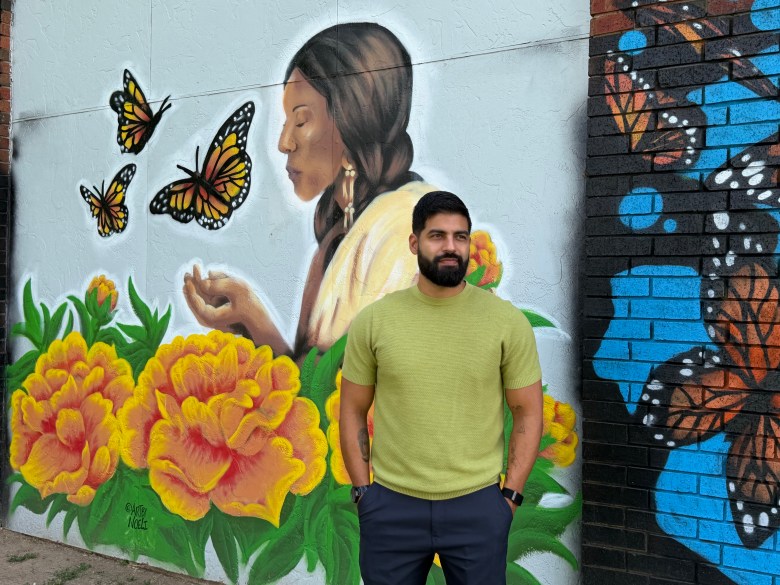
Carlos Canizales was 24 when he went to therapy for the first time. As a Hispanic man, he couldn’t believe his diagnosis.
“I was diagnosed with anxiety and depression,” he said. “And I said, ‘That’s not possible because I’m a man.’”
It took him a long time to understand and then learn to regulate his emotions with the help of therapy. Now 34, Canizales spends his time teaching others how to do the same.

On any given day, you can find Canizales behind a desk at El Centro, a Tulsa-based organization focused on empowering migrants. As the administrative coordinator, he helps them with budgeting, payroll, planning and more. He’s been with the organization for a year, even launching a music school with El Centro for children in east Tulsa.
On the side, Canizales is a life coach. He hosts free workshops and one-on-one sessions in Spanish, helping people in east Tulsa and virtually across the globe on how to better manage their mental health.
“When we think about mental health, we don’t have a budget for it,” he said. “We often think about having a budget for food or a budget for bills or for the doctor, but our mental health is not a priority.”

Facing mental health head on as a Hispanic man
Canizales was used to the stigma of mental health as a Hispanic man, especially growing up with four brothers in Costa Rica.
“If I would cry, my brothers would say, ‘Men don’t cry,’” he said. “Or if I was sad, ‘We aren’t sad.’”
The more he learned about his emotions, he says he accepted that they existed within him. He searched for multiple ways to help himself.
Canizales says he believed there were more people like him who felt like mental health didn’t affect them and saw it as an external force.
“But when those people are in situations they don’t understand, who helps them?” he said.
This was when he decided to become a certified life coach. He started hosting workshops and one-on-ones with people in Costa Rica. He eventually accepted virtual clients too.
Canizales moved to Tulsa a year and half ago with his wife, Brittne, who is from the area. She was starting a nonprofit organization called The Elevate Project, which provides one-on-one bilingual therapy and group counseling for Latino youth. He wanted to support her dream.
Once he moved to Tulsa, he started hosting mental health workshops for the Hispanic community. Soon, he got the attention of the executive director at El Centro, who hired Canizales a year ago as a program coordinator. He was promoted to administrative coordinator in August.
“For me, El Centro has been the path of getting to know the Hispanic community,” he said. “I’ve (seen) the need that there is for regulating emotional and mental health and the need for resources.”
Teaching others how to understand and regulate their emotions
Now in his eighth year as a life coach, he says more women than men take his workshops because of the stigma — about 80% are women.
Men don’t want to talk about mental health or sometimes deny they have anxiety, he says.
“‘I’m good, I don’t need that,’ those are typical comments we men have,’” he said. “‘Why do I need it? I can do it alone.’”
How to connect with Canizales
Reach out to Carlos Canizales via email at carlos@carloscanizales.com or by phone at 918-998-3196 to schedule a one-on-one session or a group workshop with your organization.
Andrea Parrado, a program manager for UMA Tulsa, a nonprofit largely serving Latino communities in east Tulsa, says she connected with Canizales through his work at El Centro.
Parrado says his portfolio was exactly what UMA was looking to present to their program participants about healthy lifestyles.
“He gave participants the tools to manage anxiety and stress and the barriers we face emotionally every day,” Parrado said.
This type of workshop is important to help the Latino community feel empowered to improve their health and face the barriers they face as immigrants in the United States, Parrado said.
“It’s creating a safe space for them and with people who speak their language, and who understand their difficulties and barriers, while also connecting them to the culture of this country and the resources in this country,” Parrado said.
During a workshop or one-on-one session, Canizales teaches participants how to recognize and manage stress, anxiety and other emotions. People know when they get anxious but don’t know what to do with the emotion, he says. That’s where he comes in.
Canizales helps people create “first aid kits.” He knows they aren’t going to therapy in the middle of the night, so the kits include activities they can do in the moment.
“We know when we’re mad or when we’re anxious, but what’s missing is how to regulate emotions,” he said.
Canizales says people don’t worry about their mental health until they need help. He believes the community needs to work on creating healthier habits and preventative measures before they are struggling.
“One way to prevent it is to learn and educate yourself about mental health,” he said.
This article was produced as part of a partnership between the Tulsa Flyer and La Semana, a Tulsa-based bilingual Spanish-English newspaper serving Latino communities in Oklahoma.
News decisions at the Tulsa Flyer are made independently of our board members and financial supporters. Read more about our editorial independence policy here.