


On Feb. 9, Asher Jay showed up at the downtown Tulsa Day Center in his wheelchair sobbing and scared. The 20-year-old made his way from 71st Street and Memorial Drive after being asked to leave an apartment shared with a sibling because he wasn’t on the lease.
He arrived at the homeless shelter with no money and no identification. His anxiety was at an all-time high, worsening symptoms related to his other disabilities: tachycardia, neuropathy and autism.
“I didn’t have anywhere to go. I just ended up homeless,” Jay said. “I was outside a Sonic because that was the only place I could buy a water and sit. I thought, ‘I can figure this out.’ So I looked up a homeless shelter, got to a bus stop and came here crying.”
Jay missed being counted in the annual Point-in-Time Count by just about two weeks. He was couch-surfing at the time, but would have been counted if he had been on Tulsa’s streets Jan. 23. That is the required federal census of people living in shelters and on streets for a specific day in January. The data is used to determine funding from the U.S. Department of Housing and Urban Development.
Results from January’s snapshot of Tulsa’s homeless shows a leveling off of the population after significant increases since the expiration of pandemic-era federal funds. The count of 1,443 people is six less than the previous year, where 1,449 were counted.
Tulsa’s census of people experiencing homelessness was rising well before the pandemic. A decade ago, the count was 811 people and rose each year until 1,221 in 2020. Federal economic stimulus and pandemic funds helped lower the census until three years ago, when the number jumped to 1,389.
Tulsa Mayor Monroe Nichols campaigned in 2024 on a promise to reach “functional zero homelessness” that he describes as rare, brief and non-recurring. Last year, several Tulsa business leaders became frustrated by the visibility of homelessness and called on Gov. Kevin Stitt to take action.
Stitt ordered the Oklahoma Highway Patrol to tear down homeless encampments on state property in what he called Operation SAFE. The effort did not re-house those living in tents but did temporarily clear areas.
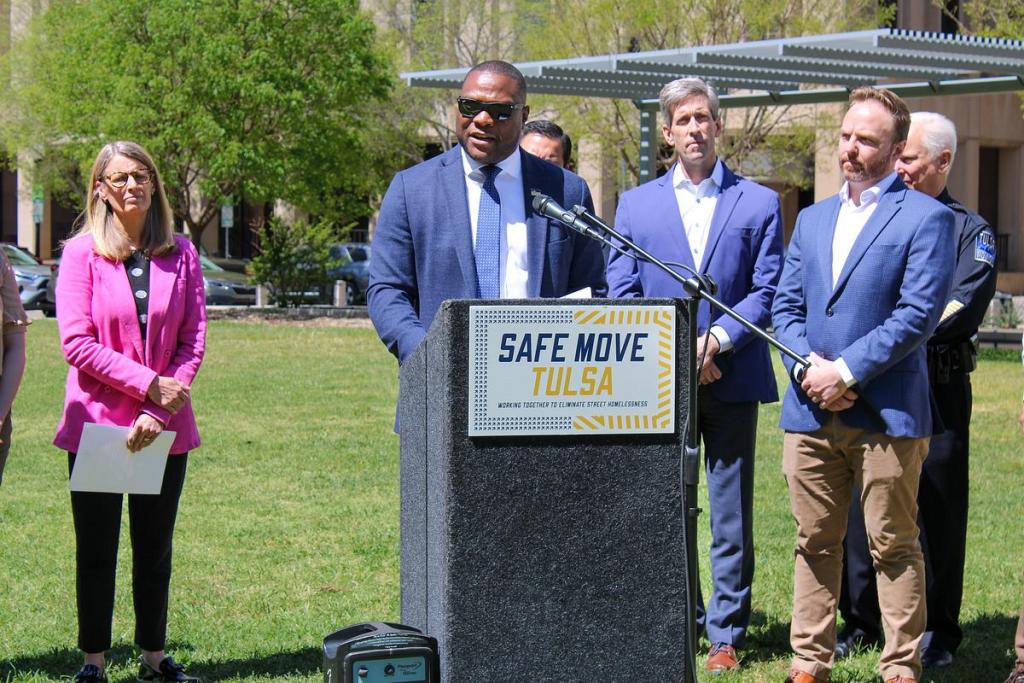
Months later, Nichols announced the Safe Move Tulsa initiative aimed at rehousing at least 300 people and effectively ending homelessness by 2030 through partnerships with Housing Solutions and other organizations serving people without shelter.
Four components of the initiative are camp de-commissioning with a focus on re-housing those being moved; downtown engagement to stop sleeping outside by relocating people to shelters; housing stabilization once a person is moved into a permanent unit; and boosts in mental health service coordination.
It’s funded with $11 million from the city and $4 million from the Tulsa Leadership Council. City leaders said 118 people have been rehoused as of April.

Tulsa Day Center CEO Mack Haltom said the only part not fully in place is the mental health access and wraparound services, which is the most complex and expensive part of the plan.
“I was apprehensive in the beginning, but I’m really supporting the mayor on this,” Haltom said. “He wants to see some effort with this, and I think we are seeing some effects of Safe Move Tulsa. We’re seeing good results. The (PIT) is good news.”
The housing stabilization aspect has launched and in its beginning phase.
For years, the Day Center has operated a rapid re-housing program and started a specialized outreach called the Blue Team for individuals who are living on the streets with mental illness but don’t recognize their disability. The nonprofit is participating in the city’s housing stabilization program.
“The stabilization pieces are going to be the toughest for some of these individuals,” Haltom said. “My concern is people going back into homelessness after being housed. I know we’ll get there, but that has always been my concern.”
Top reasons leading to homelessness in Tulsa are lack of affordable housing, loss of income, mental health challenges, job loss and substance use. The census found one-third of people without shelter experienced domestic violence, 14% are employed, 8% are veterans and 77% have a disabling condition.
Jay falls into several categories, though only 18% of Tulsa’s homeless population are younger than 24. He says his disabilities may be a byproduct of being born addicted to drugs. He said he was in foster care and eventually adopted but was kicked out after identifying as LGBTQ+.
He arrived at the shelter and immediately met with social workers, who started the process of getting identification documents. He is on a waitlist for a housing voucher for a handicap-accessible unit. His dream job is to work in art or in creating online content.
“When you look at people here, you can see who has given up and who hasn’t,” Jay said. “I refuse to let go of hope because I don’t want to be homeless the rest of my life. This sucks, but it could be worse. I could be out on the streets.
“I hold on to that hope and find one good, beautiful thing in life each day. It takes having nothing to appreciate everything.”
News decisions at the Tulsa Flyer are made independently of our board members and financial supporters. Read more about our editorial independence policy here.