


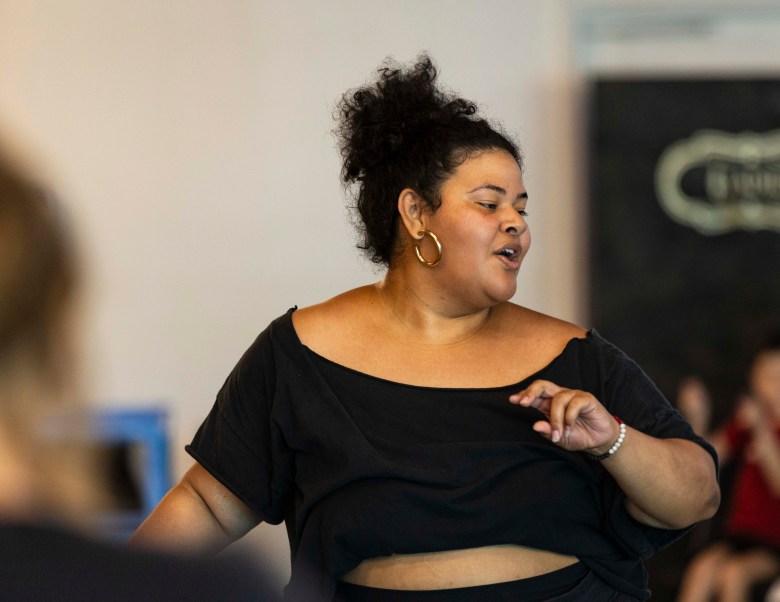
Charity Lynn Velazquez-Crenshaw commands the room easily at Tulsa’s Bluey Creations space. She stands at the front of the dance studio and doesn’t even have to say “let’s begin” before everyone quiets down, takes their spot and gets ready to stretch.
“Even if you aren’t part of the culture, it’s important to honor our ancestors,” Velazquez-Crenshaw, co-founder of the arts organization Legacy Foundation Creations, says to the group on a recent Sunday afternoon as they begin to dance.
Velazquez-Crenshaw has shared the movements of Afro Latin fusion dance with other Tulsans for the last seven years. It’s her way of connecting with her roots while also sharing the history with others.
“For me, it’s like I’m dancing with my ancestors,” she said. “I am embracing the struggles that they went through.”
Afro Latin fusion dance incorporates salsa, bachata, hip-hop, cha cha cha and other dance styles together. They can be paired with non-Afro Latin music or with it.
“Sometimes it’s not all those combos at once,” she said. “It could be one day, ‘OK, I want to do bachata and maybe some hip-hop here.’ One day can just be Afro and salsa. Another day could just be a dose of a little bit of everything.”
Connecting dance to identity
Music, culture, history and dance were always part of her life. Her dad was always dancing hip-hop and salsa, but he never taught her. So she taught herself.
The desire to dance only grew. She learned traditional dances from her other cultures, including traditional Pacific Islander dances.
“I felt like music and dance, it helped me a lot through my own situations as a young kid and then also like trying to find my identity,” Velazquez-Crenshaw said.
It wasn’t until high school when she was around other Black and brown kids that she felt truly seen. For the longest time, she only saw herself as Puerto Rican. It wasn’t until one of her friends told Velazquez-Crenshaw that Blackness was also part of her identity that she started to research.
Later on, she went to one of her cousins to ask questions about identity. She asked them if they considered themselves Afro-Latino. They said yes and to just be proud of who you are, she remembers.
“Something clicked in my mind, you know, everything settled,” she said. “… I didn’t even know I was holding in so much. It made teaching dance easier. I didn’t realize that I was holding so much expression of my culture.”
Teaching Afro Latin fusion dances
It’s important to Velazquez-Crenshaw to teach the history of fusion dances. While teaching a class, she explains the background of the movements and why it’s danced a certain way.
“We go through every intricate detail so people can understand why we dance the way we do, why people dance the way they do, why the music is played this way, why it’s danced in this way and how it affects the culture and in life all around the world today,” she said.
Indra Coronado met Velazquez-Crenshaw through her husband when they danced together in a hip-hop event about four years ago. Velazquez-Crenshaw eventually asked Coronado if she would be interested in joining the Afro Latin fusion dances.
Coronado, who is Mexican, knew about salsa and bachata, but she didn’t grow up dancing those styles. She appreciates how Velazquez-Crenshaw sets up her classes and places an emphasis on the history behind the dances.
She believes Velazquez-Crenshaw’s experiences as an Afro-Latina have helped with her resilience. It only motivates her to share the cultures and injustices of those who created the dances to express their joy through performance, Coronado said.
“I feel the most welcomed and encouraged with Charity and in the events she puts on within the dance community because I, myself, have a really strong belief that it’s important to honor the histories and the roots of these dances and the cultures that they came from,” she said.
Audrey Godwin, another member of the dance community, said understanding the roots of the dances is important to her. Godwin has been told she wasn’t Puerto Rican enough growing up because she wasn’t born on the island.
“I’m like, ‘Bro, your passport is an American passport, right?’ We don’t have separate citizenship yet until we become our own sovereign nation,” Godwin said. “(The classes) are a great place to talk about that push and pull between the island and the diaspora.”
Oftentimes, Velazquez-Crenshaw connects with folks who already have an understanding of Black and brown experiences, but she’s learning to teach classes to those who don’t understand what it means to be Afro-Latino.

What’s next
Legacy Foundation Creations is focused on partnering with Tulsa organizations, Velazquez-Crenshaw said, with a desire to have a widespread community impact. The organization is also discussing the possibility of bringing back weekly classes.
Overall, Velazquez-Crenshaw’s biggest goal is to bring more freedom into other people’s lives through movement. She wants people to understand that dance is resistance and Afro Latin fusion comes from people battling racism in the past.
“They fought through so many things for us to have these dances and this music to have joy,” she said. “They had the joy back then too, you know? They had a lot of joy, but their reality wasn’t as real as what we’re facing today. You know, we’re not facing segregation, but we know that there are oppressive systems.”
This article was produced as part of a partnership between the Tulsa Flyer and La Semana, a Tulsa-based bilingual Spanish-English newspaper serving Latino communities in Oklahoma.
News decisions at the Tulsa Flyer are made independently of our board members and financial supporters. Read more about our editorial independence policy here.