

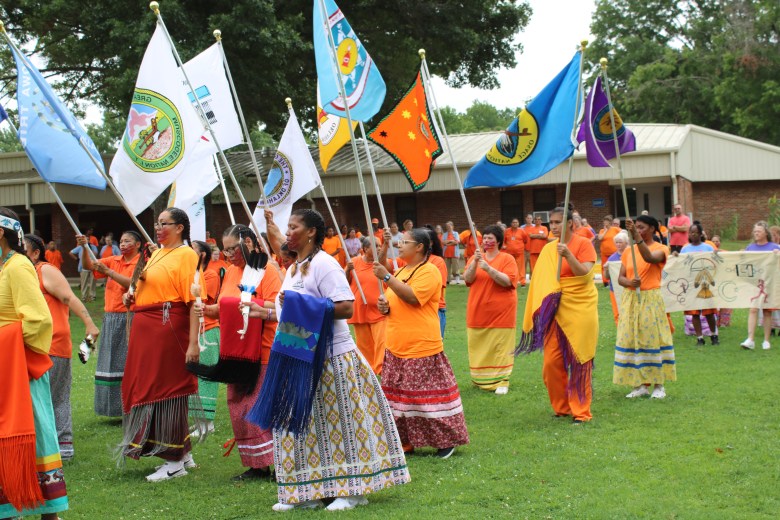
TAFT — Joycee “Hawwinpii” Newrider, of the Otoe, Pawnee and Osage nations, remembers sitting in a small room with one other person, listening to music on a CD during what was supposed to be the Native American service in 2021. She prayed for the future of opportunities on the yard.
Years later, her prayers are being answered.
Native Americans are communal people relying on community bonds, music and dance to connect to their heritage and history. This can be difficult due to restrictions and policies while incarcerated. Yet the last year has reintroduced Native cultural opportunities on the yard in many ways.
The Indigenous Women’s Club worked alongside Jonathan Hook, a Cherokee Nation citizen and president of the Intercultural Partnership Council, and other volunteers to bring opportunities in the form of a sweat lodge, Wellbriety classes and other cultural traditions to the Eddie Warrior Correctional Center for improving the lives of inmates.
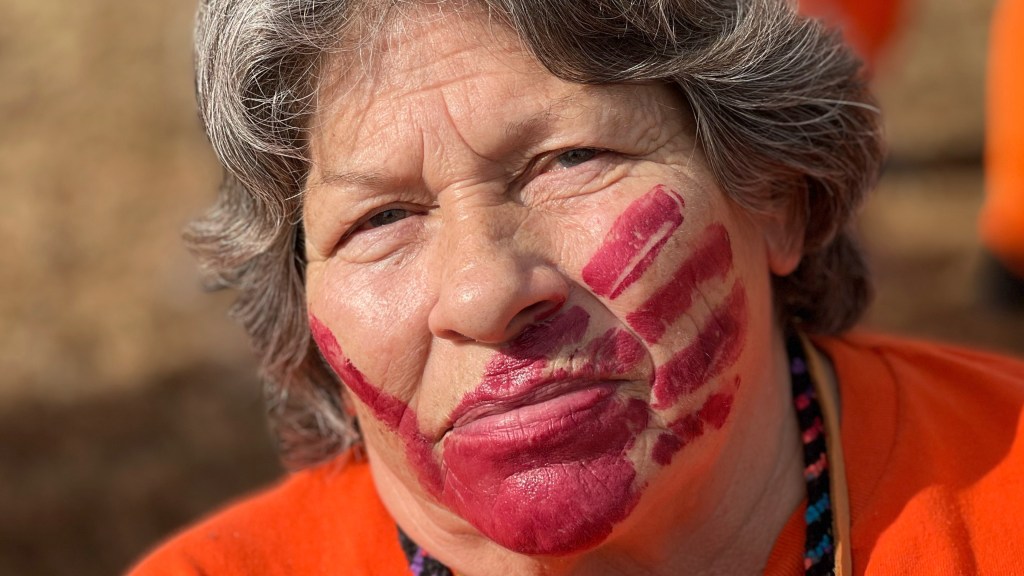
Mary Meadows displays the symbol of Missing and Murdered Indigenous People on her face during a November 2025 Native American Heritage Month event at Eddie Warrior Correctional Center. Credit: Lance West / Oklahoma Department of Corrections 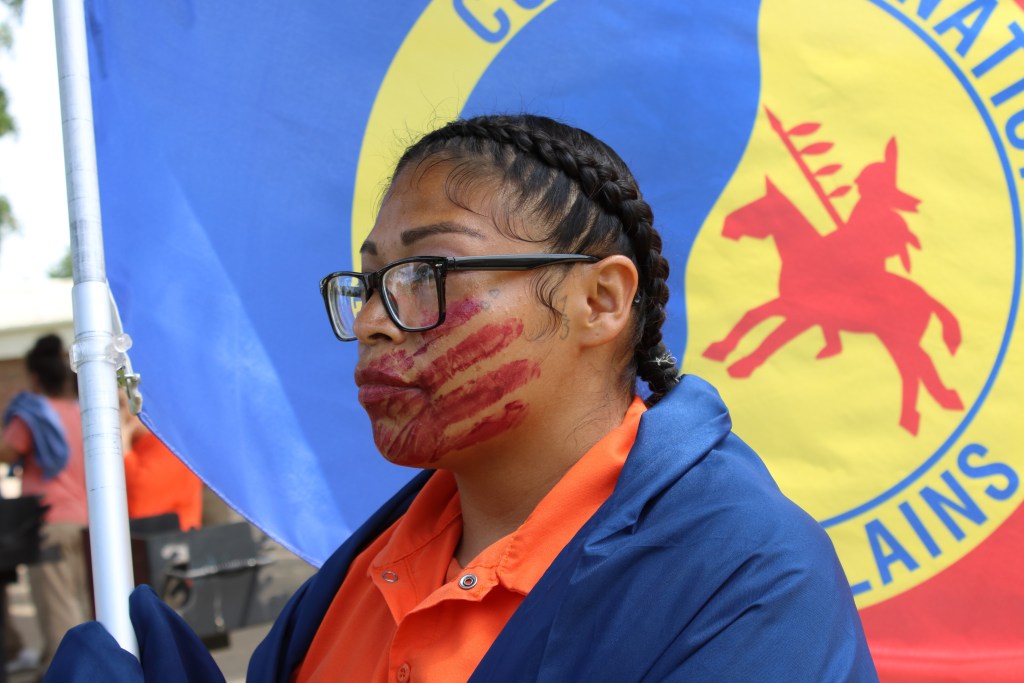
With a red handprint representing missing and murdered indigenous people on her face, Felicia Costilla presents a tribal flag at a July Unity Event at the Eddie Warrior Correctional Center. Credit: Chaplain Shannon Kearns 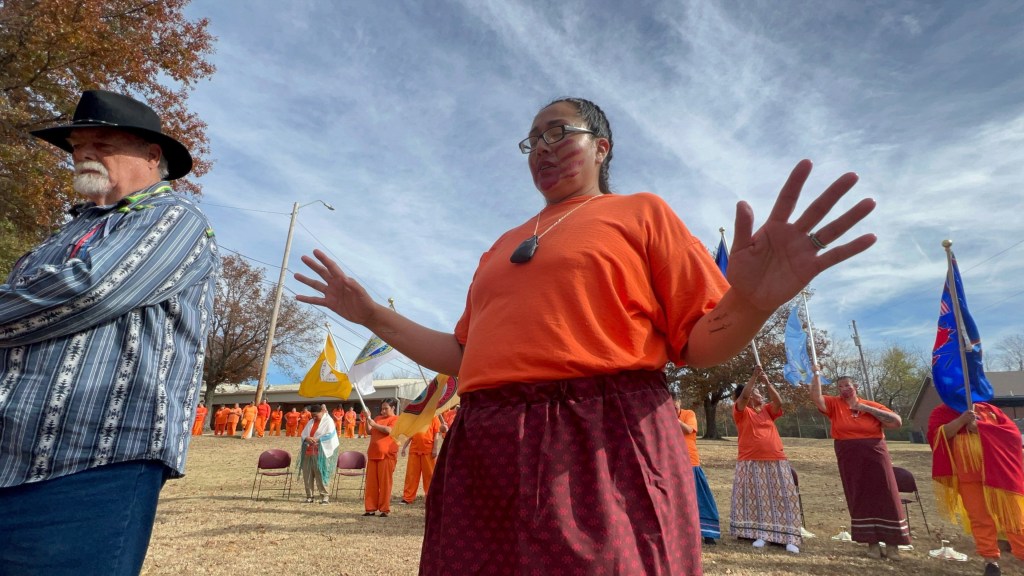
Indigenous inmates take part in a moment of prayer and celebration during a gathering to honor Native American culture at the Eddie Warrior Correctional Center in November 2025. Credit: Lance West / Oklahoma Department of Corrections
“We aren’t the Native Club; we are the Indigenous Women’s Club,” said Stacie Jones of the Seminole Nation. “We are focused on unity and integrating the community we are part of here on the yard.”
For some justice-impacted Natives, being separated from their home communities and lacking the resources to contact their tribes is a struggle that can leave them feeling isolated.
“We want women to know that while they are incarcerated they are still part of their tribe,” said Charlene Killsfirst of the Apache and Ogalala-Lakota Sioux nations. “We offer resources to help women get in contact with their tribe, and many tribes offer assistance for incarcerated individuals.”
In the fall of 2025, Hook and his wife, Rose, volunteered teaching women at Eddie Warrior to create Native beadwork projects. From medicine bags and ribbon skirts, this class transitioned from bi-monthly to weekly classes in the chapel earlier this year. They also integrate Native American history lessons into beadwork classes.
A new religious worship class teaches traditional Native hymns and performs periodic smudgings. Recently, in partnership with Hook, they brought in the sweat lodge.
“The cycles of the sweat involve healing, purification, prayer and thanksgiving,” Jones said. “It is a cultural and religious experience, where the lava rocks are our ancestors (grandfathers) and the sweat is our sacrifice and prayers.”
The sweat lodge is a spiritual opportunity to bring oneself closer to the maker. The construction of the lodge is made from willow reeds and branches. The sacred lava rocks are heated in fire to warm the lodge. Water poured on the rocks creates steam, raising the humidity to that of a sauna.
“When you are going through the sacrifice, you begin to feel really close to the women alongside you. I didn’t fully understand the immensity of it, and I came out feeling like a brand new person,” said Rachael Ferguson of the Euchi-Creek Nation.
Wellbriety classes occur twice a month in the chapel. This is the Native cultural approach to 12-step programs. It focuses on the self as a body and spirit with its connection to the creator.
Working through the program utilizes cultural practices to maintain personal wellness and sobriety from mind-altering substances on the “red road,” or the emotional, mental, spiritual and physical health on the recovery journey.
Native dance classes are held in the gym and teach intertribal dances such as Fancy Shawl and Jingle Dress. These prepare Indigenous women to participate in the powwows held occasionally on the yard and beyond the fence.
Through these opportunities, Indigenous women are finding reconnection with each other and with their true selves. Heritage is considered essential for healing and success.
These activities are welcome to everyone in the Eddie Warrior community, not just the Native population.
Oklahoma is home to 39 tribal nations and is named after the Choctaw words “okla” meaning “people” and “humma/homma” meaning “red.” However, the Choctaw people also used “homma” as a war title for people who did not retreat, offering a deeper meaning.
Rebekah Cooper is the co-editor of The Warrior Standard, an award-winning prison newspaper at Eddie Warrior Correctional Center in Taft. The nonprofit Poetic Justice partners with national nonprofit Prison Journalism Project to produce the paper. Cooper is a citizen of the Mvskoke Nation.
News decisions at the Tulsa Flyer are made independently of our board members and financial supporters. Read more about our editorial independence policy here.