


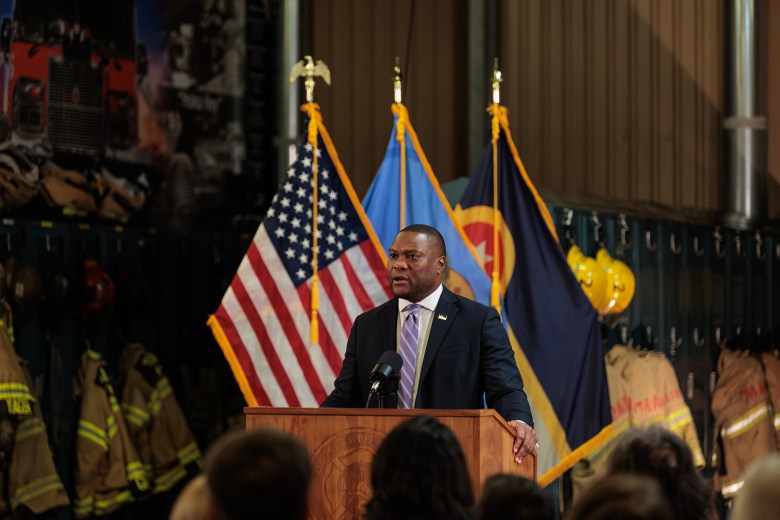
Increased housing stock, decreased homelessness, lower crime rates and rising job growth are just a few wins Tulsa Mayor Monroe Nichols touted during his second State of the City Tuesday.
The address was livestreamed on the city’s channels from Tulsa’s Fire Safety Training Center. His in-person audience included his cabinet members, former mayors and leaders from nonprofit, philanthropic and business communities along with media members. He spoke for about 40 minutes — occasionally swatting at a pair of house flies.
Nichols opened with a moment of silence for a Webster High School student who died Monday in an accident involving a semi-truck in Lincoln County. Several others were injured.
“Yesterday, we lost a shining light in our city in an accident on Turner Turnpike,” Nichols said. “As we gather here, we offer our prayers to a family who lost their pride and joy, to those recovering from their injuries and to the entire Webster High School and west Tulsa community.”
‘Next great renaissance’
When he took office in December 2024, Nichols said early challenges in City Hall led to questions as to how effective his administration could be.
“It’s no secret that some of those challenges have produced disagreements at times — some of which have been in the full view of the public. Some of those conflicts have caused us to ask a number of questions,” Nichols said. “Can the mayor and the council get along? Can the City and the private sector get on the same page on critical issues facing our city?”
Nearly two years later, Nichols said his administration is facing those challenges head-on.
“I’m proud to report that we’re meeting our challenges with the honesty, tolerance, curiosity, perseverance and hope I spoke out on the first day as your mayor,” Nichols said. “And because we are, we’re on the cusp of Tulsa’s next great renaissance.”
Nichols said the Safe Move Tulsa initiative moved 820 Tulsans out of homelessness over the past 12 months, with a goal of housing 1,300 overall. About 25 homeless encampments have been closed at the same time. Additionally, he pointed to the opening of Tulsa’s first 24/7 homeless shelter in December.
In housing, Nichols set a goal to increase the city’s stock by 6,000 affordable units by 2028.
“Since Dec. 2, 2024 — we’ve still got two years by the way — you’ve seen 4,400 housing units completed or permitted, with 2,500 of those meeting that affordability threshold,” he said.
Nichols noted the city’s economic development efforts over the last year, including significant investment in the aerospace industry and job growth.
“Just this year, we’ve expanded our role in aerospace; we’ve become a major player in the space economy; we’ve seen the announcement of nearly 5,500 jobs; and that wage growth has outgrown the national average,” Nichols said.
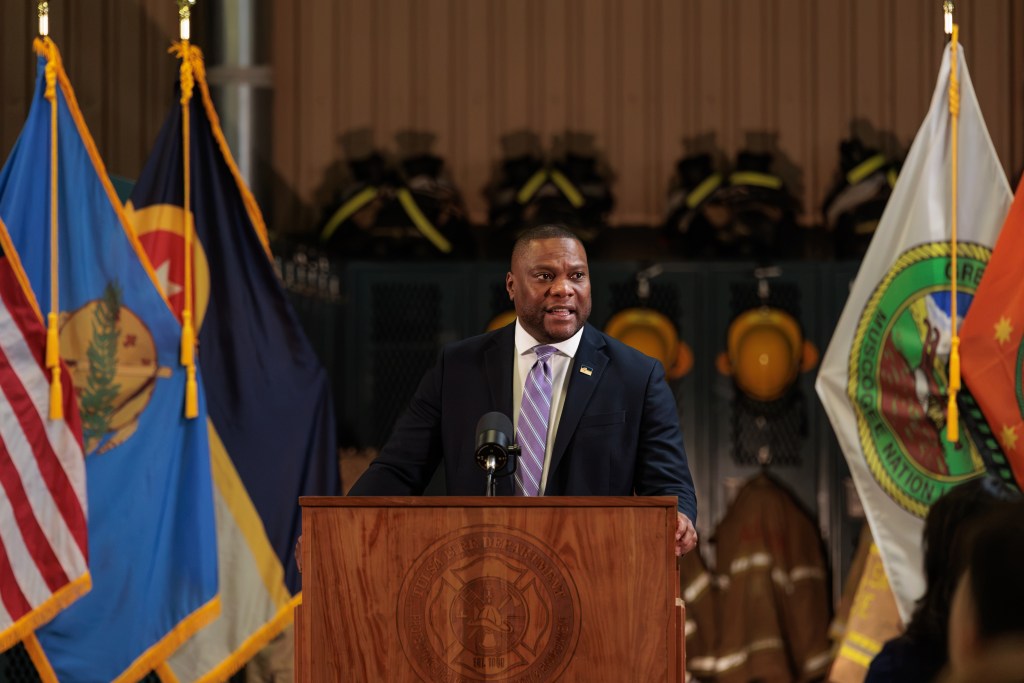
Nichols highlighted outcomes in Tulsa’s public safety — something he restructured on day one of his mayoral term by creating a new public safety commissioner position to oversee all public safety departments. He hired Laurel Roberts to that post and, more recently, he appointed Jonathan Brooks as Tulsa police chief.
The administration is “delivering on public safety,” he said, pointing to “double digit drops” in property crime, a 17% drop in homicides, a near-fully staffed fire department expanding alternative response teams, a new emergency management department and an 82% live release rate for animals at the city’s shelters.
“The data shows we’re trending towards progress,” Nichols said.
Just a week after the midterm elections, Nichols called on Tulsans to bridge divides to create a better city.
“I don’t know that there is a more noble mission than putting aside all divisions in the name of building a better city,” Nichols said. “I hope you all will join me as we continue this journey in being the best city in the country.”
News decisions at the Tulsa Flyer are made independently of our board members and financial supporters. Read more about our editorial independence policy here.
