

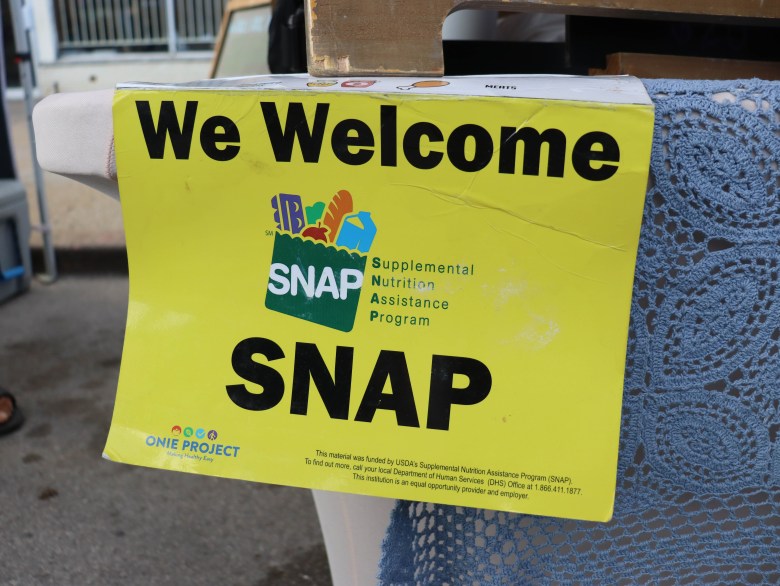
A long-held perception — particularly among Republican officials — is that the country could eliminate the federal Supplemental Nutrition Assistance Program and let charities handle hunger response.
Not true, according to Oklahoma leaders working in the food insecurity space. They say the scale the government can reach is far greater than what charitable systems can muster.
Of all U.S. food assistance programs, 90% to 95% come from SNAP funds. The rest is covered by nonprofits and faith institutions, Hunger Free Oklahoma CEO Chris Bernard said during a recent luncheon at the University of Oklahoma-Tulsa Center for Studies in Democracy and Culture.
“There is no way we can replace SNAP,” said Bernard, who has led the Tulsa-based nonprofit since 2016. “We could bankrupt George Kaiser in a matter of years if we expect to get philanthropy to cover SNAP.”
The Food Bank of Eastern Oklahoma reports increased demand of 12% year-over-year from its 700 partner agencies, including in wealthier cities. The national food bank network Feeding America found every county in Oklahoma exceeded the national hunger rate in 2024.
The state’s free 211 helpline, operated by Tulsa Area United Way, fielded 32,000 calls last year from people looking for help getting food.
Reasons for the rise are myriad, but food policy experts point to the chief reason being the consequence of SNAP reforms passed in the Big Beautiful Bill in July 2025.
The legislation will eliminate $186 billion from SNAP over a decade, add stricter work requirements and shift more administrative costs to states. It changed eligibility of some categories of people including veterans, youth older than 14, homeless youth aging out of foster care and subcategories of seniors.
Since the law went into effect in 2025, the number of Oklahomans receiving SNAP fell by 147,000. Of residents no longer on SNAP, 42% are children, Bernard said.
“That has implications for our schools. That has implications on our healthcare,” Bernard said.
Gov. Kevin Stitt, speaking to Stateline in early July as chair of the National Governors Association, said SNAP has become full of “fraud and abuse” and too easy to use with benefits placed on plastic cards.
“Maybe it’s going back to the day where there was a little stigma attached and you had to actually go to a food bank and pick up commodity cheese and commodity groceries, and it had a little stigma so you were a bit embarrassed,” Stitt told Stateline.
“Nobody’s going to go hungry in Oklahoma … I can assure you people were eating, getting married, graduating from high school before we even had anything called SNAP benefits.”
Oklahomans spend about $1.6 billion in SNAP funds annually at local grocers and farmers markets. For comparison, the two major food banks in Oklahoma have combined budgets totaling $182 million, with up to 25% of the income coming from federal sources.
The average SNAP benefit per Oklahoma recipient is about $6 a day.
Too often, the SNAP debate pulls between a government and charitable solution, Bernard said.
“We want a system with strengths in both,” Bernard said. “Charitable dollars can meet people where they are immediately when in crisis and make sure they have what they need when they need it. Federal dollars can be there for the larger societal problem we have in food insecurity.
“We need a system that helps families while they work to dig out of poverty and meets them on a regular basis, not keep them in a cycle of crisis. The two work together importantly. Both are critical.”
For decades, Oklahoma under-enrolled residents eligible for SNAP. Since 2016, Hunger Free Oklahoma developed programs like Double Up Oklahoma, which matches up to $20 per day in SNAP dollars at participating locations, to reach more people facing food insecurity.
The state went from having 78% of eligible SNAP households enrolled to 98%.
“That dropped almost overnight when the Big Beautiful Bill passed,” Bernard said.
Adding additional stress on Oklahoma’s SNAP is the potential of losing hundreds of millions in annual funds if the program’s error rate is not brought down, said State Auditor Cindy Byrd.
That comes from a new penalty starting in October 2027 for states exceeding a 6% error rate, which is a measure of mistakes such as incomplete documents or missing forms, not fraud. Oklahoma’s error rate rose slightly this past year, to 11.06%. The national error rate is 10.6%.
“How do we prove to government that some of these things are effective and work in a political environment like our state?” Bernard said. “Right now, federally, there is a skepticism of any government program. There is a downplaying of the impact they have, and there is a risk aversion to taking anything new on.”
News decisions at the Tulsa Flyer are made independently of our board members and financial supporters. Read more about our editorial independence policy here.