




With two weeks left until Election Day, voters got another chance to hear directly from candidates running to represent Tulsa City Council’s District 1 during The Oklahoma Eagle’s forum Tuesday night.
Vanessa Hall-Harper has led the district for the past decade and faces four challengers for the seat. Throughout her campaigning, Hall-Harper has leaned on her years of service in the position, highlighting initiatives like the opening of Greenwood Entrepreneurship at Moton and the establishment of Oasis Fresh Market.
However, the challengers — Thomas Moore, Corinice Wilson, Reggie Williams, Jr. and Mareo Johnson — have made the case that it’s time for a new voice to lead the district.
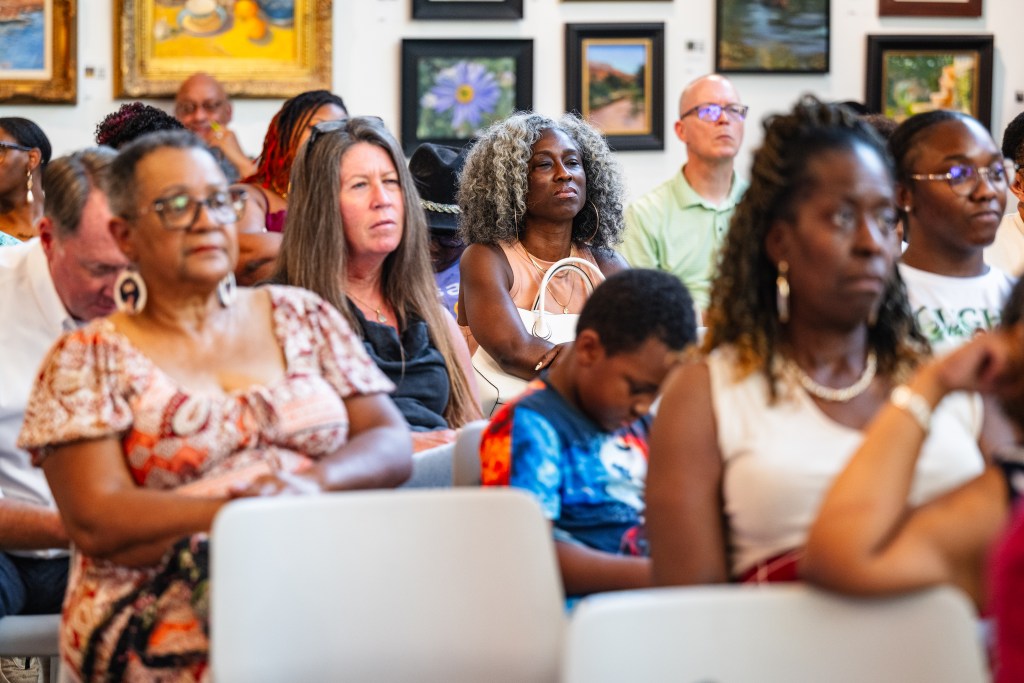
Eighty-plus attendees filled the galleries at 101 E. Archer St. to ask candidates who they would support if they lost, how decades-old issues are still impacting the district today and their positions on reparations. Early voting runs from Aug. 20-22. Election Day is Aug. 25.
Addressing the Equality Indicators report
The annual report released by the city tracks disparities among communities across Tulsa.
Some disparities in this year’s report, which uses 2025 data, included:
- The ratio of banks and credit unions to payday lending businesses is nearly 15 times higher in south Tulsa than in north Tulsa.
- The percentage of south Tulsans in households earning a living wage is 78% higher than that of north Tulsans.
- Life expectancy after retirement age (66 years old) is about 13 years for south Tulsans — and just three years for north Tulsans.
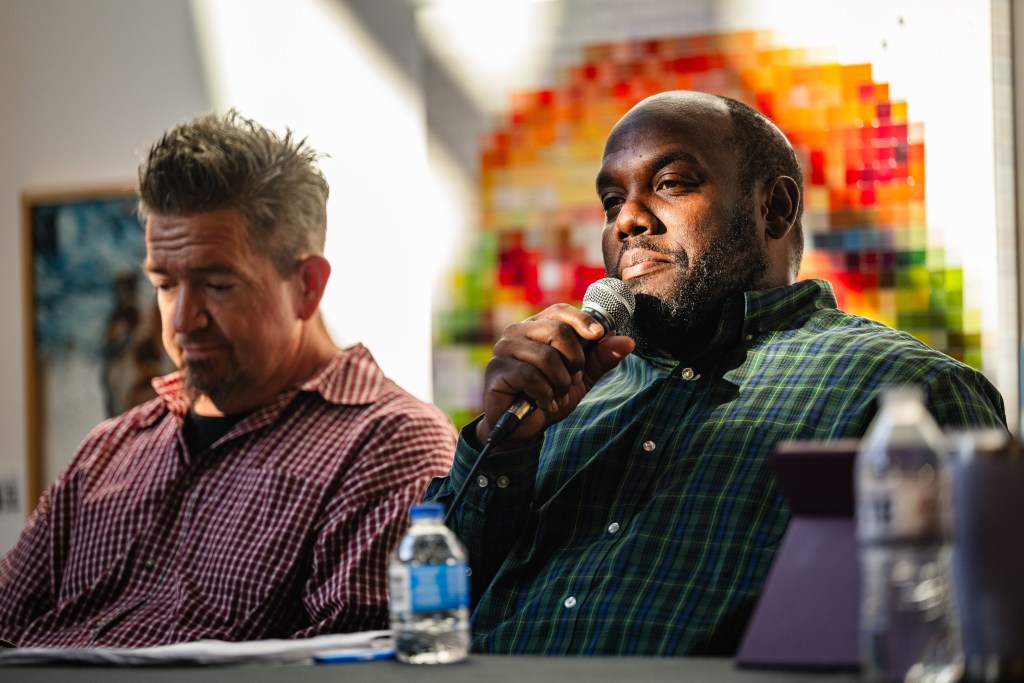
When asked which of those indicators they felt was most important to tackle first, Johnson and Hall-Harper agreed on life expectancy, Wilson and Moore said addressing the gap in access to a living wage and Williams said the proliferation of payday loans in north Tulsa.
“The more money poured into this place — north Tulsa — the better off it’ll be,” Williams said.
Industries that set up within the district and receive tax incentives should prioritize hiring those that live within the community, Wilson said.
“Businesses are coming to our community and they’re not hiring the people from our community,” she said. “As I’ve mentioned before, we will have a community benefit agreement where people will get trained, people will get hired.”
On collaboration and representing all of north Tulsa
A major conversation in the lead-up to Election Day has been perceived fractures and infighting between stakeholders in north Tulsa. And while north Tulsa is sometimes conflated with “Black Tulsa,” it is a diverse community.
We asked candidates how they would govern above infighting and work to make sure all of District 1 feels represented at City Hall.
Moore said the primary job of a city councilor is to be a public servant and that should be the focus. “If you’ve got to be at the front of the line, if you got to be the one, you ain’t doing a lot,” he said.
Williams encouraged others to “reflect and look at ourselves in the mirror,” adding that people need to sacrifice egos for the betterment of north Tulsa. “I don’t want to break something up because I wasn’t a part of it or it wasn’t my idea. Whose to say that your idea is the greatest?”

Wilson said it is “the responsibility of the city councilor to work with all stakeholders” and that people must “move beyond our differences” to move the district forward. “We are deficient in so many areas. It is time to work together,” she said. “We need to start moving in tandem.”
Johnson said the district will go further if everyone works together. “Regardless of if certain people voted for you or not, you still represent those people,” he said. “The city councilor has to be the bigger person. There are needs all across the district. If those people don’t come to you, you find a way to go to them.”
Hall-Harper, who has spent much of her campaign this year responding to highly-publicized criticisms, said that “no one individual or entity owns the story of north Tulsa or its future.” She did not name individuals, but disagreements with some community advocates have played out publicly online.
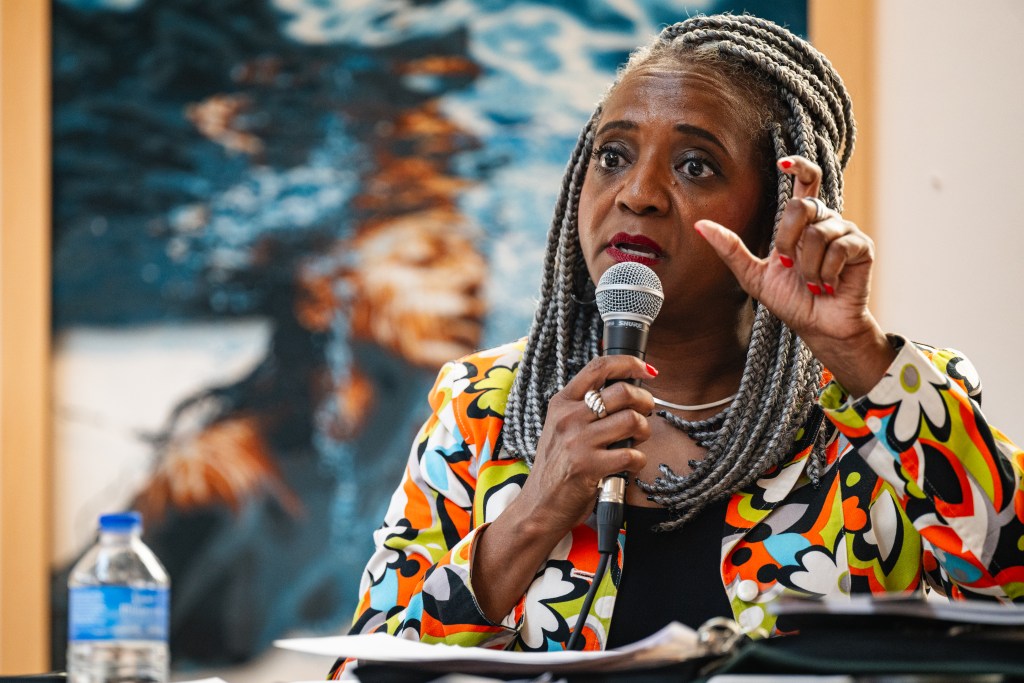
“I’m an elected official, I’m a public official. But I’m also a human being,” she said Tuesday night. “What I’m going to say is respect is a two-way street. And hopefully we can meet each other halfway. And I am open to doing that and I think I have enough collaborations and working with either individuals or institutions that are proving that. My record speaks for itself.”
On reparations
An audience member asked candidates their opinions on the hotly-contested issue of reparations for descendants of enslaved Africans and of the 1921 Tulsa Race Massacre.
All of the candidates agreed reparations are necessary for past harms done in the district. However, Moore said direct cash payments would face pushback.
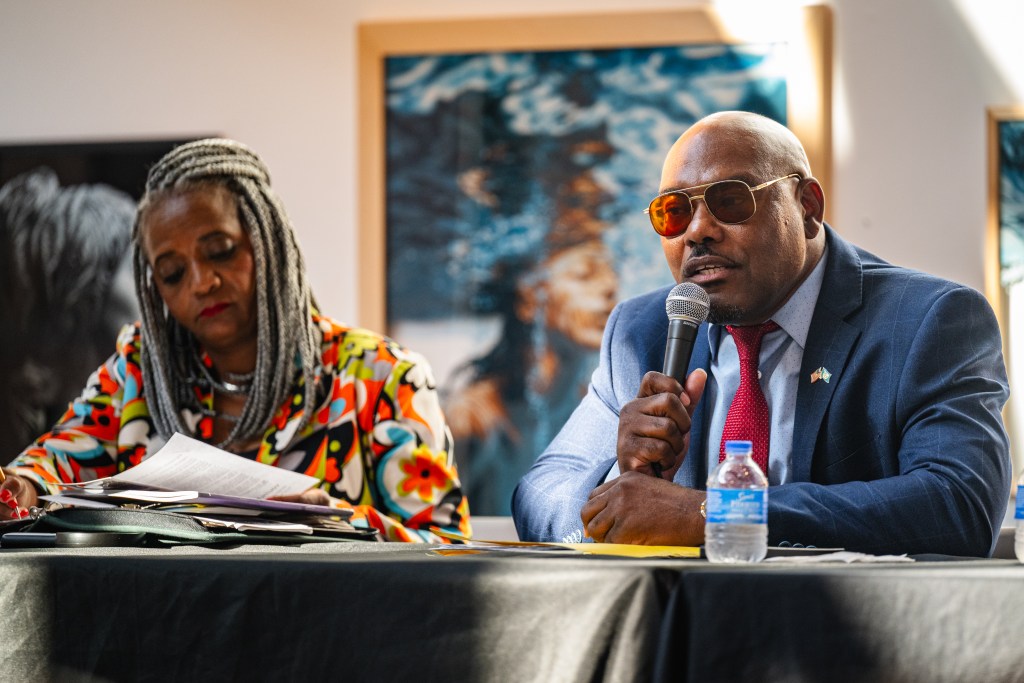
Johnson brought up other groups, like Japanese Americans and Jewish people, who have received reparations for historic harms. Reparations are necessary, he said, because “we still deal with the trauma from before. Generational trauma is real.”
Hall-Harper said she supports reparations on the federal and local levels. She was instrumental in advocating for the formation of the African American Affairs Commission and Beyond Apology Commission.
She also highlighted an ordinance she plans to bring to council that would regulate how artifacts related to the 1921 Tulsa Race Massacre are handled. “It’s similar legislation that the Native Americans have on the federal level,” she said.
Wilson, a member of the Beyond Apology Commission, pointed to the need for financial investment in the Greenwood Trust, a private charitable trust, launched as part of Mayor Monroe Nichols’ Road to Repair Initiative. Nichols aims to raise $105 million in assets through private philanthropy to support economic growth in north Tulsa.
“We want you to basically cut the check,” Wilson said. “And when we say cut the check, we mean we need to provide redress for the harm, the atrocity that was done for the city of Tulsa.”
Williams said “a lot of things are unfair based off what happened a long time ago.” He supports reparations in the form of scholarships and said he hates “that Greenwood is so small compared to what it should be.”
“So much more is owed to people that have passed away, people that are living and people that are not even born yet,” he said.
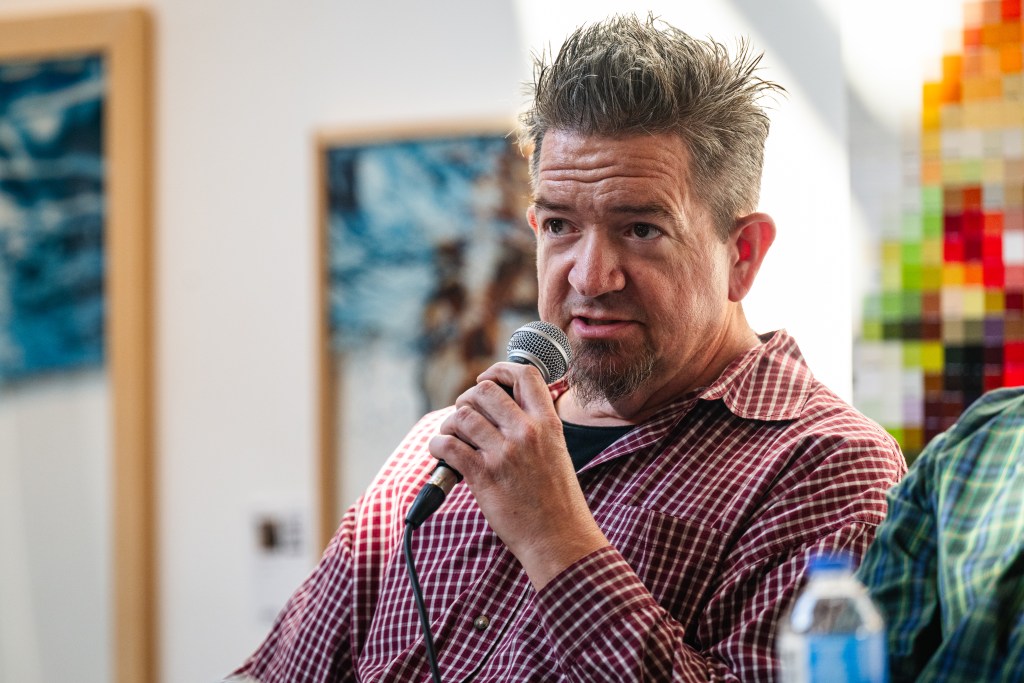
Moore said a great start to reparations would be removing the section of I-244 that bisects the Greenwood District. Elected officials like Nichols and State Sen. Regina Goodwin have both thrown support behind studying the feasibility of removing that piece of highway.
“They’re not going to move the highway but that’d be a start,” Moore said.
However, he questioned how cash reparations would be enacted in practice saying there needs to be “more concise” language on what paying reparations would accomplish. If, for instance, reparations is funded through raising taxes, Moore said some people are going to push back about “paying reparations for things they didn’t have a part of. That’s the conflict that you’re going to run into.”
In municipal races with more than one candidate, a winner must get 50% plus one to win outright. If no candidate gets that majority, the top two will go to a runoff Nov. 3.
For more information on where to vote and what’s on the Aug. 25 ballot, check out the Tulsa Flyer’s voter guide.
