


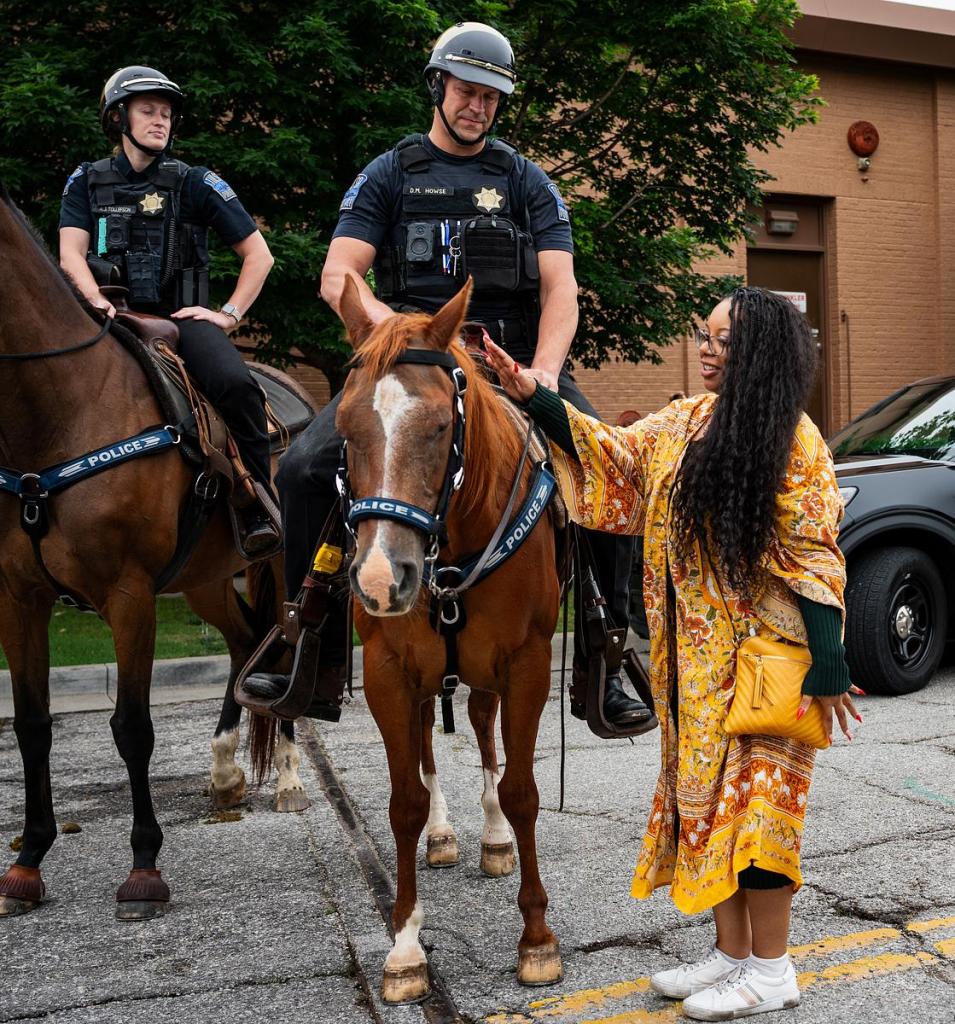
Eight years ago, Horsey was found starving and wandering after being abandoned north of Tulsa. Tulsa Police Officer Darin Howse adopted her for $100 from a shelter to be his hunting and outdoor partner.
That partnership turned into a job with a badge. Horsey has joined the newly re-established Tulsa Police Department mounted patrol unit as one of three horses.
“She’s pretty amazing. She does well in crowds and isn’t bothered by traffic or loud noises like most horses,” Howse said. “When we talked about bringing back mounted patrol, I thought this would be an amazing opportunity for both of us. It’s a great way to get out and engage with the community.”
TPD had a mounted patrol until it was disbanded in 2010 due to budget cuts. Back then, the city paid for all equine bills — food, housing, maintenance, training, medical care and a full-time farrier. The new version uses horses already owned by officers, says Maj. Mark Ohnesorge, who oversees the TPD downtown division.
“Those costs are now absorbed by the officer,” Ohnesorge said. “The officers are taking on a huge financial burden to be able to do this, but it does seem like officers who already own their own horses want to be able to utilize them in this manner. It’s very low-cost to the city.”
The Tulsa Police Foundation paid a little less than $100,000 for the three horses — Horsey, Rosie and Wrecker — and their officer-owners to go through a certified mounted patrol training and get specialized equipment. That includes horseshoes made of high-traction rubber to handle different surfaces, saddles built with synthetic material to be lighter and reflective gear on bridles, breast collars and leg wraps.
The mounted patrol is part of an overall investment of between $150,000 to $200,000 from the foundation into downtown public safety. That includes electric bikes and utility terrain vehicles, said foundation CEO Sarah Jane Gillett.
“Mounted patrol seems incongruous in this day of the real-time information center,” Gillett said. “When TPD brought this idea to us, we learned how useful mounted patrol is in terms of policing. Officers are closer to the community, have higher visibility in line-of-sight and horses are effective at crowd control.”
Contracts are in place spelling out legal liabilities when the horses are on duty. The only expense out of the TPD budget is any officer overtime when the mounted patrol is needed. Overtime is approved by the police chief on a case-by-case basis.
Ohnesorge said research consistently shows the public safety effectiveness of mounted patrol in populated areas. A part of that is community relations since the horses make officers more accessible to the public.
“It’s really good tactically for officers to have a higher vantage point,” Ohnesorge said. “An officer can get from point A to point B quicker and move faster in places. They can see further.”

The mounted patrol could be used beyond downtown events, such as with search and rescue.
“They are going to be downtown the most because that’s where we’re going to have more interactions with the community,” Ohnesorge said. “But that said, they are also on call. So, if we need horses to go up Turkey Mountain, that may be something they do.”
Horsey can handle the rugged tasks, being used to Colorado rivers and mountains during regular trips. Howse never owned a horse before, adopting her after a motorcycle wreck limited his ability to carry a hiking pack long distances.
“I had zero training on what I was supposed to be doing,” Howse said. “But Horsey and I figured out how to understand each other and worked it out without formal training. The mounted patrol was a great opportunity to grow as a horseman and give Horsey the input she needed.”
Howse works in the auto theft unit but says he’s looking forward to switching to mounted patrol when necessary.
“A lot of people can be intimidated by the uniform, by officers,” Howse said. “Luckily, people love horses.”
News decisions at the Tulsa Flyer are made independently of our board members and financial supporters. Read more about our editorial independence policy here.