



More than 50,000 drivers in the U.S. are pulled over every day by police. For some, the flashing lights and blaring sirens can induce feelings of fear and anxiety.
The Blue Envelope Program — an initiative sparked in Connecticut in 2020 — promises to make those interactions easier.
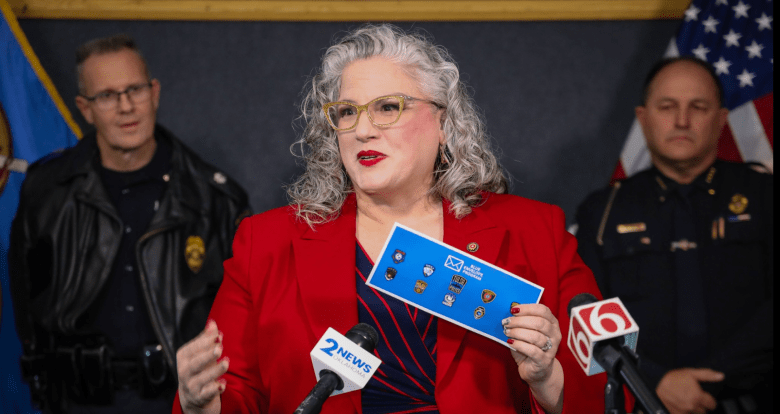
Tulsa Police Department launched its version last December in collaboration with other law enforcement agencies across Tulsa County.
District 7 City Councilor Lori Decter Wright — who has close relatives living with ADHD, anxiety and autism — was an early advocate for Tulsa County’s adoption of the program.
“(In my household) it’s not just talking about (keeping your hands at) 10 and 2, you know. There’s some other layers there,” she told The Eagle. “So that led to the broader research that I conducted about how other communities are adjusting to this.”
We talked with Decter Wright and TPS spokesman Richard Meulenberg about the program. Here are five things to know:
Residents facing different communication obstacles can use it
TPD’s website says the program empowers people to note their communication needs or issues, hand an envelope to an officer who may have stopped them and allow that officer to respond accordingly.
The materials include:
- The blue envelope that can hold your driver’s license, registration and proof of insurance
- A communications needs card
Most people’s interactions with the police come in the form of traffic stops. But Meulenberg said TPD’s initiative applies to any police interaction.
Simply put, the initiative is meant to decrease tension that may exist.
“This is just a way so that if you’re so spun up or if you’re anxious, it gives you an anchor to say ‘OK, I’ve got this.’ And the more positive reactions you have with law enforcement, the less you need it,” he said.
Reasons for using the envelope include: autism, ADHD or other neurodevelopmental conditions, difficulty speaking clearly, anxiety, PTSD or other mental health conditions. People learning English can also benefit from the program, according to TPD.
You can find the full list on TPD’s website.
It is a county-wide initiative
Bixby, Broken Arrow, Glenpool, Jenks, Owasso, Sand Springs, Skiatook and Sapulpa — inspired by a similar program in Oklahoma City — launched their initiatives in December in partnership with Tulsa.
Nationally, cities like Yonkers, New York, and Springfield, Illinois, have adopted the program too.
TPD doesn’t have data on the program’s utilization
While the initiative hopes to make police interactions with the public safer, there is little data yet on how much Tulsans have used the program. Three months into TPD’s adoption, Meulenberg said they aren’t tracking incidents when motorists have flashed their blue envelopes.
“Our current records system is over 50 years old,” he told The Eagle. “So our ability to track a lot of stuff isn’t super awesome right now.”
However, he added, the department is close to launching a new records system.
Envelopes can be found at patrol divisions or printed off
The envelopes are free and can be printed off TPD’s website. Residents can also pick up materials at all three patrol divisions — Gilcrease, Mingo Valley and Riverside — or community events with police.
Decter Wright hopes to convene a group of health care providers, disability rights advocates and first responders to increase public awareness.
“There’s such a cross-section of people who could benefit from this, whether it’s Alzheimer’s, dementia, advocates for people who are English language learners … any number of reasons people might feel challenged in communicating verbally,” she said.
Decter Wright added it could even be a tool for “people who don’t necessarily have an identified communication challenge but they just know when they see lights and sirens, whether it’s for them or not, they get that anxious feeling.”
She said she’d like to see more non-law enforcement institutions, like public libraries, promoting the program — particularly for Tulsans who wouldn’t feel comfortable picking up the materials at a police station.
TPD offers other mental health initiatives
Beyond the program, Meulenberg said, the department has other initiatives and special divisions that address mental health crises calls. That includes the mental health co-responder dispatch that started in March 2025.
“We have actual clinicians in dispatch that will talk to them and determine what’s going on with them,” Meulenberg said. “People call 911 for varying reasons and if it meets the criteria of a co-responders, sometimes we don’t even go out.”
There is also the community response team. When a threat of suicide call comes in, TPD deploys a police officer, paramedic and therapist who can best address the person’s needs.
