




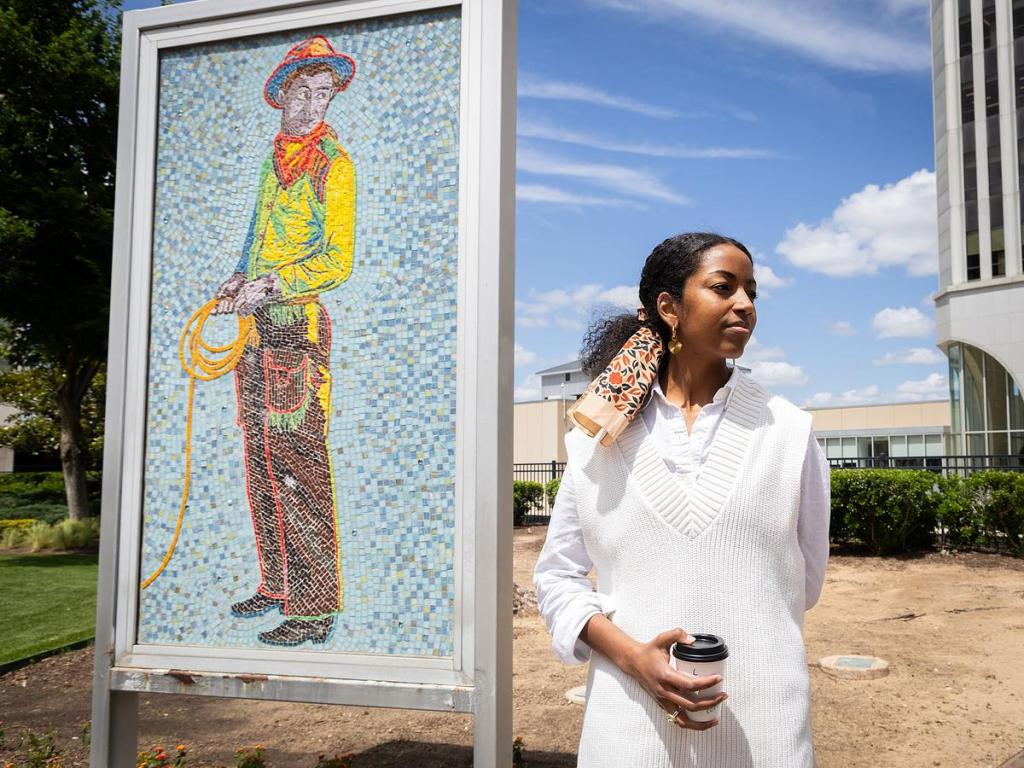
Micaela Young has a pep in her step as she walks back toward the BOK Tower. It could be the midday latte she’s finishing up from Coracle Coffee. It could also be that life is good for the accountant-by-day and tinkering musician by night.
Watch her most recent clip for her single “You Look at Me Like Art” and you can see what I’m talking about. It was filmed in March in Los Angeles while Young was there to perform a set at The Hotel Cafe.
She returned from that trip with more confidence and a goal to play in New York City by the end of the year. The 29-year-old is wrapping up all the marketing content for her new EP she’s releasing this summer and feels good about where her career is headed. The singer-songwriter describes her sound as a mix of alternative folk and jazz that is always evolving.
“It’s like the catch-all sort of category for maybe some of the strange chords or whatever that I like to use,” Young said.
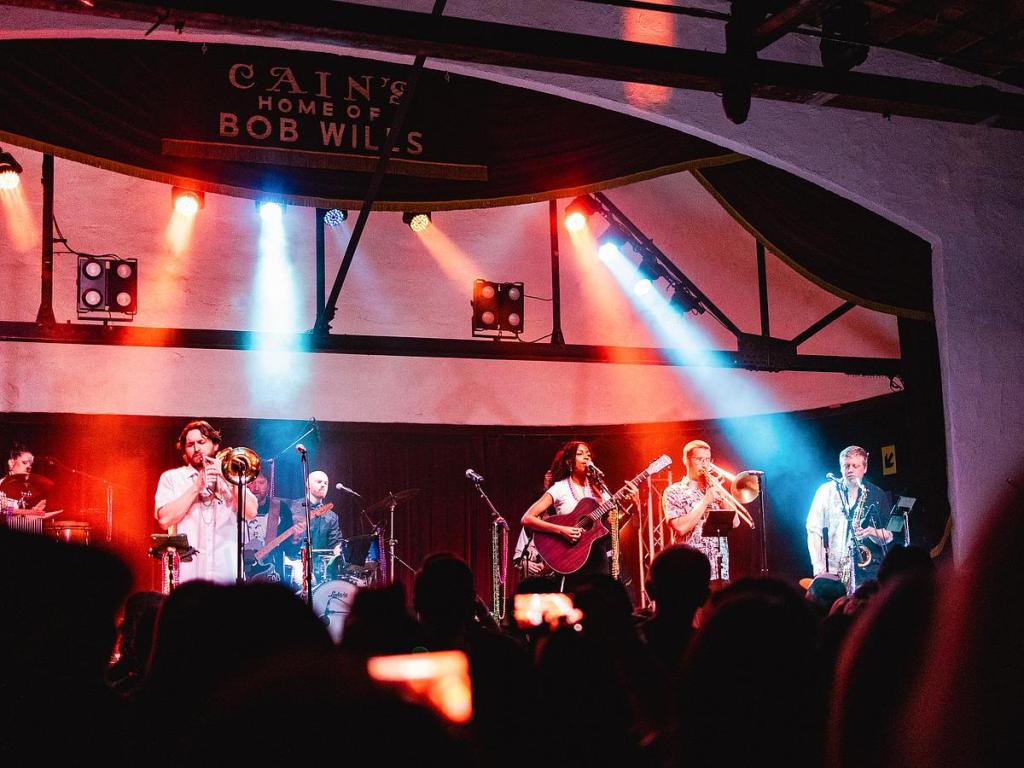
In recent months she’s played new venues like Oath Studio and Drifters Theater along with a performance on the legendary Cain’s Ballroom stage with King Cabbage Brass Band. On Friday she’s playing at Tulsa Treehouse, 260 W. Victoria St. She sat down with the Flyer to discuss her new release, how the Los Angeles gig came to be and what’s coming down the pipe.
It’s been a while since you released an EP. You’ve dropped some singles along the way. Why now for a new EP?
It’s the two-year anniversary coming up of my first EP, “Liquid Prayers,” and then the one-year anniversary of “You Look at Me Like Art.” It’s kind of like a celebration of, here’s some songs that I have out that sound totally different on “Liquid Prayers” but they’re acoustic. So they are songs that I already have out, but just songs that are more in an intimate kind of vibe. Me and Matt Magerkurth did a bunch of cello acoustic duo shows last year before he moved to L.A., and we recorded some songs as a kind of time capsule of when we had a little duo cello vibe session going on for a little bit, and it was super fun. Those are a part of it.
I find it interesting that your current approach is reworking existing songs. Does that come from playing them live?
Yes. Not every audience is the same. You have completely different people there, so you can really specify each venue, each person. You play with each atmosphere and create a little bit more varying experience for different people, so that whenever you go to hear a set, maybe it’s not the same thing. Because why would it be the same? You’re in a different mood. Even if I play the same song the same way, I’m in a different mood. Like the people that are listening, it’s a whole different mix of people. So it’s nice to switch it up and just kind of ride the wave. It keeps it real and interesting.
It’s hard to adjust to each venue and to adjust to each vibe. It’s more difficult, but it’s fun. I like to take that approach, because it feels the most natural. And I think it challenges me. It helps me grow.

You’re stripping down your songs to acoustic versions. Is this a sign of things to come or are you still interested in making music with all sorts of sounds and layers and autotune and stuff like that?
There’s a whole other different batch of songs that I’m doing with Logan (Bruhn) actually now that are not acoustic. They’re way more produced, like loop-based, so it’s completely switched on. I still like being in both worlds, but the time and with these songs, it feels like the way that they’re alive right now feels more relevant to the acoustic EP sort of vibe.
I feel like there’s different seasons for each song, so it results in either going back to how it was whenever I wrote it, or, like, I played these songs with Mitch Bell’s quartet, and it completely amplified them. So I guess it’s just kind of like wherever I feel like these songs need to go next ends up happening, rather than a response to the world. But I feel like because of the way things are going, a lot of people are subconsciously kind of going back to the more acoustic, simple stuff. I think that a lot of people are yearning for that rather than the autotune stuff. I mean, that’s all super fun, but to just mix it up and kind of go back to the original part of the song.
You sound like a tinkerer who has a day job as an accountant that does not allow you to tinker.
That’s really funny. I do like to tinker. I’m realizing that as I get older a lot of the stuff that I did those years, like with the “Liquid Prayers” EP, was a result of tinkering. Because I played guitar in high school a little bit, like six months, and then I switched that out for marching band for some reason. I actually love marching band.
I didn’t really pick up a guitar for real until 2020, so a lot of the things that I was doing was just, “Oh, this sounds cool. I like this.” I had a little bit of an understanding of the simple cowboy chords type of thing, but changing the tuning of my guitar, like doing all that, trying to get cool sounds, that was just a result of the things I was listening to and just randomly trying things and not reading the instructions to anything, and just seeing what works and literally just tinkering around. So that is how I operate.
You’re the painter who cannot ever actually finish the painting. There’s always something to add or change. Just one more brush stroke here then there.
That’s actually so funny because it helps whenever I’m creating stuff to think of it as like a different medium. Like if I was a painter, it’s adding a stroke or seeing something else that can be added.
If the question is “when do you stop?” I don’t know. I think that’s why you can do so many different versions of a song, because the song is always going to be alive. You can always be adding stuff and the different versions give me an excuse to still pull out whatever juice is still in there.
I do like to think of it as, “OK, I’m painting a picture.” Like each song is a picture, or like each song is like a movie in a way where there’s a clear understanding of what’s happening. I like people to understand what I’m saying.
You recently made the long trek to L.A. to play a show. How did that come to be and what was your biggest takeaway from the trip?
I went to TU, and that’s how I know (TU music industry professional in residence) Corey Taylor. He had hit me up and said his music business class loved my stuff and wanted to help in any way. So they reached out to a lot of L.A. venues for me and to see which ones would be available during the time that I would be there. Hotel Cafe replied and the students connected me with them and it all fell into place.
It was more of like an in-faith sort of thing of let’s just see what happens, and then let’s just see who shows up. It was a good crowd. I needed to sell 15 tickets to be paid out, and I sold 31. It had a capacity of 50, so it still felt full. Everybody there was super nice, and I got to make a couple new friends. It was just like, “What is something that I kind of feel like is unattainable? Doing a show out in LA. Let’s see if it works,” and it worked. Now next I plan to go to New York by the end of the year.
News decisions at the Tulsa Flyer are made independently of our board members and financial supporters. Read more about our editorial independence policy here.