

If you dive into Oklahoma state statutes, or the city codes of Tulsa and its surrounding municipalities, you’ll find quite a few strangely specific, outdated or flat-out weird ordinances. For this story, the Flyer found 10 odd ordinances and laws that are still on the books.
Why did we go down this rabbit hole, you ask? Honestly, because we could — and because we thought you might be interested in what’s technically illegal in your own cities. Read on and let us know if there’s anything else worth knowing.
Tulsa
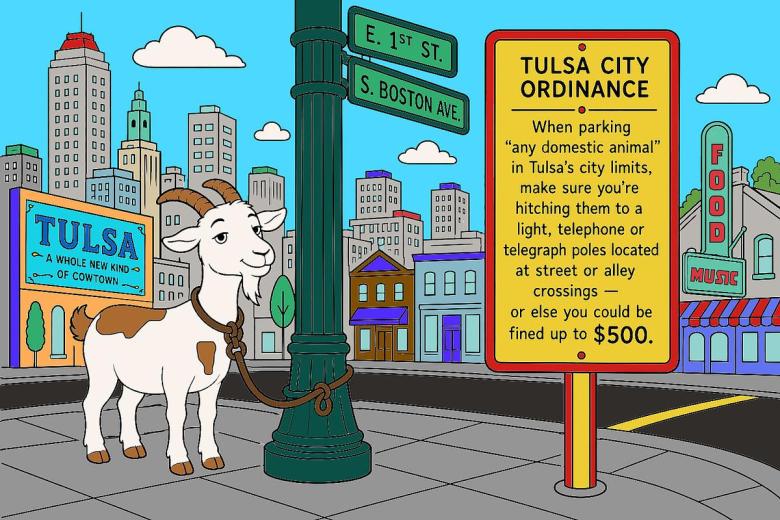
Careful where you park your goat
When parking “any domestic animal” in Tulsa’s city limits, make sure you’re hitching them to a light, telephone or telegraph poles located at street or alley crossings — or else you could be fined up to $500. This ordinance dates back to the early 1900s.
“It shall be unlawful and an offense for any person to hitch, tie or place any horse, donkey, mule, sheep, goat, cattle or any animal of bovine kind or any domestic animal to any light, telephone or telegraph pole within the City or on a sidewalk or parking area in the City except at the regular street, avenue, alley or driveway crossings.”
Grave regulations, by mayor’s order
If someone dies due to a contagious disease in Tulsa, the mayor “shall” prescribe the kind of casket and depth of grave, according to state statute. While this 1910 ordinance is still on the books — and only relates to city-owned cemeteries — city spokesperson Carson Colvin said in an email that it would be hard to say whether a Tulsa mayor has exercised that power.
“All graves shall be dug by employees of the City. A reasonable charge will be made in an amount to be prescribed by ordinance, and shall be uniform in all cases. The graves of adults must be at least four and one-half feet deep, and those of children under the age of 15 years of age, not less than four feet deep. In case of contagious diseases, the Mayor shall have the power to prescribe the kind of casket and depth of grave…”
Jenks
Free fortunes only
A state statute enacted by the Oklahoma Legislature in 1915 prohibited fortune tellers from charging for their services. Some Oklahoma towns, like Jenks, also adopted that language into their municipal code.
“It is unlawful for any person or persons pretending or professing to tell fortunes by the use of any subtle craft, means, or device whatsoever, either by palmistry, clairvoyance, or otherwise, plying his or her trade, art or profession within this city, to make any charge therefor either directly or indirectly or to receive any gift, donation, or subscription by any means whatsoever for the same.”
200 bucks an insult
Are you a Jenks public school teacher? Have you ever been insulted by a parent or guardian in front of your students? Well, Jenks city code states the offender could be fined up to $200.
“If any parent or guardian or other person from any cause, fancied or real, visits any school in the city and insults any teacher in the presence of his or her pupils, the person so offending shall be deemed guilty of an offense.”
Broken Arrow
Mini piggies as pets
In case folks in Broken Arrow wonder how many miniature pigs they can legally keep in their residence “for personal enjoyment,” city code says two and not a hoof more.
A. Miniature pig is hereby defined as a pig which, at maturity, is less than 22 inches high at the shoulder, less than 32 inches long, weighing less than 125 pounds, and which is registered with the North American Pot-Bellied Pig Association.
B. A miniature pig may be kept as normal merchandise in commercially-zoned property, or may be kept as a household pet in single-family residential or duplex property under the following conditions:
1. Each such miniature pig shall be a pet which is kept for personal enjoyment, and not raised for human consumption.
2. There shall not be more than two miniature pigs in excess of six months of age at each residence.”
Sand Springs
Shirts optional?
In October 2019, the Sand Springs City Council adopted an ordinance effectively allowing public toplessness for men and women as long as it is not “for the purpose of causing alarm or disturbance.”
Adoption of the ordinance came after the Tenth Circuit Court of Appeals sided with Free the Nipple in February 2019 on a case involving whether a public nudity ordinance in Fort Collins, Colorado, that banned exposure of the female breast violated the Equal Protection Clause.
However, after the 2019 ruling, Oklahoma’s then-attorney general Mike Hunter released a statement that the Tenth Circuit’s ruling “does not change local and state laws in Oklahoma on the subject.”
The ordinance reads:
“Every person who willfully and wrongfully commits any act which grossly injures the person or property of another, or which grossly disturbs the public peace or health, or which openly outrages public decency, including but not limited to urination in a public place, and is injurious to public morals, is guilty of a misdemeanor. Injurious to public morals shall be defined as:
A. Knowingly engage or participate in any obscene performance made available to the public; or
B. Any person to publicly expose to public view:
1. Their genitals, pubic hair, buttocks, perineum, anal region or pubic hair region.
2. Any device, costume or covering, which gives the appearance of or simulates the genitals, pubic hair, buttocks, perineum, anal region or public hair region.
3. Display in view of the public, for the purpose of causing alarm or disturbance, of any portion of a person’s breast/chest at or below the areola thereof, except:
- For persons 10 years of age and under.
- For the act of breastfeeding a child.
- For the purpose of a medical emergency.”
No parking lot shortcuts
Have you ever cut through a gas station to get around a light? Well, apparently police can cite motorists for it in Sand Springs. Cities around the country have similar ordinances on the books, but enforcement can vary significantly by department.
“It is unlawful for the driver of a motor vehicle to avoid a traffic control device by driving through a private or business driveway and reentering a public way, avenue, street, alley or highway.”
Owasso
A sin in the Bible, an ordinance violation in Owasso
In Owasso, think twice before producing or distributing any literature or language that ridicules any deity or religion.
“It is unlawful for any person to utter, publish, distribute or circulate any literature or language within the corporate limits of the city that casts profane ridicule on any deity, or any religion which in its common acceptance is calculated or where the natural consequence is to cause a breach of the peace or an assault.”
News decisions at the Tulsa Flyer are made independently of our board members and financial supporters. Read more about our editorial independence policy here.
