


After the U.S. Supreme Court ruled a Louisiana redistricting map creating a second majority-Black congressional district was unconstitutional, some Tulsans are questioning what impact it might have on the city’s civil rights advances.
Joe Williams was among those who expressed concerns. A retired north Tulsa political figure, Williams rose to citywide prominence when he became a part of structural change on Tulsa City Council in 1994. He later became the first Black councilor elected council chair in 1997.
The Supreme Court’s April 29 decision effectively gutted Section 2 of the 1965 Voting Rights Act, which protected minority voters from having their political voices diluted.
For most of its early years, Tulsa’s city government structure also had very few minority voices. Under the city’s commission-based government outlined in the city’s 1908 charter, there was no representation for Black Tulsans.
A 1989 NAACP lawsuit, spearheaded by Williams, paved the way for the city to pivot from a commission-led government to a strong mayor-council government. It also resulted in the end of at-large elections for council seats, which allowed voters across the city to select councilors even if they did not live in those districts.
From then on, voters elected the mayor and a single councilor based on where they live in the city. After the shift, B.S. Roberts was elected as Tulsa’s first Black city councilor in 1990. Williams later became one of the most high-profile Black elected officials in Tulsa city government. Since then, diverse representation in Tulsa’s government has grown.
Currently, the council includes two Black elected officials: District 1 Councilor Vanessa Hall-Harper, who represents downtown and north Tulsa, and District 2 Councilor Anthony Archie, who represents west and part of south Tulsa.
Williams fears the recent Supreme Court decision could turn back the clock on Tulsa’s earlier civil rights advances.
“When we filed the lawsuit, (council) was based on the at-large based voting system. It did not allow African Americans of Tulsa to elect a representative by choice,” Williams said. “And based on Tulsa’s history, there was never going to be a likelihood we were going to be able to do that with at-large voting.”
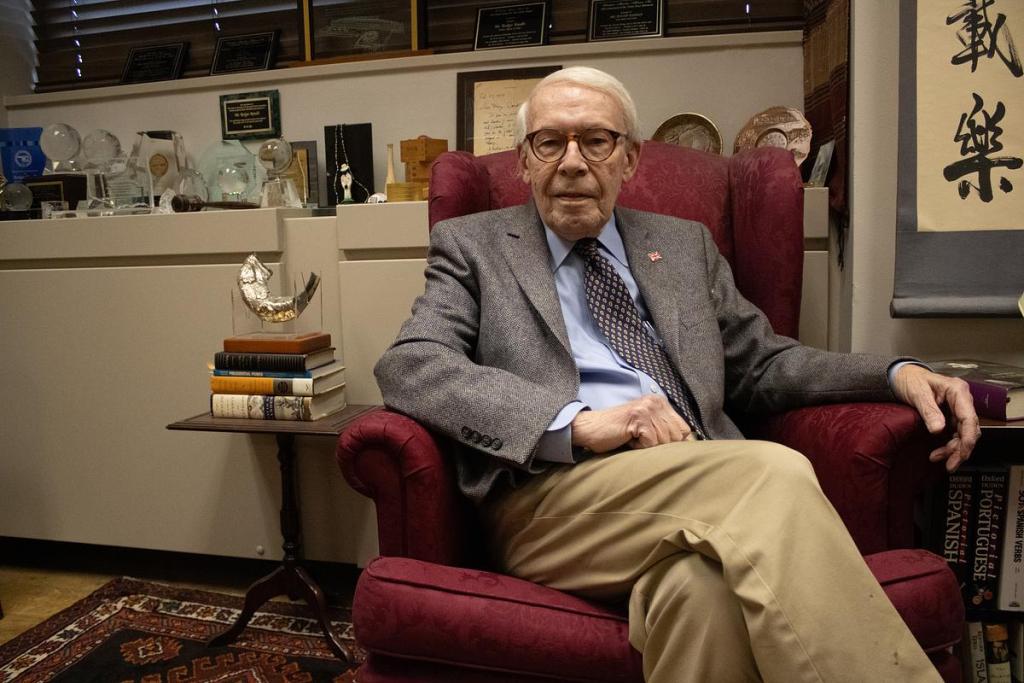
Credit: Phillip Jackson / Tulsa Flyer
Former Tulsa Mayor Rodger Randle was another key factor in instituting Tulsa’s new strong mayor-council government. Randle, who served as the city’s 35th mayor from 1988 to 1992, saw the efforts to change the city’s government structure first-hand.
Prior to his mayoral tenure, there were several attempts to change the way Tulsa was governed, Randle said. Other similar court cases around the country added to the pressure.
“It was important that we had a city government in which everyone felt an ownership,” Randle said. “The at-large formal government did not do that, because you left out populations. It represented a significant power shift in Tulsa, away from downtown as we saw in those days, to neighborhoods.”
Decision could have impact on redistricting
For Hannibal B. Johnson, an attorney and Tulsa historian, the court’s recent decision is one of the clearest examples of backtracking in the federal government.
“I hope Tulsa sees itself as a community that’s attempting to move forward, not sideways, and certainly not backwards,” Johnson said. “And at the federal level, it feels like we are definitely moving backward. We are changing legislation from the past, in 1965. That’s not progress.”
Since the court’s decision, other states are weighing whether to redraw their districts. Alabama, for example, saw its attorney general file motions to lift an injunction to federal courts to reverse protections of majority Black-districts. Gov. Kay Ivey, a Republican, organized a special session to consider redrawing districts on maps.
Tennessee passed a new redistricting map, reshaping a majority Black and Democratic district in favor of the GOP. These decisions impact opportunity districts, which function as voting districts designed to allow minority voters to elect preferred characters to represent them. A historic drop in Black members of Congress could be on the horizon, according to NPR.
“People want to be assured that when they vote it actually means something. That Supreme Court ruling is removing that opportunity,” Williams told the Flyer. “It has a big impact in Oklahoma and nationwide.”
Next steps
Organizations across the state, especially those involved with voting rights, are figuring out what action to take on the ground. Tamya Cox-Touré, executive director of the American Civil Liberties Union of Oklahoma, told the Flyer the Voting Rights Act is held as the “crown jewel” of the Civil Rights Movement.
Since the ruling struck down protection of districts that boost minority group representation, Cox-Touré says it makes the work much harder going forward.
“It is disingenuous for any leader in Oklahoma or in Tulsa to say this ruling by the Supreme Court won’t have an impact in Oklahoma. That is just as far as the truth,” she said. “States like Oklahoma and cities like Tulsa have to ensure they are creating stronger laws on how to create maps to ensure there are fair elections and voter dilution does not occur.”
News decisions at the Tulsa Flyer are made independently of our board members and financial supporters. Read more about our editorial independence policy here.