


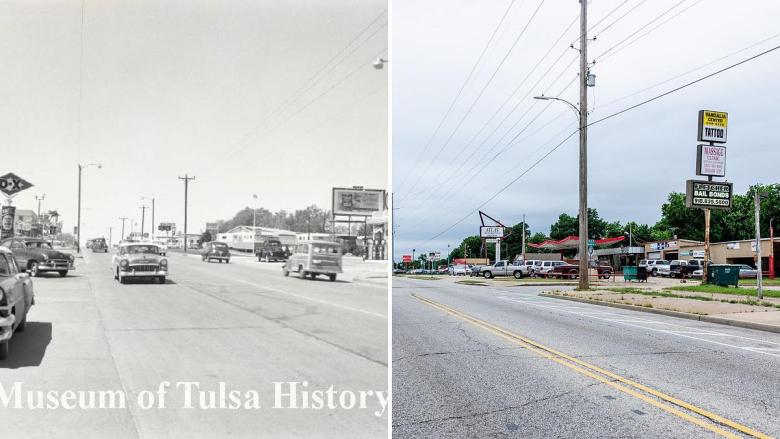
Tulsa’s 28 miles of Route 66 once greeted westward travelers with a dense, neon corridor of diners and auto shops.
Few echoes remain of the Mother Road’s mid-century heyday, especially along stretches targeted by the last two decades of economic revitalization. Many are unrecognizable, defined by parking lots and strip malls.
For a little centennial nostalgia, we collected archival photos from the Museum of Tulsa History, visited each location and captured its appearance today.
From Ed’s to the golden arches
West 23rd Street and Southwest Boulevard
1967, Tulsa Tribune
Burger joints and gas stations emblematic of Route 66’s heyday surround this west Tulsa intersection, captured in 1967. Today, Ed’s Hamburgers is swapped out for McDonald’s and the once ubiquitous D-X Service Station for QuikTrip.


Grub of the Mother Road
2120 E. 11th St.
1960
11th and Lewis is now a hub for Tulsa tourists interested in Route 66’s eateries. The addition of Mother Road Market in 2018 revitalized local food startups along the strip. The Chuck Wagon, a 1960s restaurant known for its onion rings, is now overflow parking for the award-winning food market.


Bridging the Arkansas
11th Street bridge over the Arkansas River
1934
Originally completed in 1915, the 11th Street bridge brought Route 66 over the Arkansas River According to the Museum of Tulsa History, the original design had a classical railing and Victorian-era lighting that was eventually swapped out for Art Deco designs in the 1920s. In 1934, the bridge was widened by 18 feet at a cost of $305,000 — more than $7.6 million today, adjusted for inflation.


Cruising to the Metro Diner
Metro Diner
1995, Metropolitan Tulsa Chamber of Commerce
The Metro Diner, captured here in 1995, was a popular hangout for hot rodders cruising down Route 66. It was demolished in 2006 to make room for additional apartments at The University of Tulsa but its neon sign still glows at the Stokely Event Center today.


Starship Records’ first goodbye
Starship Records & Tapes
1997, 2800 block of 11th Street
Starship Records & Tapes was another Tulsa institution relocated for The University of Tulsa expansion in the early aughts. The beloved shop, captured above in 1997, moved in 2005 to its final location on South Lewis. It’s since closed for good, leaving many music lovers like the Flyer’s Tim Landes without its familiar scent of incense and old vinyl.


Texaco to QuikTrip
10165 E. 11th St.
1968, Howard Hopkins
Texaco gas stations once dotted Tulsa’s landscape, including this newly constructed location on Route 66 in 1968. The oil company bought land in west Tulsa in 1906 and opened its refinery on the banks of the Arkansas in 1910 before closing the plant for good in 1982. Today, a QuikTrip station stands in its place.


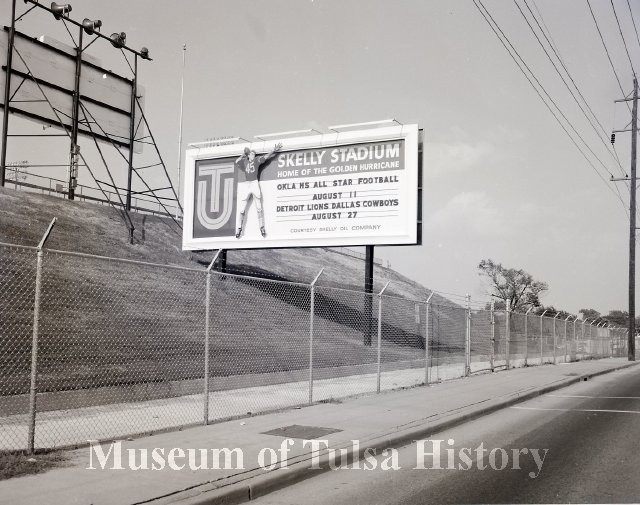
Skelly Stadium in the ‘60s
The University of Tulsa Stadium
1966, Howard Hopkins
Oil millionaires drove development across Tulsa and along Route 66 — William Grove Skelly key among them. As president of the Skelly Oil Company, Skelly was the primary benefactor of The University of Tulsa’s football stadium, which opened in 1930 along the Mother Road. He also established the state’s first FM radio station in 1947, KWGS, whose call letters bear his initials. The stadium was renamed in 2007, sharing Skelly’s with another banking and oil philanthropist H.A. Chapman.

Enduring glow of Desert Hills Motel
5220 E. 11th St.
Undated, Howard Hopkins
The Desert Hills Motel has kept 50 rooms open for Route 66 travelers since 1953. Unlike most motels that sprung up in the highway’s heyday, Desert Hills has been maintained even down to its neon sign that was refurbished in 2004, as reported by TulsaPeople.


Moving Meadow Gold
Original Meadow Gold
1992, John Anderson
The must-see Meadow Gold sign on Route 66 originally sat on 11th and Lewis before the building beneath it was demolished in 2004. The neon advertisement for Meadow Gold and Beatrice Foods Company was dismantled and moved a few blocks west with funding from the “Vision 2025” Route 66 enhancement project. Mother Road Market is located at the sign’s original address.


Demolition in ‘80s and ‘90s
5338 E. 11th St.
1988, John Anderson
Not all neon fixtures of Route 66 persist or were preserved. Photographer John Anderson captured this rusted Bel-Air Motel sign in 1988 before it was demolished alongside several other retro signs. Anderson’s work documenting Tulsa landmarks can be found in the Museum of Tulsa History archive.


Diner days are over for Miss Tulsa
1915 E. 11th St.
1950
Like many 1950s diners along Route 66, Miss Tulsa Lunch Restaurant was open 24 hours a day. The air-conditioned restaurant served plate lunches and steaks. Today, it is home to a nondescript building across the street from The Starlite Bar.


Bama Pie beginnings
2747 E. 11th St.
1943, Beryl Ford
The Bama Pie Company started in the 1920s in Cornelia Alabama Marshall’s Dallas kitchen. After the Great Depression, her son Paul moved with his wife Lilah to Tulsa, opening the local branch and eventual headquarters captured above in 1943. Today, Bama says its global facilities produce 2 million pies, 1.5 million biscuits, 1 million hotcakes and 1 million pizza crusts every day.


Downtown commercial corridor no more
10th & Main
1960s
Furniture stores, hotels, a steak restaurant and Pioneer Finance lined this downtown stretch of Route 66 at 10th and Main in the 1960s. Businesses at this intersection have since been leveled for parking at Tulsa Community College’s Metro campus and First Christian Church of Tulsa.


Autocraze on full display
4621 E. 11th St.
1955, Beryl Ford
A D-X fuel ad, classic cars, Texaco station and Tulsa Trailerhomes make up this quintessential Route 66 image captured by Tulsa historian Beryl Ford in 1955. Today, the midtown drag is still defined by auto lots and shops. If you’d like to bring back the classic cars, check out the centennial car parade set for May 30.


News decisions at the Tulsa Flyer are made independently of our board members and financial supporters. Read more about our editorial independence policy here.
