


Katie Marion can’t imagine where her family would be without Broken Arrow’s Tiger Connect program.
Her son, Ryker, struggled with emotional regulation in day care — a problem that worsened when he entered preschool. He could get destructive when he was upset, running out of the classroom and ripping decor off walls.
“It got kind of crazy,” Katie said. “Each of those sites has a behavioral coach, so they would often get that person to try and help, to de-escalate him, but sometimes even that wasn’t enough.”
Ryker didn’t do well with unstructured time, so Katie picked him up at 1 p.m. every day before his classroom’s “brain break,” or quiet time. They tried everything, she says, including additional therapy outside the school day. There was a honeymoon phase in kindergarten, but it was short lived, and his outbursts continued well into first grade.
That’s when Tiffany Green, Ryker’s principal at Timber Ridge Elementary, approached Katie with a new option: a brand new, short-term behavioral program for kids like Ryker. Green was on the team designing the program and had Ryker in mind while putting it together. He was the first Broken Arrow Public Schools student to enroll.


Tiger Connect is a nontraditional environment for kindergarten through fifth grade students struggling in traditional classroom settings. Participating students leave their home classrooms for a period of six to eight weeks, focusing intensely on self-regulation and social skills before they “level up” and return home.
“We keep, obviously, teaching the academic side of it, but we really focus on those behaviors: What to do when you’re frustrated, how do you get along with others?” Green said. “We teach them coping strategies to manage those big feelings that everybody has.”
In its second year at BA, the program is staffed by two classroom teachers, three behavior coaches and a full-time counselor. So far, 26 kids have participated in Tiger Connect, but nearly 600 students in their home classrooms are benefiting.
“By taking that child that’s disrupting the learning environment, we saved that 23 (other students in the classroom) over there, you know, of being able to get back to focusing on academics and feeling safe at school,” Green said.
Building skills for the long term
The Tiger Connect wing in Broken Arrow’s Options Academy building is specially designed for the students it serves.
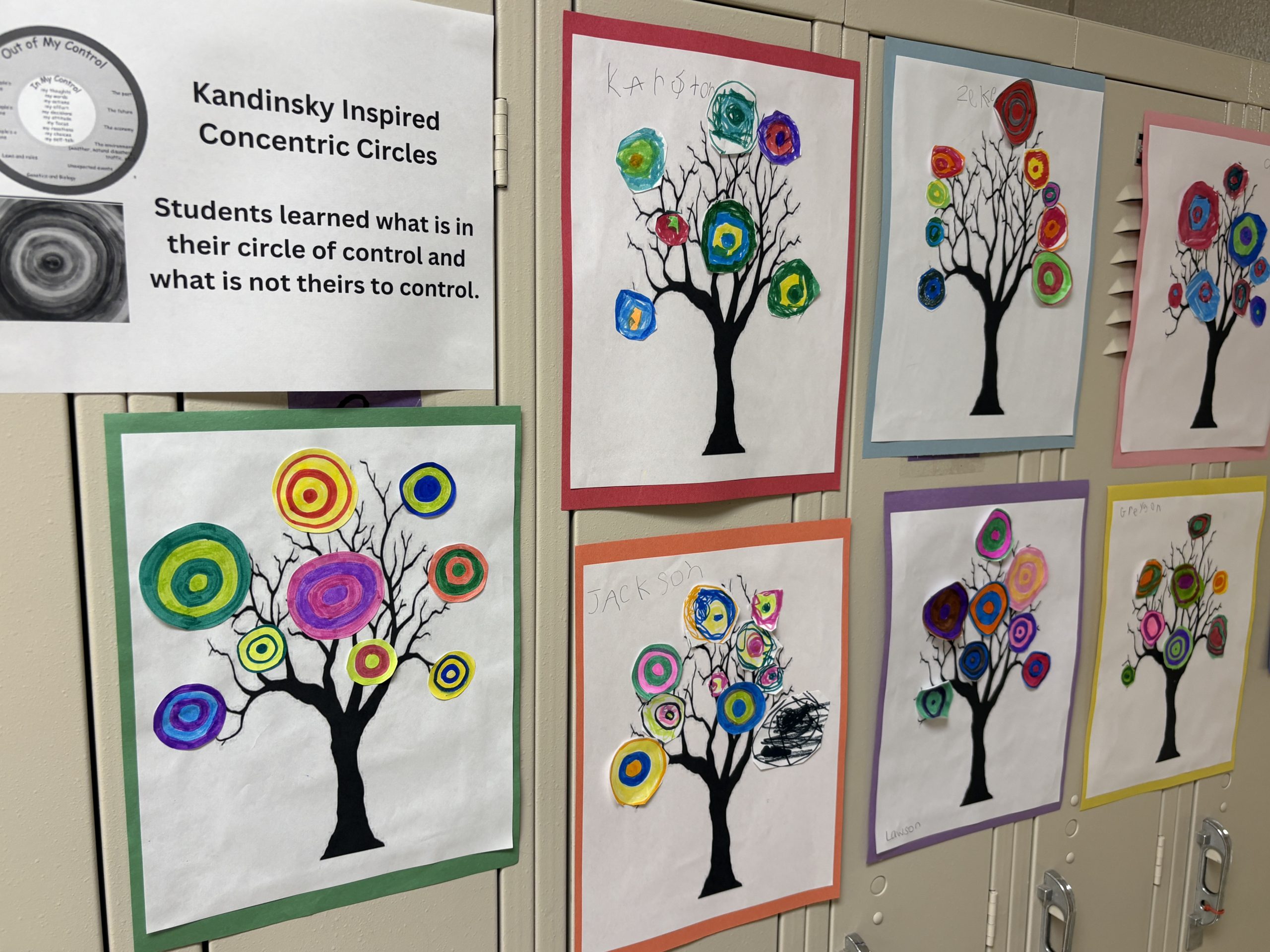
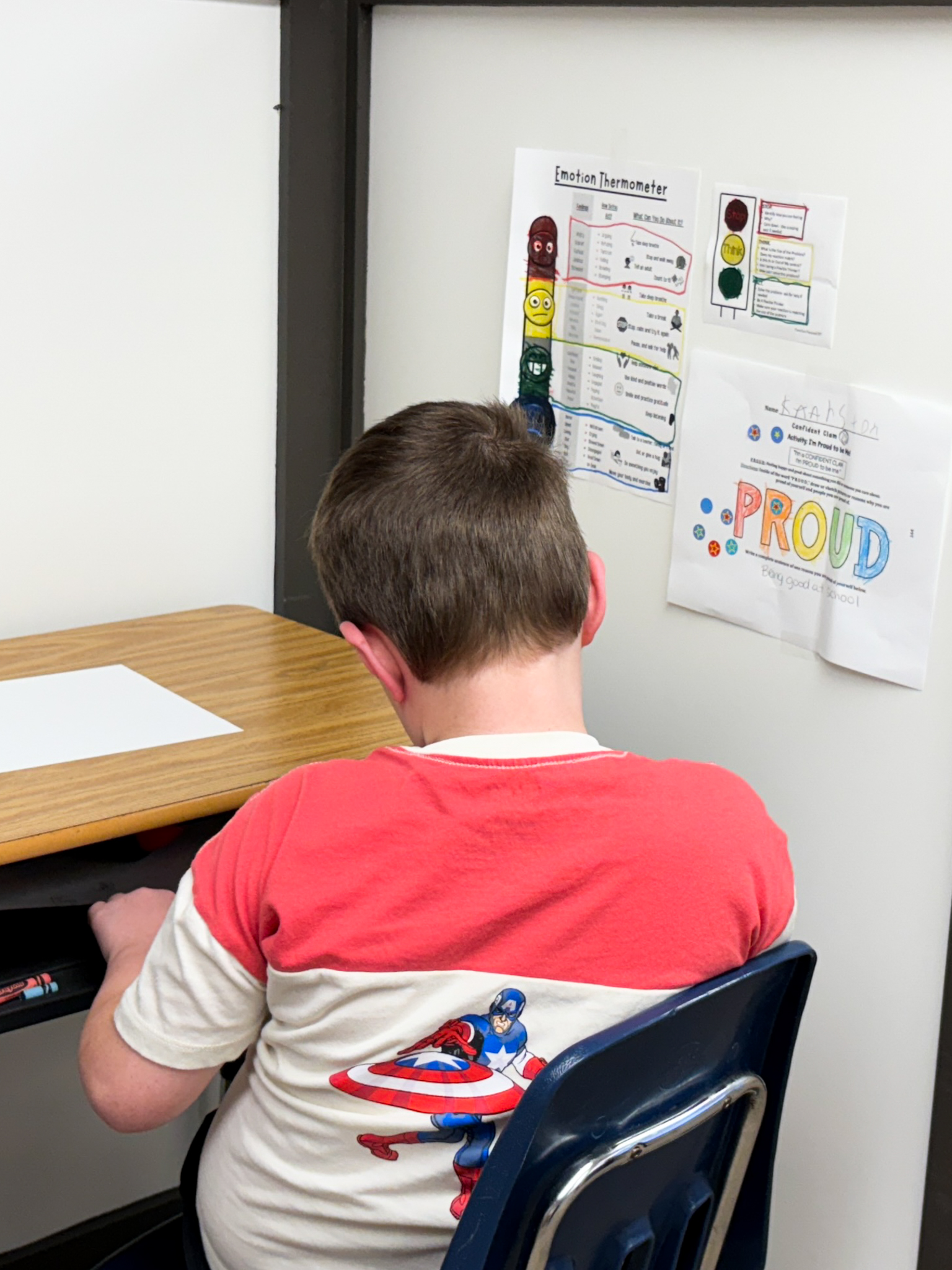
Desks are enclosed with partitions to give kids a sense of privacy and fewer distractions. Sensory tools and murals of redwood trees line the walls. The hallways are lined with student art, like trees covered in Kandinsky-inspired concentric circles — representing a student’s circle of control — or “anger volcanoes” to help students identify triggers and lessen explosions.
There’s a quiet room, or “the chill zone,” where students can sit in beanbags or rocking chairs to cool off, trace lines on the wall or practice yoga poses. If a student becomes violent or aggressive, they move to an adjoining empty room where they can express their big, scary feelings without endangering themselves or others.
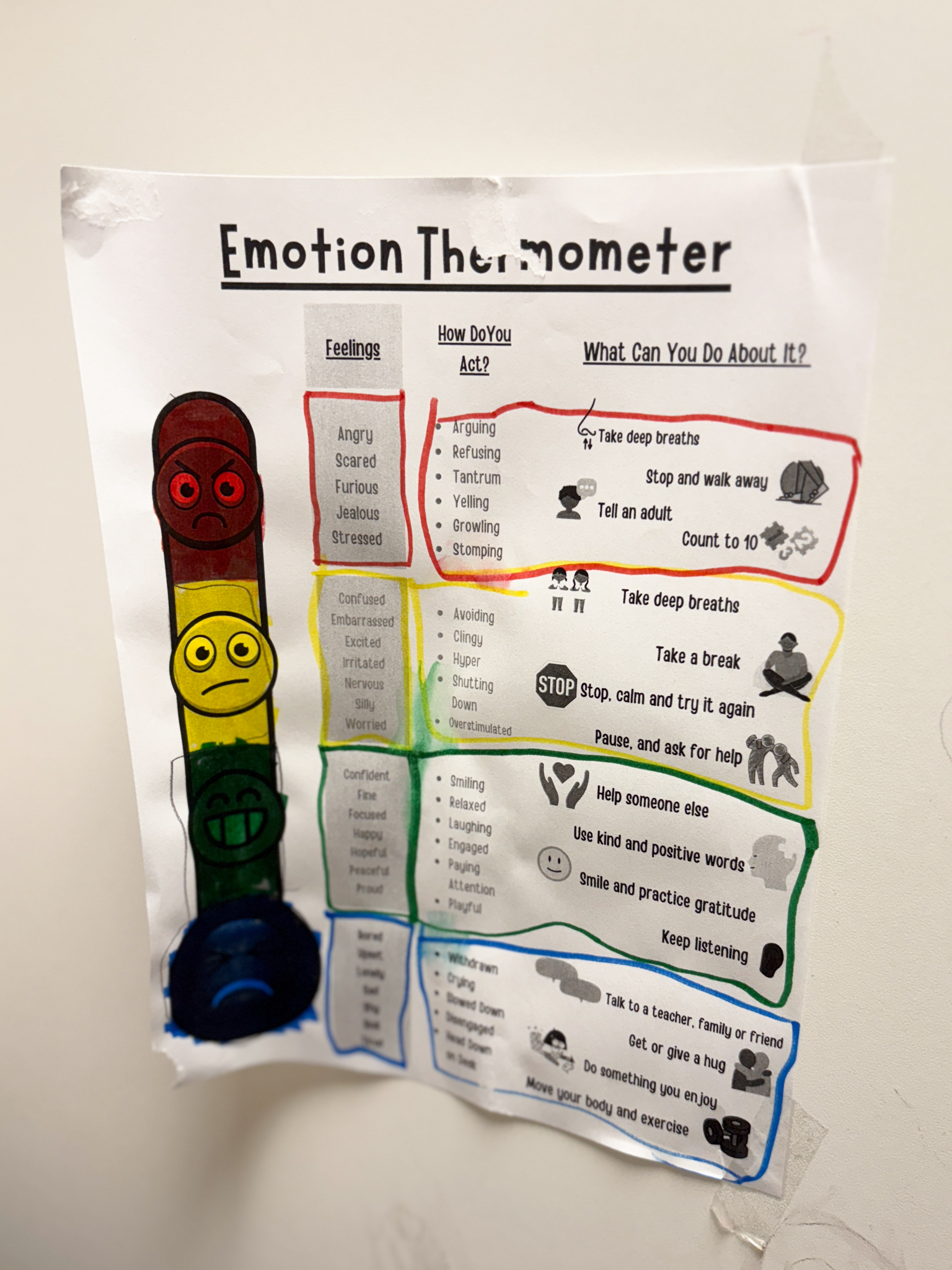
In all these spaces, posters remind students of coping mechanisms. An emotion thermometer helps kids identify their emotions as blue, green, yellow or red, and reminds them how they can respond.
Animal breaths help students regulate their nervous systems, transforming brain science into kid-friendly exercises. Feeling angry? Take a deep breath in, then exhale like a lion. Feeling panicked? Breathe like a puffer fish, holding a big breath in your cheeks and puffing it out slowly.
Throughout the day, classroom teachers track student progress on a points sheet with categories like showing respect and handling conflict. Students need to show they are expressing emotions with words, following expectations and staying on track with coping skills.
When students are regularly scoring at the highest level, it’s a sign they are ready to return to their home classrooms. Home classroom staff are expected to visit the student once a week in the program, keeping educators connected and up-to-date on their progress. Tiger Connect staff then work with the student’s school to prepare the classroom and teacher for the student’s return, prioritizing confidentiality and respect for the child.
“However, it’s usually no secret that those kids had behavior issues,” Green said. “So kids know, and when they come back and they see that that kid is able to get along better and doesn’t fly off the handle most of the time, they’re really excited for them.”
To help students maintain skills learned in Tiger Connect, staff send them back with copies of posters or art to remind them of coping mechanisms and brief the teacher on what works best. In most cases, there’s a lasting impact.
“We’re hoping that they’re going to be able to maintain those skills and keep applying those skills, but time will really tell,” Green said.

Ryker, now 8, takes “balloon breaths” when he’s upset and steps away to a “safe space” in his classroom when he needs to take an emotional break. There were a couple hiccups with adjusting to a new teacher, his mother said, and she’s had to take him home early occasionally. But he hasn’t needed to go to the office or see a behavioral coach since transitioning out of Tiger Connect.
“They were able to work together to solve those problems without it getting out of hand, like it had before,” Katie said.
Tiger Connect is now implementing a tracking system for its alumni to determine whether the program is a long-term solution or a temporary fix that requires revisiting.
Tackling trauma across Oklahoma
Tiger Connect isn’t a fit for every student struggling with behavior issues, and it’s still a work in progress. Staff are not working with products but people — and little ones, at that.
“We can have a process and a profile of a kid on paper, but not every kid is going to fit in the box,” Green said.
Pulling students from their home classrooms, friends, teachers and neighborhoods is not a decision to be made lightly. The student’s school initiates the process, often after conversations with parents, and applies on the student’s behalf. From there, parents attend an orientation, tour the facility and meet the staff, eventually deciding whether to enroll their student.
Tiger Connect sees a wide variety of behaviors, including aggression, anxiety and defiance. It’s not about the behavior itself, staff says, but the needs of the child. Some students express volatile emotions due to developmental challenges or disabilities, making them a better fit for special education programs at their home schools. Students who need new coping skills but not years to develop them are the right fit for Tiger Connect.
Preexisting trauma is the unifying factor, according to program staff. Sometimes it’s intense cases, like sexual or physical abuse, but it could also be the death of a sibling or parent that triggers reactions. Students come from all sorts of backgrounds — from wealthy families to those below the poverty line — and trauma doesn’t discriminate.
“Life is hard for a lot of people,” Green said. “Some people, for whatever reason, have a better ability, or maybe better situation, that they’re able to better manage it in a healthy way, and others aren’t.”
She sees a need to expand the work to other school districts in Oklahoma. The committee that designed the program toured sites in Arkansas and Texas with similar goals, but the majority were in secondary school buildings.
Elementary intervention is needed, Green says, and several legislators like Senator John Haste, R-Broken Arrow, have scheduled tours of Tiger Connect to consider further applications of the program.
“If you talk to any educator about what the biggest struggle is, they’re going to tell you behavior. It keeps them from being able to do their jobs,” Green said. “I think the need is there, and they’re just kind of learning about what we’re doing, and we’re still trying to figure it out too.”
News decisions at the Tulsa Flyer are made independently of our board members and financial supporters. Read more about our editorial independence policy here.
