



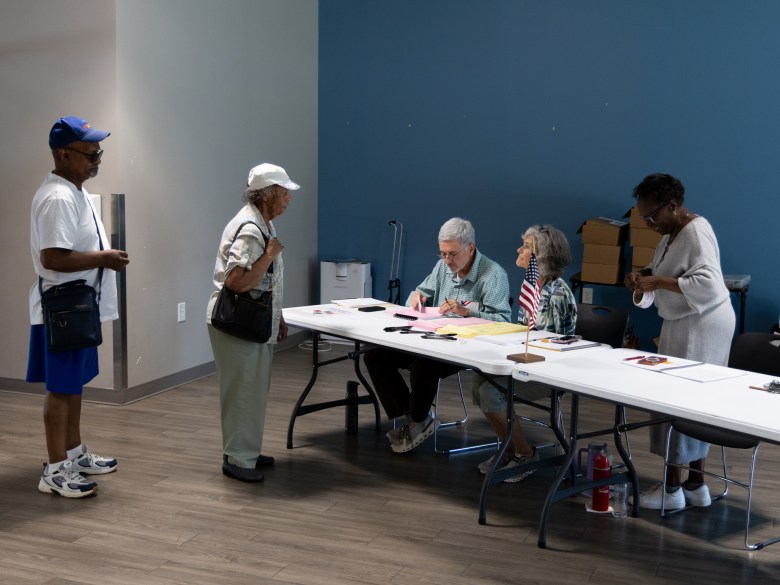
After advancing in Tuesday night’s municipal elections, the two remaining Tulsa City Council District 1 candidates — Corinice Wilson and incumbent Vanessa Hall-Harper — told The Eagle they were encouraged by the level of civic engagement they had seen leading up to Election Day.
But, despite a stream of social media discourse about candidates and policies in the weeks leading up to the race, data shows the number of people that actually voted across Tulsa was low — again.
Ronni Pierce, Tulsa County Election Board’s communications coordinator, said 17,887 people in Tulsa County were registered to vote in the District 1 election. There were also some voters in Osage County who could have cast a ballot in the race.
However, only 4,223 votes were cast in the race. That gap has sparked more conversation online.
Angelia King-Barnett, an Austin, Texas native who has called Tulsa home for nearly three decades, posted on Facebook the day after the election to ask people if they had voted and if not, why.
King-Barnett admits Oklahomans are “pretty used to low voter turnout,” she told The Eagle.
“It seems like it’s getting worse,” she added. “People are feeling more disenfranchised.”
Part of the cause, she said, is residual effects from apathy toward national politics. There is a disconnect in people’s understanding of how voting in local elections impacts their day-to-day lives, she said.
“Our local election affects if our trash is picked up. It affects if our city streets are fixed. It affects if we have proper police coverage and who those police officers are in our neighborhood. That’s why local elections matter,” she said.
Michelle Brown-Burdex, the program coordinator for the Greenwood Cultural Center, believes not enough is being done to engage voters. She also took social media to encourage more people to get involved in the political process.
“I have spoken to a few people who I knew did not vote and asked them why and one of the reoccurring responses was that they didn’t think that it mattered,” she said.
For Brown-Burdex, casting a ballot is deeper than just choosing who represents your community.
“Our vote is a response to our ancestors who fought for us to have the right to vote,” she said.
Many people who don’t live in District 1, like Democratic National Committee’s Women’s Caucus chair Alicia Andrews, were paying attention to social media conversations about the council race. Andrews led an effort to bring another early voting site closer to north Tulsa after the election board’s headquarters moved further east in March.
“I’m like, ‘OK, look at all these people engaged. We’re going to have a better turnout than we always do.’ And no, we did not,” she said. “There was a whole lot of online chatter. But it was the same amount of people (voting).”
In fact, turnout was down across all contested city council district races this year, not just in District 1.
Tuesday’s results have inspired Andrews to convene a public discussion on voter turnout and participation in Oklahoma ahead of the Nov. 3 election, which will feature a runoff between Hall-Harper and Wilson.
Voter participation in District 1 specifically has been on a downward trend since 2016. That year, when Hall-Harper defeated incumbent Jack Henderson, 12,805 votes were cast.
But it was also on the ballot in November, coinciding with state and federal elections. That year, then-City Councilor Anna America proposed moving the municipal elections from November to August, a move she said would remove confusion for elected officials and candidates.
Voters passed a charter amendment changing the municipal election schedule in 2017.
But Andrews does not believe there is an exact correlation between the municipal elections being moved to August and continued low voter turnout.
What to know ahead of November election
Alongside elections for federal and statewide offices, Vanessa Hall-Harper and Corinice Wilson will compete in a runoff for Tulsa City Council District 1 on Nov. 3.
Find our previous coverage of the race here, and don’t forget: The deadline to register to vote in the November election is Oct. 9. Find information on how to register here.
“Most people do not fill out the complete ballot,” she said. “If we moved municipalities back to the (November) ballot, I don’t know that we would get much more than we get now.”
Instead of focusing on the election schedule, she wants Oklahoma to expand voting options, like adding more days for early voting and allowing same-day voter registration.
States that have the top voter participation, like Minnesota and Oregon, “also have more paths to the ballot box than we do,” Andrews said. “We have a very complicated path. Places with less voter participation have more hurdles.”
