

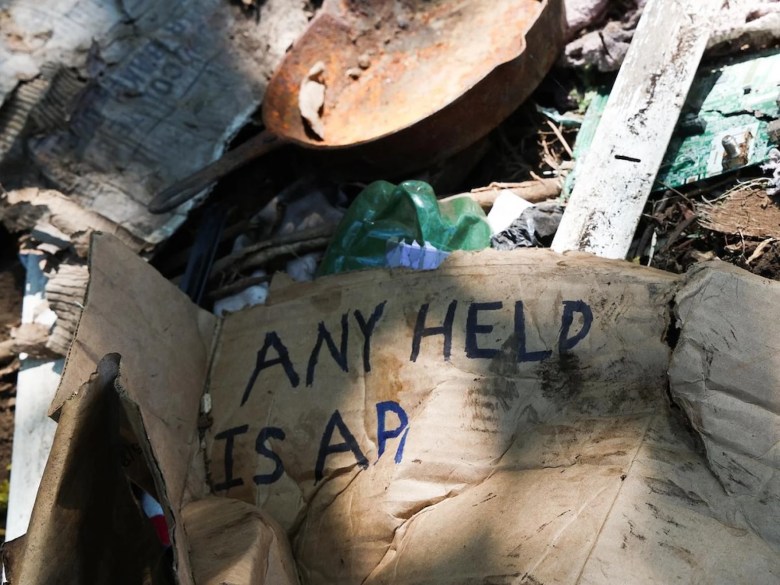
Oklahoma Gov. Kevin Stitt is threatening to invoice Tulsa and Oklahoma City Police Departments for costs associated with clearing homeless encampments on state land.
Neither municipality has received formal charges, but they were told the state will “pursue every available avenue” to fine them if local police departments fail to “enforce the laws and address unlawful encampments.”
The threats stem from a controversial initiative called Operation SAFE, under which Stitt has ordered state troopers to forcibly clear encampment sites in Tulsa, Oklahoma Cityand Norman.
State officials estimate that encampment sweeps cost more than $500,000 in Tulsa and more than $375,000 in OKC. Norman has not received a similar estimate.
The sweeps began in Tulsa in mid-September last year. The rapid enforcement measure came as a surprise to Tulsa leadership and local homeless service providers, who have criticized its effectiveness in functionally improving homelessness. During encampment sweeps, people experiencing homelessness can lose important documents, like IDs or birth certificates, that are often required to get a job or obtain housing.
Stitt has championed Operation SAFE since its launch. He said the move “is not about solving homelessness,” but rather about enforcing the law. Under the initiative, state troopers are dispatched to encampment sites on state land. Everyone they encounter is required to leave the area, and any possessions that remain are gathered up and thrown away.
Like Tulsa, neither Norman nor Oklahoma City leadership asked for Stitt to bring the operation to their city.
Now, Stitt’s office is threatening Tulsa and Oklahoma City with possible related charges. The news came in the form of a letter sent to police chiefs in each major city on Monday.
In the letters, Oklahoma Chief Operating Officer David Ostrowe said Operation SAFE was a necessary measure because Tulsa and Oklahoma City are failing to address encampments.
It is illegal to camp on state property, but there is confusion about which agencies are responsible for and legally permitted to enforce the state’s camping ban.
“State government is not Oklahoma City’s cleanup crew, and state taxpayers should not be required to subsidize a municipal policy of non-enforcement,” Ostrowe said in the letter to OKC Police Department Chief Ron C. Bacy.
The arrangement “cannot continue,” he said. “Each time the City refuses to act, the financial burden is shifted from Oklahoma City to taxpayers across all 77 counties.”
In otherwise identical letters, Ostrowe said the state has spent $523,873.90 clearing encampments in Tulsa and $375,701.21 in Oklahoma City.
The Oklahoma City letter makes no mention of the state’s $800,000 agreement with the city-run homelessness partnership Key to Home. The state agreed to pay for housing and services for people displaced by Operation SAFE in Oklahoma City, but has not extended a similar offer to Norman and Tulsa.
In the letters, Ostrowe said that next year, the state will “seek legislation authorizing the recovery of the entire cost of any past, present, or future cleanup measures undertaken by the State when those measures become necessary” because a municipality hasn’t acted to clear encampments. The Governor’s Office did not respond to questions about the possible measure, its mechanics, or which lawmaker would sponsor it.
Tevis Hillis, a spokesperson for Stitt’s office, instead issued the following statement:
“The state has shielded the municipality from the costs of providing mental health and social services to those who accepted help. The least the municipality can do is keep the streets clean and safe,” the statement said.
A spokesperson for Oklahoma City acknowledged receiving the letter but declined to comment.
Meanwhile, Tulsa Mayor Monroe Nichols is pushing back, criticizing the state’s threat to invoice municipalities for Operation SAFE.
“The State made a decision to conduct a large-scale cleanup of property that it owns and maintains,” Nichols said in a statement. “It is difficult to understand how the City of Tulsa then becomes financially responsible for that cleanup simply because the State wants to be reimbursed for their own expenses.”
Nichols said Tulsa has expended “significant time and resources” responding to the consequences of the state’s operations, including helping people who were displaced recover lost property, including medications and identification.
He said the city’s initiative to end street homelessness, called Safe Move Tulsa, has moved nearly 600 people out of homelessness, closed 10 encampments, provided housing services for 40 animals and cleared nearly 190 tons of trash in less than a year.
State-led encampment sweeps in Tulsa led to no arrests and one connection to services.
“This should not be a competition over who can send the other government the largest bill,” Nichols said. “The City and the State should be working together to address homelessness and public safety, not shifting costs onto one another.”
This article was originally published by KOSU. You can see the original story here.