



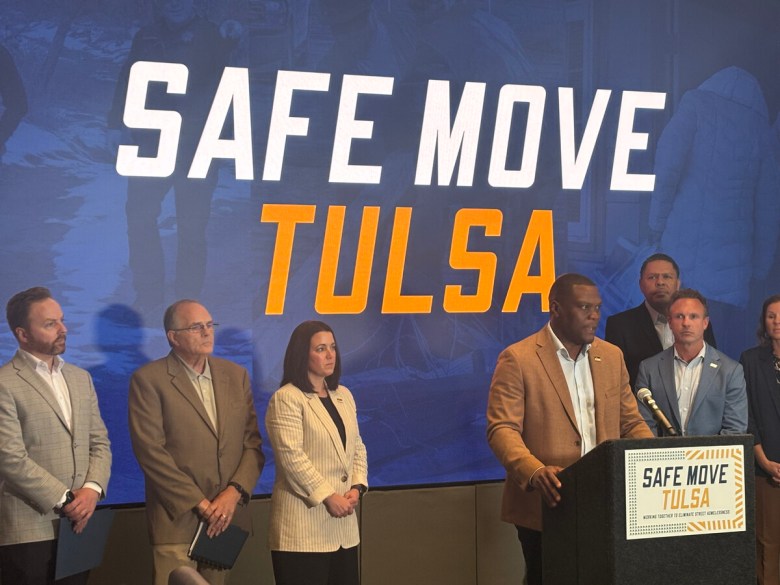
City officials and homeless advocates announced Wednesday Safe Move Tulsa has surpassed its goal of housing 300 people since launching in November.
Just since the start of May, 213 people have been rehoused as part of the program’s rapid exit strategy, putting the total at 360.
Rapid exit strategies are short-term solutions to help people on the brink of chronic homelessness. The process may include assistance with security deposits, transportation or limited financial assistance.
“It’s two tactics under one strategy,” Mayor Monroe Nichols said Wednesday, joined by city leaders and homeless advocates as he gave an update on the program.
“One addresses people already experiencing long-term homelessness outside and in our shelters. The other helps people before they get to that point with light touch intervention,” Nichols said.
On average, it takes about 90 days for someone to exit homelessness without prolonged government support, said Tulsa Day Center CEO Mack Haltom. But with the rapid exit strategy, the city has been able to get people rehoused within 15 days, he added.
The city initially implemented the strategy in February, but it wasn’t until two months ago that Safe Move partners at Mental Health Association Oklahoma, the Tulsa Day Center and John 3:16 began to see results at their shelters.
Nichols cautioned the work isn’t done yet. He thanked city councilors for approving the $1.2 billion city budget, which includes $23.5 million for a multi-year response to homelessness. An additional $500,000 will go toward operations at The Harbor, a low-barrier shelter at the former juvenile detention center in west Tulsa.
While the city expects to have 1,300 people exit homelessness by the end of the year — with 1,000 going through the rapid exit strategy — Haltom said the progress is a mixed bag.
“Safe Move Tulsa has given us a protocol for rapid exit and response, (but) it still doesn’t fix the underlying drivers of homelessness,” he said.
According to the Tulsa nonprofit Housing Solutions, the city’s main causes of homelessness are lack of affordable housing, loss of income, mental health challenges, job loss and substance use.
The group’s 2026 annual Point in Time Count found one-third of people without shelter experienced domestic violence, 14% are employed, 8% are veterans and 77% have a disabling condition. The count remained relatively flat as 1,443 people were experiencing homelessness this year compared to 1,449 last year.
Safe Move Tulsa launched in November with a goal to rehouse 300 people in nine months.
It’s funded with $11 million from the city and $4 million from the Tulsa Leadership Council. The city and its partners have also closed nine encampments.
Ismael Lele is a Report for America corps member and writes about business in Tulsa for The Oklahoma Eagle. Your donation to match our Report for America grant helps keep him writing stories like this one; please consider making a tax-deductible gift of any amount today by visiting this link.
